










A Problem You’ve Already Faced
- The hose pulls off under pressure — a smooth plastic adaptor won’t hold the hose at 8–10 bar; the barbed profile of a brass fitting grips the hose reliably even before the hose clamp is tightened.
- The adaptor cracked in winter — cheap plastic or zinc-alloy fittings don’t survive −15…−20 °C: the material becomes brittle and cracks at the first hose bend.
- The thread seized and won’t unscrew — a steel fitting in contact with moist air and condensate corrodes within a season; brass resists corrosion and remains serviceable for years.
- Wrong hose size ordered — got a fitting for a 19 mm hose instead of 20 mm; the clamp can’t compress properly and the hose works loose.
- Required size not in local stock — a small fitting holds up the entire system start-up.
The right fitting means a reliable hose joint for years, not just one season. Brass, the barbed profile and the correct diameter solve all three problems at once.
What Is the P-24-3 Hose Barb
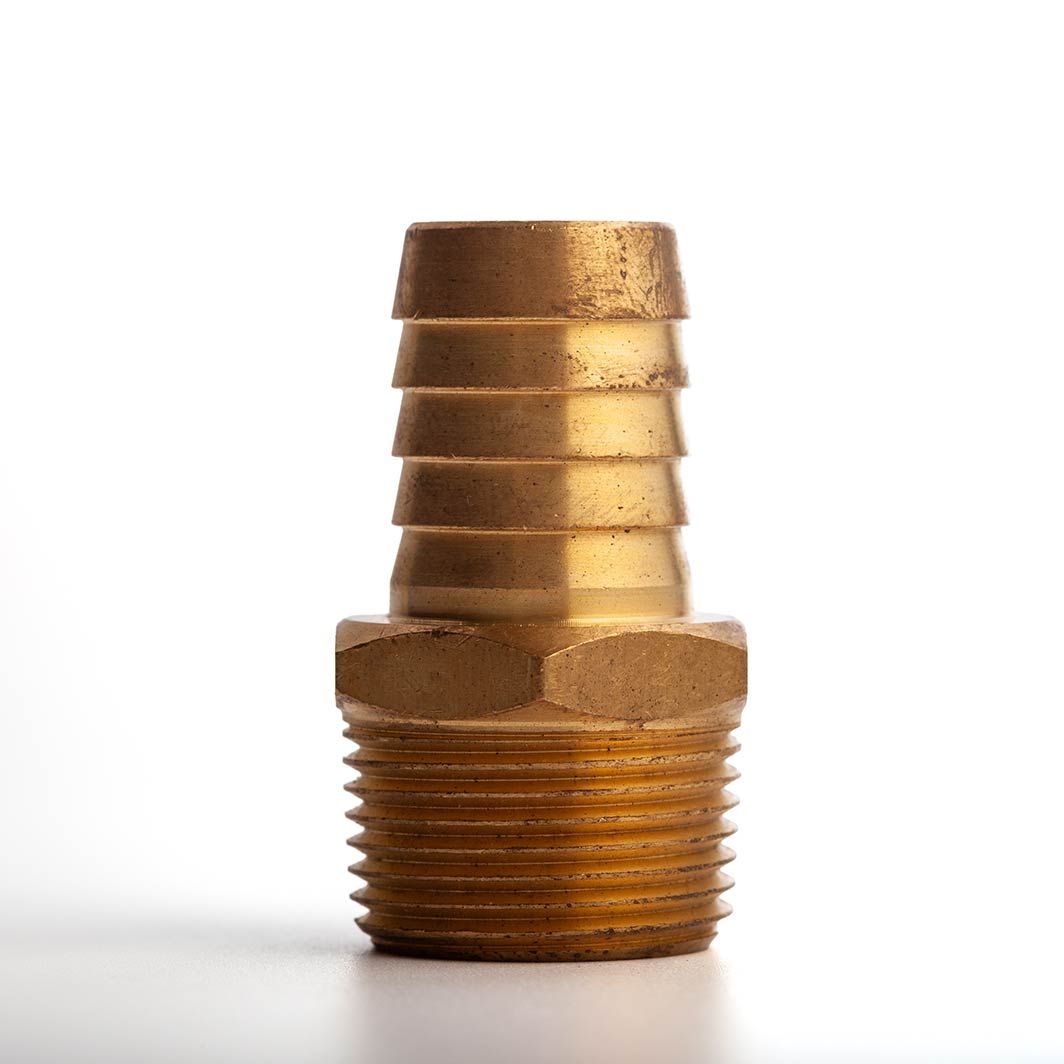
A hose barb fitting is a threaded adaptor for connecting a flexible hose to a pipeline or pneumatic equipment. One end is a G 3/4″ male thread that screws into the mating port; the other is a tapered barbed tail with annular ridges (the «barb» or «Christmas tree» profile), which is pushed into the hose and secured with a hose clamp.
Why brass: brass (Cu-Zn alloy) does not corrode in contact with moist air, condensate and compressor oil. The thread remains serviceable for years. Tensile strength is sufficient for pressures up to 16 bar at 20 mm diameter.
Technical Specifications
| Parameter | Value |
|---|---|
| Part number | P-24-3 |
| Type | Hose barb, thread-to-hose |
| Thread | G 3/4″ male (BSP, parallel, ISO 228-1) |
| Hose tail diameter (hose ID) | 20 mm |
| Tail profile | Barbed — tapered annular ridges |
| Material | Brass (Cu-Zn) |
| Working pressure | 16 bar |
| Temperature range | −20 °C … +120 °C |
| Working media | Air, water, mineral oil |
| Thread seal | PTFE tape or thread sealant (not included) |
| Thread standard | ISO 228-1 (G BSP) |
| Hose retention | Hose clamp (not included) |
💡 Expert tip: the 20 mm dimension refers to the hose’s inside diameter (ID). Standard reinforced compressor hoses are marked ID×OD: 20×27 mm or 20×28 mm. Always measure the hose ID — not the OD — before ordering. For a reliable joint, use a full-band screw-type clamp (not a spring clamp) and position it 5–10 mm from the end of the tail.
Comparison with Equivalents
| Part/type | Thread | Hose (ID) | Material | Pressure | Application |
|---|---|---|---|---|---|
| P-24-3 (this model) | G 3/4″ male | 20 mm | Brass | 16 bar | Air/water, compressor |
| P-21 (smaller) | G 3/8″ male | 10 mm | Brass | 16 bar | Small pneumatic lines |
| P-22 (medium) | G 1/2″ male | 13 mm | Brass | 16 bar | Medium hoses |
| P-23 | G 1/2″ male | 16 mm | Brass | 16 bar | 16 mm ID hoses |
| Plastic equivalent | G 3/4″ male | 20 mm | Plastic | 8 bar | ⚠️ Cracks in frost |
| Zinc-plated steel | G 3/4″ male | 20 mm | Galv. steel | 16 bar | ⚠️ Corrodes within 1–2 seasons |
Why Acvatron SRL — 5 Solid Reasons
Brass Fittings with Confirmed Specifications
Acvatron SRL supplies high-strength brass fittings — not zinc die-cast marketed as brass. Visually the parts look similar, but zinc alloy (zamak) degrades in contact with condensate and compressor oil within 1–2 seasons.
Full Range of the P Series
In stock: P-series hose barbs in G 1/4″, G 3/8″, G 1/2″, G 3/4″, G 1″ for hoses from 6 to 25 mm. Complete pneumatic line supply — in one place in Chișinău.
In Stock at the Chișinău Warehouse
The P-24-3 (G 3/4″, 20 mm hose) is permanently in stock at acvatron.md. Collect on the day of payment.
Compatible Hoses and Clamps
Acvatron SRL supplies reinforced air hoses and hose clamps for the complete joint assembly. No need to source additional components elsewhere.
Documents for Legal Entities
All items are supplied with accompanying documents. For legal entities — invoice and contract.
Applications
Compressor Pneumatic Systems
- Connecting a reinforced air hose to the compressor or receiver outlet (G 3/4″ is the standard outlet port for 4–7.5 kW compressors)
- Connecting a hose to a pneumatic distribution manifold
- Adaptor from a 3/4″ main pipe to a flexible hose at the work station
Auto Service and Tyre Fitting
- Connecting a 20 mm air hose to the compressor bay
- Connecting the inflation main to the hose for inflating heavy vehicle tyres
Construction and Industry
- Installing air mains on construction sites
- Connecting pneumatic tools via flexible hose to a fixed supply network
Water Supply Systems
- Connecting a garden or industrial hose to a 3/4″ pipeline
- Connecting an irrigation hose to a tap or pump
Expert Opinion
“In practice I see two typical mistakes with this type of fitting. The first — people buy a ‘brass’ adaptor at a low price that turns out to be zamak zinc alloy: visually indistinguishable, but after a season or two it develops a white powder coating and starts leaking at the thread. The check is simple: brass has a characteristic yellow-gold colour; zamak is grey-silver. The second mistake — people tighten without a seal: G thread (parallel) does not self-seal; PTFE tape or anaerobic sealant is mandatory. Two to three wraps of PTFE tape on the thread — and the joint will be leak-free for years.”
Vitali Bolucevschi, Chief Engineer at Acvatron SRL, 15 years in the industry
How to Install a Hose Barb Correctly: 5-Step Procedure
- Wrap PTFE tape on the thread — 2–3 wraps in the direction of the thread. G thread is parallel — it will leak without PTFE tape.
- Screw the fitting into the mating port — spanner size 30–32, torque 30–40 N·m. Do not over-tighten.
- Slide the hose clamp onto the hose — before pushing the hose onto the tail. A forgotten clamp is a common installation mistake.
- Push the hose onto the barbed tail — all the way to the shoulder. Lubricate with soapy water if needed.
- Tighten the clamp — position: 5–10 mm from the end of the tail. Check for leaks with a soapy solution under working pressure.
FAQ
❓ What is the difference between P-24-3, P-21, P-22 and P-23?
All four P-series fittings are brass hose barbs with male BSP thread, but in different sizes. P-21: G 3/8″, hose 10 mm. P-22: G 1/2″, hose 13 mm. P-23: G 1/2″, hose 16 mm. P-24-3: G 3/4″, hose 20 mm. The choice is determined by the hose ID and the thread port size of the equipment.
❓ Is a hose clamp required when fitting the P-24-3?
Yes, mandatory at pressures above 4–5 bar. At 8–10 bar working pressure, without a clamp the hose can pull off under load. Use a full-band screw-type clamp, not a spring-type band clamp. Tighten until the hose is fully compressed without cutting into it.
❓ Is the P-24-3 suitable for hot water?
Brass withstands up to +120 °C — technically compatible with hot water (up to 90–95 °C in DHW systems). For industrial hot media (non-potable) — use without restrictions. For potable water systems, verify the sanitary certification of the material.
Take the Next Step Right Now
The right fitting means a reliable hose joint for years with no leaks and no replacements.
- 📞 Call us — the Acvatron SRL engineer confirms P-24-3 is in stock and selects the compatible hose and clamp.
- 📋 Request a commercial quote — with part numbers, price and documents. For legal entities — invoice and contract.
- 🛒 Place your order by phone or at our office — collect from the Chișinău warehouse on the day of payment.
Acvatron SRL — an engineering approach to every sale.









Reviews
Clear filtersThere are no reviews yet.