










A problem you have already faced
- The cylinder returns on signal loss — a spring-return 5/2 (4V310) is installed where a bistable 5/2 (4V320) is needed to hold the last position
- The solenoid overheats during prolonged position holding — a monostable circuit keeps the coil energised continuously; with the 4V320 this is unnecessary
- A brief power interruption moves the rod unexpectedly — the spring on a single-solenoid valve could not maintain the position
- Confused 4V320 (bistable 5/2) with 4V310 (monostable 5/2) or 4V330 (5/3) — without understanding the difference in operating principle
- Higher flow needed for a large-bore cylinder — series 200 (Cv = 0.7) is insufficient; series 300 (Cv = 1.2) is required
Using a monostable 5/2 where a bistable is needed means continuous coil heating, unnecessary PLC current draw and the risk of unintended movement on signal loss.
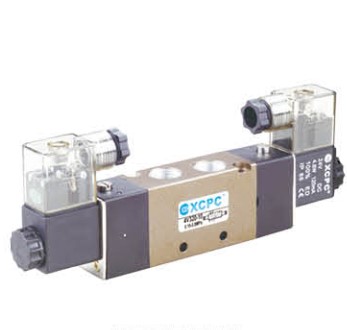
What is the XCPC 4V320-08: part number breakdown
4V — 4V series: electromagnetic pneumatic directional control valves, spool type. Internal pilot, oil-free operation. XCPC platform compatible with Airtac 4V series and SMC VF series.
3 — 300 series: next size up from the 200 series. Port thread G 1/4″ (code 08), but the internal spool bore is enlarged — flow Cv = 1.2 versus Cv = 0.7 for the 200 series. Suitable for cylinders with bore 50-100 mm and above.
2 — two positions (5/2). The valve has only two stable working positions: rod extended (A connected to P) and rod retracted (B connected to P). There is no intermediate position.
08 — port size G 1/4″ (code 08 in the XCPC system). Do not confuse with code 10 (G 3/8″) on 4V300 variants with a larger port.
DC24V — coil supply voltage 24 V DC, power 3 W per coil (two coils). Substitution with AC24V or AC220V without changing the coil is not permitted.
Bistable principle (double solenoid, no spring): applying a pulse to coil A shifts the spool and it remains in that position after the signal is removed. Applying a pulse to coil B shifts it back and it holds. Both coils operate in pulse mode — neither heats up from continuous energisation.
Technical specifications — XCPC 4V320-08 DC24V
| Parameter | Value |
| Part number | 4V320-08 |
| Manufacturer | XCPC (China), ISO 9001 |
| Configuration | 5/2 — five-port two-position |
| Actuation type | Double solenoid (bistable, no spring return) |
| Behaviour on signal loss | Last position retained (memory function) |
| Port thread | G 1/4″ (BSP) |
| Port size code | 08 (= G 1/4″) |
| Coil voltage | DC 24 V |
| Power per coil | 3 W (pulse mode) |
| Working pressure | 0.15 – 0.8 MPa (1.5 – 8 bar) |
| Proof pressure | 1.5 MPa (15 bar) |
| Flow coefficient (Cv) | 1.2 |
| Response time | < 30 ms (energise), < 25 ms (de-energise) |
| Working medium | Compressed air (filtered, oil-free) |
| Fluid temperature | -5 … +60 degrees C |
| Protection class | IP65 |
| Mounting | Any orientation; manifold base recommended |
| Service life | over 50 000 000 cycles |
| Standards compliance | ISO 4401, CETOP 3 |
Expert tip: when controlling from a PLC, always apply a short pulse to the 4V320 coil (50-150 ms) — not a sustained signal. Continuous energisation of a bistable valve coil is not needed to hold position, but it overheats the coil and reduces its service life. Use SET/RESET logic in the PLC program, not a latched output.
Series 300 comparison: 4V310 / 4V320 / 4V330
| Part no. | Configuration | Actuation / behaviour on fault | Application |
| 4V310-08 | 5/2 | Single solenoid + spring: spring returns rod to home on signal loss | Safe return to home position on power fault |
| 4V320-08 | 5/2 | Double solenoid, bistable: position retained after signal removal | Energy saving; no coil heating during hold |
| 4V330-08 | 5/3 | Double solenoid, three-position: neutral = exhaust centre | Three states: actuator unloads on power fault |
Warning: 4V320-08 (bistable 5/2) and 4V310-08 (monostable 5/2) look identical externally. Distinguish by body marking or behaviour: 4V320 stays in the last position when de-energised; 4V310 springs back to home.
Equivalent products by brand
| Brand | Equivalent part no. | Type | Thread | Voltage | Note |
| XCPC (original) | 4V320-08 | 5/2 bist. | G 1/4″ | DC24V | Direct original |
| Airtac (Taiwan) | 4V320-08B | 5/2 bist. | G 1/4″ | DC24V | Direct equivalent, interchangeable |
| SMC (Japan) | VF3220-5GB | 5/2 bist. | G 1/4″ | DC24V | Premium; different body, ISO 4401 |
| Festo (Germany) | VUVG-LK10-M52-MT-M5-1P3 | 5/2 bist. | G 1/4″ | DC24V | Different form factor — adapter needed |
| Parker (USA) | P2R-B series | 5/2 bist. | G 1/4″ | DC24V | ISO 4401 compatible |
| CKD (Japan) | 4GA220-00-E2 | 5/2 bist. | G 1/4″ | DC24V | Functional equivalent |
5 parameters to verify when selecting an equivalent:
- 5/2 configuration and type (bistable) — double solenoid without spring only; 4V310 (monostable) is not a substitute
- Port thread — G 1/4″ (BSP): do not confuse with NPT 1/4″ (different thread pitch)
- Coil voltage — DC24V; substituting AC24V or AC220V without changing the coil will cause immediate failure
- Mounting dimensions ISO 4401 / CETOP 3 — when manifold-mounting: XCPC 4V320-08 is compatible with Airtac 4V300-08 manifold bases
- Flow Cv = 1.2 — series 300 suits cylinders 50-100 mm bore; for smaller cylinders series 200 (Cv = 0.7) is sufficient
Why Acvatron SRL — 5 compelling reasons
1. Engineering selection: bistable vs monostable
Before issuing a quotation, an Acvatron engineer clarifies the control circuit and the required behaviour on signal loss. You receive the correct type — 4V310 (spring return) or 4V320 (bistable) — for your application.
2. Confirmed compatibility with Airtac and SMC
XCPC 4V320-08 complies with ISO 4401/CETOP 3 and is a direct functional equivalent of the Airtac 4V320-08B. Manifold bases and collectors of the 4V300 series are compatible.
3. In stock in Chisinau
4V320-08 DC24V is in stock. Same-day dispatch; next business-day delivery within Moldova.
4. Full XCPC 4V range
Acvatron SRL stocks the complete range: 4V1 (G 1/8″), 4V2 (G 1/4″, Cv 0.7), 4V3 (G 1/4″, Cv 1.2), 4V4 (G 1/2″), manifold bases and DC/AC coils.
5. Documentation: ISO 4401, IP65, ISO 9001
Every XCPC valve is supplied with a data sheet and ISO 9001 declaration of conformity. For companies — tax invoice and supply contract.
Application areas
Large-bore pneumatic cylinders
- Controlling cylinders with 50-100 mm bore: Cv = 1.2 delivers the calculated cycle time without flow restriction
- High-speed cycles on packaging and stamping lines — up to 5 cycles/s
- High-force actuators for presses and locks — series 300 holds pressure to 8 bar without leakage
Energy-saving control systems
- Bistability: coil is energised only during switching (50-150 ms pulse) — no PLC current consumed for holding
- Lower heat output in the control panel: with 10 valves in the panel, saving approx. 30 W versus a monostable circuit
- Position held on accidental power loss — rod stays where it was
Rotary actuators and pneumatic manipulators
- Controlling double-acting rotary actuators (90°, 180°, 270°) without mechanical locking
- Pneumatic grippers and pushers on robotic lines — reliable hold without signal
- Pneumatic conveyor switching: diverter gates switched without continuous coil energisation
Expert opinion
Vitali Bolucevschi, Chief Engineer, Acvatron SRL — 15 years in the industry:
The 4V320-08 is the best choice for systems where the cylinder must hold position on signal loss without continuous coil energisation. A mistake I see regularly: a 4V320 is installed and the PLC is programmed with a sustained output for holding — as if it were a 4V310. The coil starts to overheat and its service life drops by a factor of three to four. Remember: the 4V320 switches on a 50-150 ms pulse and no further signal is needed. The second point on flow: if you have a cylinder with an 80 mm bore at 6 bar and a 0.5 s cycle time, the series 200 at Cv = 0.7 will not achieve the calculated speed. The series 300 at Cv = 1.2 covers the requirement with a 20% margin.
Applicable standards: ISO 4401 (mounting dimensions), ISO 5599-1 (directional control valves), IP65 (IEC 60529), ISO 9001 (XCPC manufacturing).
How to choose the right 5/2 pneumatic directional valve: a 6-step process
- Determine whether spring return is required. On emergency signal loss the rod must return to a safe home position → 4V310 (monostable). The rod must stay in the last position → 4V320 (bistable).
- Calculate the required flow Cv. For a 63 mm bore cylinder, 200 mm stroke, cycle time 0.3 s at 6 bar → Cv approx. 1. Series 300 (Cv = 1.2) is suitable; series 200 (Cv = 0.7) is not.
- Confirm PLC output voltage. DC24V — standard for most industrial PLCs. AC220V — for direct mains control.
- Program pulse control in the PLC. Use SET/RESET logic (not a latched output). Pulse duration: 50-150 ms. Do not apply a sustained signal to the 4V320 coil.
- Verify the port thread. G 1/4″ BSP (outside diameter approx. 2 mm). Do not confuse with NPT 1/4″.
- Select the mounting method. 1-2 valves: direct port fittings G 1/4″. 3+ valves: manifold base 4V300-08.
Handling common objections
“I will buy a 4V310 — it is cheaper and also 5/2”
The 4V310 (monostable) springs the rod back to home on signal loss — this is not always what is needed. If the circuit requires the cylinder to hold position on signal loss (for example, gripping a workpiece during a stop), the 4V310 will release the workpiece. The 4V320 is the correct choice.
“A series 200 is fitted on similar equipment — I will use that”
Series 200 (Cv = 0.7) and series 300 (Cv = 1.2) look similar but their flow capacity differs by 70%. For cylinders with 80 mm bore and above, the series 200 will give lower speed and an unstable cycle. Provide the cylinder bore and cycle time — an Acvatron engineer will confirm the correct series in 5 minutes.
“I do not know how to program pulse control”
Acvatron SRL provides a wiring diagram and a SET/RESET program example for the main PLCs (Siemens S7, Mitsubishi FX). Call us — we will assist with the configuration on the day of your enquiry.
Frequently asked questions
What is the difference between the 4V320-08, the 4V310-08 and the 4V330-08?
4V310-08: 5/2, single solenoid + spring; spring returns the rod to home on signal loss. 4V320-08: 5/2, double solenoid, bistable; position is retained after signal removal. 4V330-08: 5/3, double solenoid; there is a third (neutral) position. For holding position without signal — 4V320. For safe return on a fault — 4V310. For three states — 4V330.
Why does the series 300 (Cv = 1.2) give higher flow than the series 200 (Cv = 0.7) at the same G 1/4″ thread?
The G 1/4″ thread size defines only the port connection diameter. The internal spool bore in the series 300 is larger than in the series 200, hence the difference in Cv. At the same G 1/4″ connection the series 300 passes 70% more air. This matters for cylinders from 50 mm bore and at cycle rates above 60 strokes/min.
Can the DC24V coil be replaced with an AC220V coil?
Yes. Remove the coil (two screws) and replace with an AC220V coil of the same XCPC 4V3 series frame size. The spool body remains in place. Important: DC and AC coils are constructionally different — do not apply AC voltage to a DC coil.
How do I connect the 4V320-08 without a manifold base?
P (port 1) — air supply; A (port 4) and B (port 2) — to cylinder; R1 (port 3) and R2 (port 5) — exhaust silencers or vent tubes. All ports G 1/4″ BSP. Coil A controls the A port feed; coil B controls the B port feed. To verify bistable operation: apply a pulse to A — check rod movement, remove signal — rod must stay; apply a pulse to B — rod must switch.