











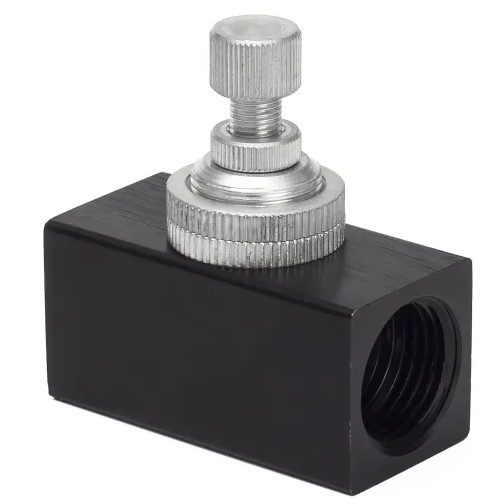

RE-04 In-Line Pneumatic Flow Control Valve (G 1/2″)
The RE-04 in-line (line-mounted) flow control valve restricts compressed air flow and lets you fine-tune the speed of large-bore pneumatic cylinders, actuators and air tools. It is installed directly into the air line through its G 1/2″ ports.
1. Purpose and operating principle
Flow is adjusted by turning the needle knob: the needle changes the cross-section of the flow passage. The chosen setting is locked with a lock nut, so it does not drift under equipment vibration.
The key difference from speed controllers with a check valve (ASC, GRL and similar series): this valve is bidirectional — flow is restricted equally in both directions, and the installation direction does not matter.
2. Technical specifications
| Parameter | Value |
|---|---|
| Model / part number | RE-04 |
| Brand / series | XCPC, RE series |
| Type | In-line (line-mounted) flow control valve, bidirectional |
| Port thread | G 1/2″ (BSPP, female, both ports) |
| Medium | Compressed air, filtration no coarser than 40 µm |
| Operating pressure | 0.05 – 1.0 MPa (0.5 – 10 bar) |
| Proof pressure | 1.5 MPa (15 bar) |
| Operating temperature | 0 … +60 °C |
| Nominal flow (at 6 bar) | ~3200 Nl/min |
| Body | Anodized aluminum alloy |
| Needle / adjusting screw | Brass / stainless steel |
| Seals | NBR (nitrile rubber) |
| Adjustment | Needle knob, lock-nut locking |
⚠️ To be confirmed against the datasheet. Flow, pressure range, temperature and material values come from the current product page on the site; no public manufacturer datasheet could be found. For reference: the bidirectional Camozzi RFO 377-1/2 (G 1/2) is listed by a distributor at 2…10 bar, 0…80 °C and 7 mm nominal size; the SMC AS4000-04 (one-way, Rc 1/2) is rated at about 1670 Nl/min. Verify the ~3200 Nl/min flow and the 0.05 MPa minimum pressure with the supplier’s documentation or a manager. Which part uses brass and which uses stainless steel (needle vs. screw) should also be clarified.
3. Design features
Part number breakdown:
| Code part | Meaning |
|---|---|
| RE | Series: in-line flow control valve (Line Flow Control Valve) |
| 04 | Thread size: G 1/2″ (series numbering: 01 = G 1/8″, 02 = G 1/4″, 03 = G 3/8″) |
Design solutions:
- Anodized aluminum body — corrosion- and impact-resistant, lightweight.
- Needle-and-seat pair — smooth adjustment from minimum to maximum flow.
- Lock nut — fixes the spindle after commissioning and protects the setting from vibration.
- Symmetrical G 1/2″ — G 1/2″ ports — the valve can be installed either way round; resistance is the same in both directions.
4. Installation recommendations
- Thread sealing (BSPP). G 1/2″ is a parallel (cylindrical) thread. Seal on the face (bonded washer, O-ring or flat gasket) — no PTFE tape. Tape fragments get into the narrow needle channel and block it.
- Matching threads. Make sure the mating fittings have G (BSPP) threads, not R/Rc (BSPT). Mixing parallel and tapered threads does not guarantee a leak-free joint.
- Filtration upstream. Fit a filter upstream (no coarser than 40 µm, ideally 5 µm). Scale and abrasive particles from receivers and pipes quickly wear the needle-and-seat pair.
- Location. To tune cylinder speed, install the valve as close to the actuator as possible so the air volume between them is minimal.
- Adjustment. Start from an almost closed position and open the needle gradually while watching the stroke speed. Once set, tighten the lock nut by hand or with an open-end wrench, without jerking.
- Do not use it as a shut-off device. For emergency line isolation, install a ball valve or a shut-off valve.
5. Alternatives and comparison
Cross-references (verified part numbers only):
| Manufacturer | Model | Notes |
|---|---|---|
| Camozzi | RFO 377-1/2 | Bidirectional in-line flow control, G 1/2, 2…10 bar; closest in function. Check flow and dimensions before replacing |
Not replacements for the RE-04 (per distributor catalogs): the Festo GR-1/2 and Camozzi RFU 477-1/2 are one-way (they regulate flow in one direction only); the SMC AS4000-04 is a speed controller with an Rc 1/2 (tapered) thread and roughly 1670 Nl/min. For SMC, Festo (bidirectional), Parker Legris, Metal Work and EMC we have no verified part numbers for a direct bidirectional G 1/2 equivalent — select from the manufacturer’s catalog and always check the throttling type and thread.
Comparison with neighboring RE-series models (flow and cylinder diameters are approximate, per the product page ⚠️):
| Model | Thread | Flow | Cylinder diameter |
|---|---|---|---|
| RE-01 | G 1/8″ | ~700 Nl/min | Ø 16 – 25 mm |
| RE-02 | G 1/4″ | ~1400 Nl/min | Ø 32 – 50 mm |
| RE-03 | G 3/8″ | ~2200 Nl/min | Ø 63 – 80 mm |
| RE-04 (this product) | G 1/2″ | ~3200 Nl/min | Ø 100 – 200 mm |
Cylinder diameter is a guideline; determine the exact valve size from the required flow, stroke and cycle time.
6. Common mistakes
- Using the RE-04 where a one-way controller is needed. If you want a slow working stroke and a fast return, the RE-04 is the wrong choice: it slows both directions. Use a controller with a check valve (ASC series and similar).
- Screwing the needle in “all the way” with a wrench. The needle cone and the seat get deformed, and the valve no longer shuts off tightly.
- Installing without a filter. Scale from rusty pipes clogs the narrow gap and the stroke speed “wanders”.
- Sealing G 1/2″ with PTFE tape. Tape fragments block the needle channel; use face sealing.
- Selecting by thread only. A G 1/2″ valve on a small Ø32 cylinder gives coarse, unstable adjustment — use RE-01 / RE-02 for small actuators.
7. Applications
- Large-bore pneumatic cylinders (Ø100, 125, 160, 200 mm): smooth rod travel on presses, guillotine shears, lifts and forming machines.
- Industrial automation: limiting air flow on branches and in actuator control lines.
- Compressor stations and receivers: metering flow and gradual pressure release in process lines.
- Woodworking and construction industry: adjusting clamping and feed speed of heavy workpieces.
8. Expert opinion
“The RE-04 with a G 1/2″ thread is the right tool when you need to limit flow on a high-capacity line or bring a large cylinder up to speed smoothly. Keep the main point in mind: it is bidirectional, so it slows both the working stroke and the return. If you need a fast return, choose a controller with a check valve. And when installing, don’t wrap PTFE tape on the parallel G thread: seal on the face, otherwise tape fragments will clog the needle.”
Vitali Boluchevski, Lead Engineer, Acvatron SRL, 18 years of experience
9. FAQ
1. How does the RE-04 differ from ASC-series valves? The RE-04 restricts flow equally in both directions. ASC-series valves have a built-in check valve: they regulate flow in one direction and let air pass freely in the other.
2. Can it shut the flow off completely? Fully screwed in, the needle closes the passage, but the RE-04 is a flow regulator, not a shut-off valve. For emergency isolation, install a ball valve or shut-off valve.
3. What thread does the RE-04 have? Both ports have a G 1/2″ (BSPP) female parallel thread. Seal on the face (washer, O-ring, gasket), without PTFE tape.
4. Can the RE-04 be used on a line with lubricator oil mist? According to the product page, the seals are NBR, which is resistant to mineral oils. For synthetic oils of special composition, check compatibility with a manager.
5. Is the RE-04 suitable for a Ø32 cylinder? It can be fitted, but adjustment will be coarse: the RE-01 or RE-02 is better for small cylinders.









Reviews
Clear filtersThere are no reviews yet.