












Technical specifications
| Parameter | Value |
|---|---|
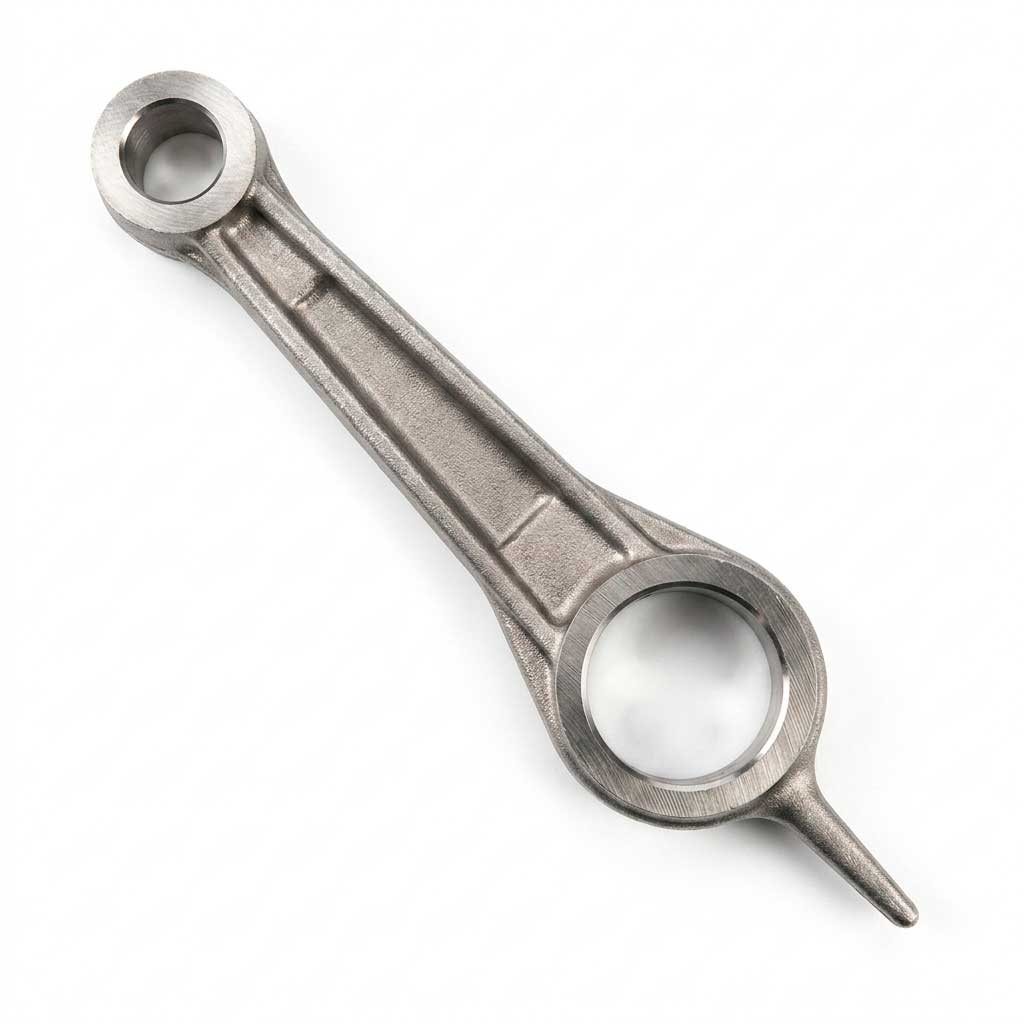
| Pin bore diameter | 12 mm |
| Crankshaft bore diameter | 20 mm |
| Center distance (pin to crankshaft) | 87 mm |
| Distance from top of pin bore to bottom of crankshaft bore | 103 mm |
| Distance from bottom of pin bore to top of crankshaft bore | 71 mm |
| Material | aluminum alloy / powder metallurgy (depending on batch) |
| Type | one-piece, non-split (no bearing shell in the big end) |
| Motor power compatibility | 1.3 kW and 1.5 kW |
💡 Engineer’s tip: when ordering, check not only the bore diameters but also the center distance (87 mm) — it determines the actual piston stroke and compression ratio. A rod with the same pin and crankshaft diameters but a different center distance changes the cylinder’s working volume and can cause the piston to strike the valve plate.
Design features
- The precise geometry of the pin and crankshaft bores ensures minimal play and even load distribution under pressure.
- The material is selected for small and medium-power compressors (1.3–1.5 kW), balancing strength against the weight of moving parts.
- The 20mm crankshaft bore matches the journal size common on household and semi-professional piston compressors.
Installation guidelines
- Disconnect the compressor from power, drain any condensate, and remove the valve plate and cylinder per the specific model’s instructions.
- Remove the old rod together with the piston, carefully driving out the piston pin.
- Check the crankshaft and cylinder for scoring and wear — fitting a new rod onto a worn crankshaft won’t eliminate knocking.
- Assemble the piston with the new rod on the piston pin, securing with retaining clips if the design calls for them.
- Fit the rod onto the crankshaft journal and tighten the fasteners to the torque specified by the compressor manufacturer — avoid overtightening, which risks deformation.
- Turn the crankshaft by hand and confirm the piston moves freely through the full cylinder stroke with no binding.
- Reassemble the cylinder and valve plate, run the compressor idle for 1–2 minutes, and check for knocking or unusual noise.
Compatibility and selection
| Parameter | Value | Affects |
|---|---|---|
| Ø pin 12 mm | fixed | must match the piston pin diameter |
| Ø crankshaft 20 mm | fixed | must match the crankshaft journal diameter |
| Center distance 87 mm | fixed | determines piston stroke and compression ratio |
| Motor power | 1.3 / 1.5 kW | reference for selecting by the rod’s load capacity |
⚠️ Ordering note. Rods with identical bore diameters but different center distances are nearly impossible to tell apart visually, yet they are not interchangeable — fitting the wrong length changes the piston’s dead-center geometry and can damage the compressor on first start-up. Always verify all three dimensions: pin diameter, crankshaft diameter, and center distance.
Common replacement mistakes
- Replacing only the rod without checking the crankshaft and cylinder condition — the knocking returns quickly.
- Fitting a rod with a different center distance “by eye” based only on matching bore diameters.
- Overtightening the big-end fasteners — causes overheating and seizure on the crankshaft journal.
- Starting the compressor without first manually checking piston travel — risk of the piston striking the valve plate if the geometry doesn’t match.
Practical use cases
- Replacing the rod when a distinctive knocking sound appears in the compressor under load.
- Scheduled overhaul of the piston-cylinder assembly together with a repair kit (piston rings, pin, valves).
- Repairing a compressor after operation with low oil level that scored the rod journal.
FAQ
Will this rod fit a compressor with a different power rating? The primary application is 1.3 kW and 1.5 kW motors. If all three mounting dimensions match exactly (12mm pin, 20mm crankshaft, 87mm center distance), the part may fit other models too, but motor power should be checked separately since it affects the load on the rod.
How do I know I need this exact rod if the old one is broken and hard to measure? Measure the diameter of the remaining piston pin and crankshaft journal with calipers, and determine the center distance from the distance between the bore axes in the cylinder and crankcase if the rod is completely destroyed.
Can the rod be installed without replacing the piston rings and pin? Technically yes, but with significant wear in the piston-cylinder assembly, replacing the full set is recommended — otherwise the new rod will quickly develop play against the already-worn mating parts.








Reviews
Clear filtersThere are no reviews yet.