










A Problem You’ve Already Faced
- The compressor doesn’t build working pressure — it fills slowly or never reaches 8 bar: the valve plate has cracked or lost its spring tension and no longer seals against the valve seat.
- A distinct knocking sound and sharp hissing from the head — the valve plate is broken or deformed, air bypasses the valve seat in both directions.
- The compressor rattles and heats up without building pressure — the piston recirculates air through the failed valve instead of discharging it into the receiver.
- Bought a plate of “similar size” — the holes don’t line up — there are several valve plate sizes for J1048-series compressors; a plate of different length or with mounting holes in a different position will not physically fit onto the head’s locating pins.
The valve plate is the most consumable component of a piston head. Replacing it in time restores full compressor output in 20–30 minutes without specialist tools.
What a Valve Plate Is and How It Works
The valve plate is a thin spring-steel component that functions as a reed valve. It covers a port in the valve plate body: on the piston’s downstroke the plate flexes away from its seat — air is drawn into the cylinder; on the upstroke the plate presses against its seat — air cannot flow back and is discharged through the delivery valve into the receiver.
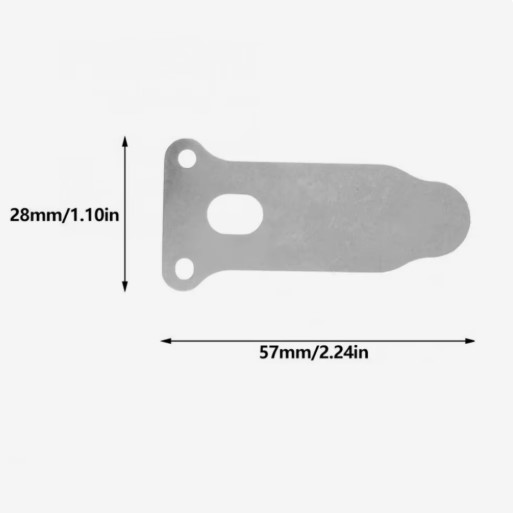
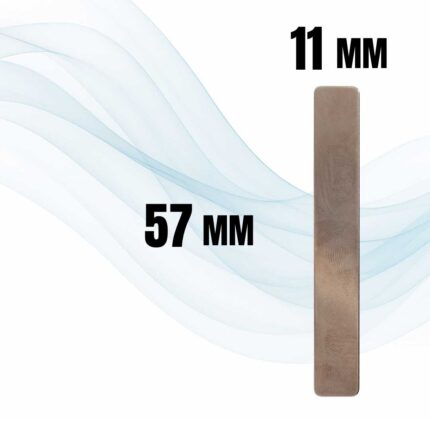
Construction of the J1048 / BM40 plate (as shown in the photo):
- Two mounting holes at the narrow end — secure the plate on the valve plate’s locating pins, setting the precise position of the working edge
- One elongated window in the centre section — eases the plate’s flex and determines the stiffness of the spring element
- A rounded wide end (“tip”) — the working edge that seals against the valve seat
Typical causes of valve plate wear:
- Metal fatigue from millions of flex cycles — the plate cracks near the window or the mounting holes
- Ingress of foreign particles (carbon deposits, metal swarf) — causes a dent or chip on the working edge
- Overheating from running without oil or with a clogged air filter — the metal loses its spring tension and no longer seals tightly against the seat
- Hydraulic lock when starting the compressor with condensate in the cylinder — the plate breaks instantly
Technical Specifications
| Parameter | Value |
|---|---|
| Item | Valve plate |
| Designation | J1048 / BM40 |
| Length | 57 mm |
| Width | 28 mm |
| Construction | 2 mounting holes + 1 elongated valve window |
| Material | Spring steel |
| Compatible head series | J1048 |
| Valve type | Reed type |
⚠️ Important when ordering: the J1048 compressor range uses several different valve plate sizes across different head variants. Before ordering, compare dimensions against your old plate (length, width, distance between mounting holes), or send a photo of the removed part — this allows the Acvatron SRL engineer to confirm an exact match to the 57×28 mm size.
How to Replace the J1048 Valve Plate: Step-by-Step
- Isolate the compressor — disconnect from the mains, depressurise the receiver fully via the condensate drain valve.
- Let the head cool down — removing the head from a hot compressor is risky: bolts can seize and the thread in the cast iron cylinder can strip easily.
- Unscrew the head cover bolts — evenly, in a cross pattern, typically 4–6 bolts.
- Remove the cover and valve plate assembly — you will see the 57×28 mm valve plate on the assembly. Inspect it for cracks near the mounting holes, chipping on the working edge, or deformation.
- Replace the plate — fit the new plate strictly onto the locating pins through the mounting holes, without misalignment. The working edge (“tip”) must precisely cover the valve seat.
- Check the valve plate gasket — the gasket often deforms during disassembly; it is recommended to replace it together with the plate.
- Reassemble in reverse order — tighten the cover bolts evenly in a cross pattern, torque 15–20 N·m.
- Start up and verify — the compressor should reach working pressure within the normal time with no unusual sounds from the head.
Expert Opinion
“The J1048-series valve plate is one of the most requested spare parts: customers come in saying ‘my compressor takes too long to pump up’ or ‘won’t reach pressure’ — in most cases this is the cause. The good news: replacement takes half an hour with minimal tools. One important point that’s often overlooked: if the plate failed prematurely, find out why. Either the filter wasn’t changed on time and abrasive dust finished off the plate, or there was overheating, or hydraulic lock from condensate in the cylinder. Replace the plate and fix the root cause — otherwise the new part won’t last long either.”
Vitali Bolucevschi, Chief Engineer at Acvatron SRL, 15 years in the industry
Why Acvatron SRL
Precise Matching from a Photo or Sample
Send a photo of your removed valve plate or measure it with a calliper — the Acvatron SRL engineer confirms an exact match to 57×28 mm before the order is placed.
Complete Repair Kit
Besides the valve plate, Acvatron SRL supplies valve plate gaskets, air filters and compressor oil — everything for a complete piston head service in one place.
In Stock at the Chișinău Warehouse
Consumable spare parts for piston compressors are permanently in stock. Collect on the day of payment.
Documents for Legal Entities
Invoice and contract for businesses and service organisations.
FAQ
❓ How do I make sure a 57×28 mm plate fits my compressor exactly?
Remove the old plate and compare: length (57 mm), width at the widest point (28 mm), the position and diameter of the mounting holes, and the shape of the elongated window. If the parameters match, the plate will fit. If unsure, send us a photo of the part with a ruler or calliper alongside for scale — we’ll verify it visually.
❓ How many valve plates are typically fitted in a J1048 head?
A typical single-cylinder head has plates fitted on both the suction and discharge valves. When disassembling for repair, it’s recommended to check and, if necessary, replace both — even if one looks intact, its remaining service life is usually similar to the failed one.
❓ Can a non-original valve plate be used?
Yes, provided the geometric dimensions match exactly (57×28 mm, hole positions, window shape) and the steel grade is correct (spring steel with the appropriate elasticity rating). A size mismatch or the use of soft steel instead of spring steel leads directly to rapid repeat failure.








Reviews
Clear filtersThere are no reviews yet.