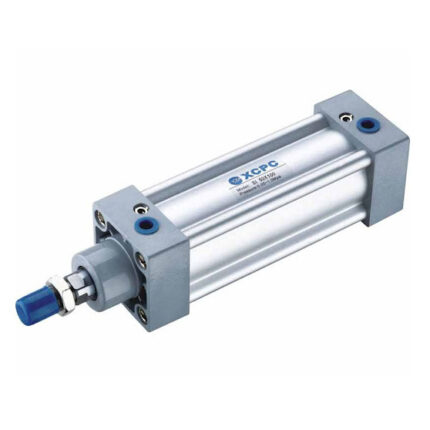









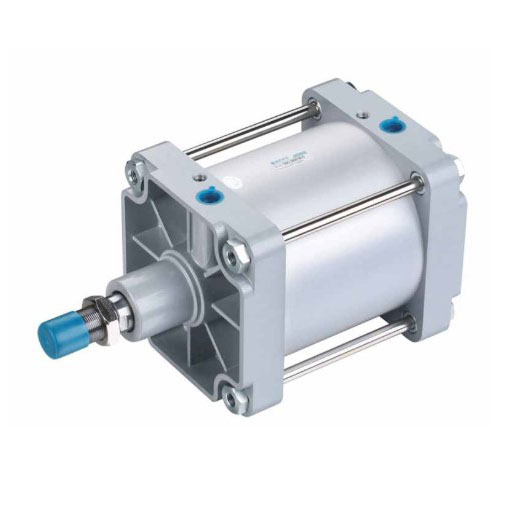

Pneumatic Cylinder XCPC DNG-200X300-S, ISO 15552, with Magnet, Heavy-Duty Series
The DNG-200X300-S is a powerful double-acting pneumatic cylinder built to the ISO 15552 standard (formerly VDMA 24562), designed to convert compressed air energy into significant linear force in heavy industrial systems. A 200 mm bore and 300 mm stroke place this model in the “heavy” range of the DNG series (160–320 mm bores) — that is, applications where high moving force matters more than compactness.
1. Purpose and Operating Principle
Compressed air is fed alternately into the front or rear chamber, moving the piston in both directions under pressure (not by a spring). The built-in magnetic ring on the piston (the S suffix) provides non-contact position monitoring — allowing the cylinder to be integrated into an automated PLC cycle via magnetic position sensors, without mechanical limit switches.
2. Technical Specifications
| Parameter | Value |
|---|---|
| Model | XCPC DNG-200X300-S |
| Standard | ISO 15552 (formerly VDMA 24562) |
| Bore | 200 mm |
| Stroke | 300 mm |
| Magnet on piston | Yes (S suffix) |
| Working medium | Clean compressed air |
| Working pressure | 0.1–1.0 MPa (1–10 bar) |
| Maximum (proof) pressure | 1.5 MPa (15 bar) |
| Temperature range | −5 to +60 °C |
| Speed range | 50–500 mm/s |
| Cushioning type | Adjustable pneumatic |
| Port size | G 3/4″ |
| Rod thread | M42×2 |
| Rod diameter | Ø40 mm |
| Calculated push force at 6 bar | ≈18,850 N (≈1885 kgf) |
| Front/rear cover material | Aluminium alloy |
| Rod material | S45C carbon steel, chrome-plated |
| Seals | NBR/PU |
| Lubrication | Not required (non-lube type); Turbine oil ISO VG32 permitted |
| Manufacturer certification | ISO 9001:2000, CE; recognized by Bureau Veritas and SGS |
⚠️ Unconfirmed parameters (not stated by the manufacturer in the open part of the documentation — confirm with the sales manager if needed):
- Weight and full overall dimensions when assembled.
- Exact seal type by position (which seal is NBR, which is PU in the assembly).
3. Design Features
Model code breakdown:
| Fragment | Meaning |
|---|---|
| DNG | “Heavy” standard cylinder series, ISO 15552 (160–320 mm bores) |
| 200 | Bore, mm |
| 300 | Stroke, mm |
| S | Magnetic ring on piston (With Magnet) for position sensors |
Design solutions:
- Full ISO 15552 compliance — the cylinder is interchangeable in mounting dimensions, fixings, and sensor grooves with similar equipment from other major brands, with no machine redesign needed.
- Adjustable pneumatic cushioning — effectively dissipates the kinetic energy of the heavy piston at the end of the stroke, reducing shock loading on the body and extending seal life.
- Front and rear covers in aluminium alloy combined with a chrome-plated S45C carbon steel rod — a construction sized for the loads typical of a 200 mm bore.
- Standard ISO mounting accessories are available: flanges (FA/FB), foot mounts (LB), clevis mounts (CA/CB).
4. Installation Recommendations
- The G 3/4″ port thread is parallel (BSPP): sealed with a flat gasket, no PTFE tape required.
- The M42×2 rod thread is metric — select the mounting fitting and mating thread exactly to this pitch, not mixing it with imperial standards.
- Adjustable cushioning should be set for the actual mass of the moved load and cycle speed — after installation, check and, if needed, adjust the buffer’s regulating screws rather than leaving the factory default setting for a heavy load.
- Although the cylinder is a non-lube type (no mandatory oil feed into the line is required), at high speeds or intensive cycling, lubrication with Turbine oil ISO VG32 is permitted — once lubrication is introduced into the line, it should be maintained continuously, not alternated with dry air.
- Use the standard ISO 15552 accessories for mounting (flanges FA/FB, foot mounts LB, clevis mounts CA/CB) — this preserves the stated interchangeability with other brands’ equivalents.
- At a 200 mm bore and an output force of around 1885 kgf, special attention should be paid to the strength of the machine’s supporting structure and mounting points, not just the cylinder itself.
5. Alternatives and Comparison
Full compatibility is confirmed via the ISO 15552 standard (mounting dimensions, fixings, sensor grooves):
| Brand | Model / Part Number | Standard | Compatibility |
|---|---|---|---|
| Festo | DNC-200-300-PPV-A or DSBC-200-300 | ISO 15552 | Full |
| Camozzi | 200MP2C200A0300 (Series 63/200) | ISO 15552 | Full |
| SMC | CP96SD200-300 or CP96SDB200-300 | ISO 15552 | Full |
| Metal Work | MCR 200×300 or Series 3 (heavy) | ISO 15552 | High |
| AirTAC | SAI200×300S or SC200×300S | ISO 15552 | Full |
Comparison with neighbouring series in the XCPC line: the DNC series (32–125 mm bores) is more modern, handling a higher working pressure (up to 1.0 MPa vs. 0.9 MPa for the SI series) and a 1.5 MPa proof pressure; the SI series (ISO 6431 standard, bores up to 200 mm) is an alternative where the design specifically calls for the older ISO 6431 standard. For bores above 125 mm and high-force applications (as here, at 200 mm), the DNG series is used.
6. Common Mistakes
- Exceeding the rated 1.0 MPa (10 bar) working pressure — the cylinder is sized for this value; the 1.5 MPa proof pressure is not intended for continuous operation.
- Running with the factory (unadjusted) cushioning under heavy load without tuning it to the actual mass and cycle speed — shock loading on the covers and accelerated seal wear.
- Using lubrication intermittently rather than continuously once it has been introduced into the line — washes lubricant out of the seals and accelerates wear.
- Using non-ISO 15552 mounting hardware instead of the standard flanges/feet/clevis mounts — loss of the stated interchangeability and risk of misalignment given this stroke length.
- Underestimating the load on the machine’s supporting structure at the cylinder’s full force (around 1885 kgf at 6 bar) — damage occurs not to the cylinder but to the mounting assembly.
7. Application
Thanks to its significant developed force, this cylinder is in demand in heavy industrial applications: metallurgy (gate/damper actuation, feeding heavy workpieces), woodworking (powerful clamping mechanisms in press equipment), the construction industry (automation of concrete and brick plants), shipbuilding and heavy machine building (moving large-sized assemblies).
8. Expert Opinion
“In the large-bore segment, the quality of the bore’s inner surface finish is decisive — it’s what determines how the cylinder behaves after years of cycling. XCPC has a solid reputation here thanks to precision production equipment, and the DNG-200X300-S, given properly conditioned air and well-tuned cushioning, genuinely runs for years without surprises,” notes Vitali Boluchevski, Lead Engineer, Acvatron SRL, 18 years of experience.
9. FAQ
Does this cylinder require mandatory oil lubrication of the air supply? No, the cylinder is a non-lube type and does not require mandatory air lubrication; at high speeds or intensive cycling, Turbine oil ISO VG32 is permitted.
What mounting options are available for this model? Since the cylinder complies with ISO 15552, all standard accessories are available: foot mounts (LB), flanges (FA/FB), and single or double clevis mounts (CA/CB).
What force does the DNG-200X300-S develop? At a working pressure of 6 bar (0.6 MPa), the calculated push force for a 200 mm bore is about 1885 kgf (≈18.85 kN); the exact value depends on the actual pressure in your network.
How does the DNG series differ from the DNC and SI series in the same XCPC line? DNC is a more modern series (ISO 15552, 32–125 mm bores, working pressure up to 1.0 MPa); SI complies with the older ISO 6431 standard (bores up to 200 mm). DNG is the heavy series specifically for 160–320 mm bores where high force is needed.
Can this cylinder be replaced with another brand’s equivalent without reworking the machine? Yes — full ISO 15552 compliance confirms full compatibility in mounting dimensions with equivalent-bore, equivalent-stroke models from Festo, Camozzi, SMC, and AirTAC.