












Technical Specifications
| Parameter | Value |
|---|---|
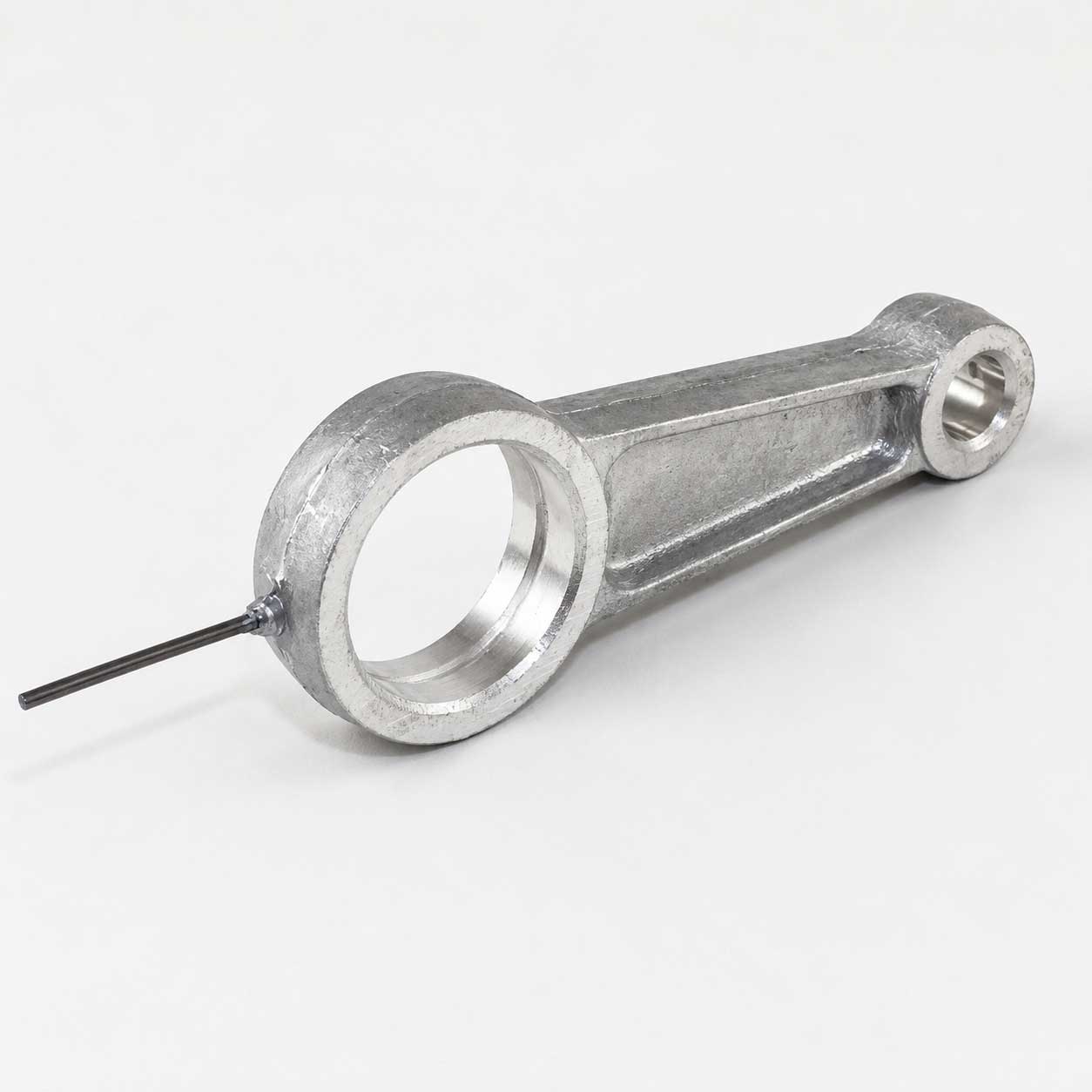
| Part type | Piston compressor connecting rod |
| Bore diameter for the piston pin | 12.7 mm |
| Bore diameter for the crankshaft journal | 35 mm |
| Center-to-center distance | 91 mm |
| Supplier internal part number | 2070 |
| Construction type | Typically a non-split (one-piece) big end — standard for this class of compressor |
| Material | Typically cast aluminum alloy — standard for connecting rods of this size class |
| Compatibility | Universal, for a wide range of Chinese-made piston compressors (see Section 7) |
Design Features
Decoding the designation 12.7×35×91 mm:
| Value | Meaning |
|---|---|
| 12.7 mm | Small (upper) end bore diameter — for the piston pin |
| 35 mm | Big (lower) end bore diameter — for the crankshaft journal |
| 91 mm | Distance between the centers of the two bores (rod length, center-to-center) |
| (2070) | Internal part number in the parts supplier’s catalog |
Notable features of this size class:
- All three dimensions (12.7 / 35 / 91) must match simultaneously — matching only the bore diameters without matching the center distance (or vice versa) does not guarantee the part will fit your compressor.
- The rod shaft for this class of compressor typically has an I-beam cross-section — the optimal balance between bending strength and part mass, reducing inertial loads on the crankshaft at high RPM.
- The small end is often fitted with a pressed-in bronze bushing, or retains a direct aluminum-to-pin fit — in the budget segment of Chinese compressors, either variant is possible depending on the production batch.
Installation Recommendations
- Always measure the old part before ordering — use a caliper to measure the diameter of both bores and the center-to-center distance; for this size class, parts differ by as little as 2–3 mm between neighboring sizes (for example, 12.5×35×85 mm is already a different part, despite looking similar).
- Check the condition of the piston pin and the crankshaft journal seat before installing the new rod — play or scoring on adjacent parts will negate the service life of the new part.
- Lubricate the mounting surfaces with oil before assembly (compressor oil of the appropriate viscosity) — dry installation accelerates scoring during the first hours of operation.
- Follow the correct installation orientation if the part is marked — on some batches, the big-end cheeks are asymmetric.
- Tighten fasteners per the compressor manufacturer’s recommendations (torque values for a universal part are not published by the manufacturer) — don’t tighten “by feel” based on similar threaded connections in household appliances; over-tightening can deform the rod’s big end.
- Turn the crankshaft by hand through a few rotations after assembly, before starting the compressor under load — this immediately reveals any binding or contact with the crankcase.
Analogues and Comparison
Below are connecting rod sizes with similar construction (for reference only; none of these are interchangeable with 12.7×35×91 mm — listed only to illustrate the size range):
| Size (pin × crankshaft × center distance) | Note |
|---|---|
| 12.7 × 35 × 91 mm | The part in this listing (Art. 2070) |
| 12.5 × 35 × 85 mm | Similar crankshaft bore, different center distance — not interchangeable |
| 12.7 × 28 × 110 mm | Same pin diameter, smaller crankshaft bore, different center distance |
| 14.5 × 30 × 108 mm | A different size class |
| 20 × 32 × 137 mm | A larger rod, for higher-capacity compressors |
Before substituting any other size, always verify all three dimensions together, not just one of them.
Common Ordering and Installation Mistakes
- Ordering “by compressor model name” without checking the old part’s dimensions — Chinese compressor factories supply different internal assemblies under the same brand, and even under the same model, across different production years; the compressor brand/model name alone does not guarantee the connecting rod dimensions will match.
- Ignoring the center-to-center distance — buyers often check only the crankshaft bore diameter, forgetting that the center distance defines the geometry of the entire piston/cylinder assembly and the piston stroke.
- Installing without lubricating the mounting surfaces — leads to accelerated wear and a characteristic knock during the first hours of operation after replacement.
- Skipping inspection of the piston pin and retaining clips — a worn pin or damaged retaining clips will negate the new part’s service life within a short time.
- Over-tightening the big-end fasteners — deforms the rod’s big end and can cause it to bind on the crankshaft journal.
- Starting the compressor straight into full load after replacement — a short break-in period at idle or with the air outlet partially open is recommended.
Application Areas
The 12.7×35×91 mm connecting rod (Art. 2070) is used as a universal, interchangeable spare part in budget Chinese-made piston compressors sold across CIS markets under numerous different trade names (Forte, Werk, Intertool, Denzel, Patriot, Kraftmann, Ergomax, Elmos, Kraton, and similar brands all manufacture compressors on similar Chinese factory platforms). Compatibility with a specific model is determined solely by matching all three mounting dimensions, not by the brand name.
Typical uses for compressors fitted with rods of this class:
- Garage and auto-service compressors of small to medium capacity (24 to ~100 l receivers)
- Small production and repair workshops
- Mobile compressor units for construction and installation work
⚠️ The brand list above is a general reference for this equipment class, not a confirmed compatibility list for any specific model. Before ordering, verify dimensions against the old part or confirm compatibility with an Acvatron sales manager.
Expert Opinion
Vitali Boluchevski, Lead Engineer, Acvatron SRL, 18 years of experience:
“For connecting rods on Chinese compressors, I have a simple rule I always share with customers in Moldova: don’t go by the compressor brand — go by three numbers: the pin bore diameter, the crankshaft bore diameter, and the center distance. The same compressor, identical on the outside, can be fitted over several production years with internal assemblies from different factories, and a rod that fit last year’s model won’t always fit a compressor with the same name bought this year. That’s why, before an order, I always ask for a photo and caliper measurements of the old part — it saves the customer time and money by avoiding the return of an incompatible part. One more thing worth noting: a connecting rod is a part subjected to alternating loads at high RPM, so it’s really not worth cutting corners on lubrication during installation.”
FAQ
How do I recognize that a compressor’s connecting rod has failed? The main signs are a characteristic dull knocking sound in the crankcase area that intensifies with rising RPM and load; increased oil consumption (on oil-lubricated compressors) due to increased clearance in the rod bearings; and a drop in compressor performance and final pressure.
How do I correctly select the connecting rod by this part number? Remove the old rod and measure with a caliper: the bore diameter for the piston pin, the bore diameter for the crankshaft journal, and the center-to-center distance between these bores. All three values must match 12.7 / 35 / 91 mm respectively. The compressor’s brand or model name alone does not guarantee compatibility.
Does this rod fit two-cylinder (V-type) compressors? Yes, provided the mounting dimensions match — this size is used in both single-cylinder and some two-cylinder compressors of the corresponding capacity class. For two-cylinder models, check whether you need to replace a single rod or a matched pair, to avoid unbalancing the piston assembly.
Do the piston pin and retaining clips need to be replaced along with the rod? Not necessarily, but it’s strongly recommended to inspect them before installing the new part — a worn pin or deformed retaining clips can damage the new rod within the first hours of operation and negate the benefit of the replacement.










Reviews
Clear filtersThere are no reviews yet.