







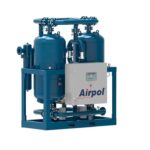
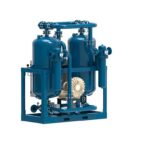

What Is the Airpol SGR1350 Dryer
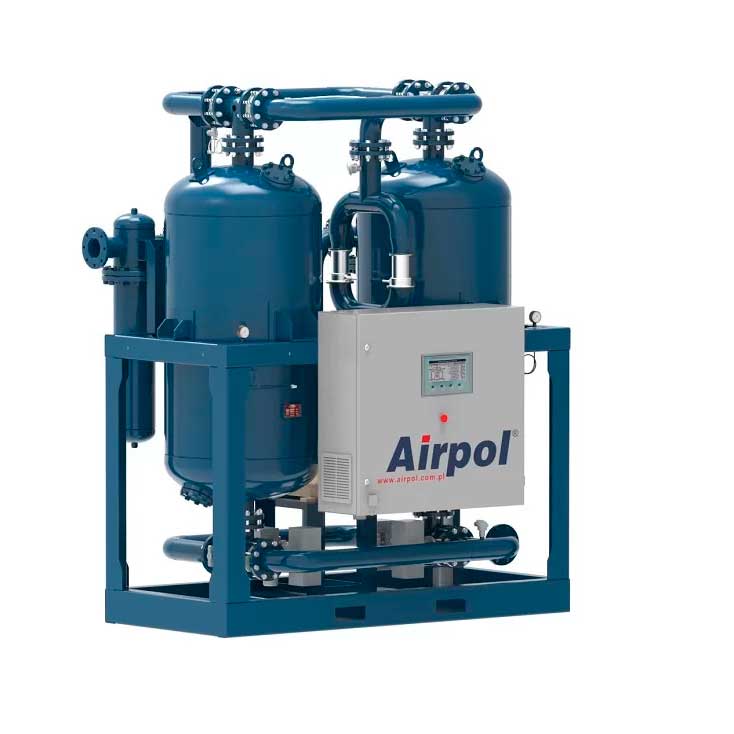
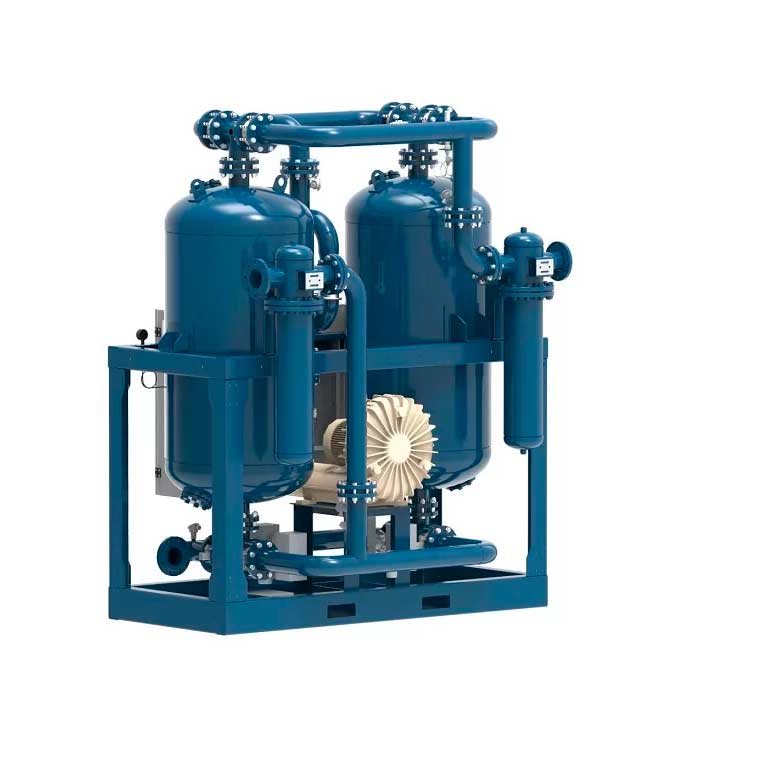
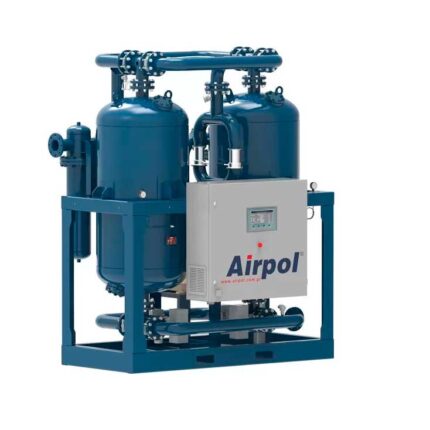
The Airpol SGR1350 is an adsorption dryer from the SGR series, manufactured by Airpol (Poland), with heated regeneration of the sorbent bed. The unit is designed to deliver compressed air of purity class 1.2.1 and above per ISO 8573-1 — free of moisture, solid particles and oil — in industrial compressed air systems where a refrigeration dryer cannot achieve the required dew point.
Model designation breakdown: SGR — Series Heated Regeneration, 1350 — nominal air flow in m3/h at reference conditions: pressure 7 bar, air temperature 35°C, ambient temperature 20°C, dew point -40°C at 100% load.
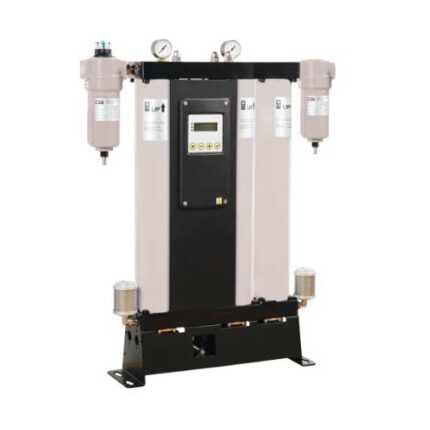
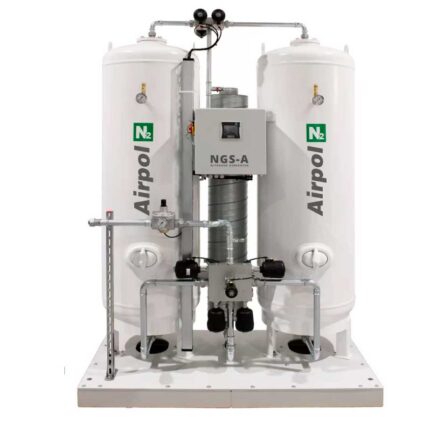
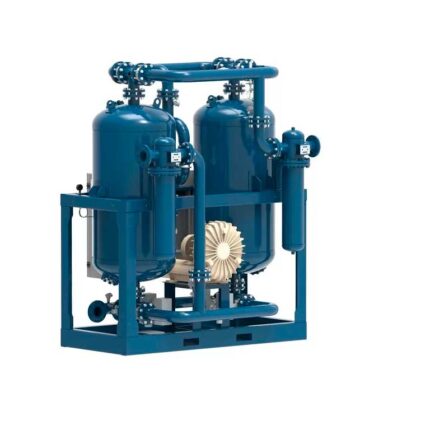
The SGR1350 consists of two adsorption columns filled with activated carbon (or silica gel), operating alternately: while one column dries compressed air under pressure, the other is regenerated by purging with heated atmospheric air from an integrated blower with an electric heater. This is the fundamental difference from cold-regeneration dryers (PSA type), which consume 15-20% of compressed air for purging: in the SGR, losses are only 3%.
Key features: Siemens microprocessor controller with dew point sensor, web server for remote monitoring via browser, integrated filters — coalescing at the inlet and dust filter at the outlet. Standards: ISO 8573-1 (air purity class), ISO 7183 (adsorption dryers).
Technical Specifications
| Parameter | Value |
| Model | Airpol SGR1350 |
| Regeneration Type | Heated (with heated atmospheric air) |
| Nominal Flow Rate* | 1350 m3/h |
| Installed Power | 22.5 kW |
| Power Supply | 400 V / 50 Hz / 3 phases |
| Connection | G 2½” |
| Dew Point (standard) | -40°C ± 1°C at 100% load (class 1.2.1 per ISO 8573-1) |
| Dew Point (special version) | -70°C (class 1.1.1 per ISO 8573-1) |
| Operating Pressure | 6 — 10 bar |
| Inlet Air Temperature | max. +45°C |
| Ambient Temperature | +5°C … +40°C |
| Oil Content at Inlet | max. 3 mg/m3 |
| Air Consumption for Regeneration | ~3% of nominal |
| Compressed Air Losses | ~3% (minimum in SGR class) |
| Dimensions (L x W x H) | 1900 x 1590 x 2300 mm |
| Weight | 2200 kg |
| Standard | ISO 8573-1, ISO 7183 |
| Manufacturer | Airpol (Poland) |
*Reference conditions: pressure 7 bar, air temperature 35°C, ambient temperature 20°C. For deviations, apply correction factors: at 8 bar and 35°C — K=1.12; at 10 bar and 35°C — K=1.37. Actual flow = 1350 x K.
💡 Expert Tip: The SGR1350 has a close neighbour — the SGR1650 (1650 m3/h, same 22.5 kW power, G 3″). If your flow rate is near the upper limit of the SGR1350, specify the SGR1650: at identical power you gain 22% capacity margin at no extra energy cost.
Brand Equivalents
| Brand | Equivalent Model | Regen. Type | Standard | Flow Rate | Note |
| Airpol | SGR1350 | Heated | ISO 8573-1, ISO 7183 | 1350 m3/h | Recommended |
| Atlas Copco | CD+1100/CD+1300 | Heated | ISO 8573-1 | ~1100-1300 m3/h | Verify flow at 7 bar/35°C |
| Kaeser | SECOTEC THD / TS | Heated | ISO 8573-1 | ~1200-1400 m3/h | Check dew point class |
| Parker Hannifin | HLD1200 / HLD1500 | Heated | ISO 8573-1 | ~1200-1500 m3/h | Verify heater power |
| Beko | DRYPOINT AC 1300H | Heated | ISO 8573-1 | ~1300 m3/h | Compare air losses |
⚠️ Warning: The flow rate of all adsorption dryers is stated at specific reference pressure and temperature conditions. Before substitution, always recalculate the actual flow rate using the manufacturer’s correction factors.
5 mandatory compatibility check parameters:
- Air flow rate — m3/h at actual pressure and temperature, applying the K-factor
- Required dew point — -40°C (standard) or -70°C (special version)
- Operating pressure — must be within the 6-10 bar range
- Power supply — 400 V / 50 Hz / 3 phases, available capacity 22.5 kW
- Regeneration type — heated (SGR) vs. cold (SG): air losses 3% vs. 15-20%
Applications
Metal Fabrication and Mechanical Engineering
- Paint booths and powder coating lines — moisture causes adhesion defects
- Pneumatic actuators on precision machine tools — condensate destroys control valves
- Laser cutting — protection of optics and mirrors from moisture at dew point ≤ -40°C
Pharmaceutical and Food Industries
- Production lines requiring ISO 8573-1 class 1 for moisture content
- Packaging machines — condensate in air causes corrosion and microbial growth
- Pneumatic conveying of bulk products — prevention of caking and clumping
Electronics and Semiconductor Manufacturing
- Clean rooms: dew point of -40°C and below eliminates condensation on surfaces
- Soldering and pneumatic systems on test benches
Cold Stores and Unheated Facilities
- Air drying in systems routed through unheated zones and freeze-risk areas
- Prevention of condensate freezing in pipelines at -40°C and below
Adsorption Dryer Selection Algorithm
- Determine the actual flow rate — sum all consumers accounting for simultaneity. Add a 15-20% margin.
- Establish the required dew point — if -40°C is sufficient (standard ISO 8573-1 class 1.2.1), choose the SGR1350 standard version. If -70°C is needed (cryogenic processes, special applications) — order the special version.
- Check your compressor station parameters — pressure (6-10 bar), outlet air temperature (max. 45°C) and oil content (max. 3 mg/m3). If oil content is higher — additional filtration upstream of the dryer is required.
- Apply the correction factor — if the operating pressure differs from the reference 7 bar, use the Airpol K-factor table: e.g., at 8 bar and 35°C K=1.12, meaning the SGR1350 at these conditions will deliver 1350 x 1.12 = 1512 m3/h.
- Confirm electrical supply availability — three-phase 400 V / 50 Hz, 40 A circuit breaker, free capacity of 22.5 kW.
- Agree on the installation footprint — 1900 x 1590 mm floor area, height 2300 mm, weight 2200 kg. A solid floor and a clearance of ≥500 mm around the perimeter for maintenance access are required.
Why Acvatron SRL — 5 Solid Reasons
Engineering-Based Selection
The Acvatron engineer performs a full calculation: actual flow with K-factor, heater power, filtration parameters. You receive a justified model selection, not simply the nearest catalogue position.
Complete Equipment Package
We supply the SGR1350 as a complete set with inlet coalescing filter and outlet dust filter (included in the Airpol standard). Where required — additional filtration stages and pneumatic condensate drains.
Stock Available in Chisinau
The stock programme covers the main SGR sizes. For the SGR1350 and larger models — supply to order within agreed lead times directly from Airpol. The Acvatron manager confirms the delivery date in the contract.
Technical Support and Commissioning
After delivery, the Acvatron engineer performs commissioning, configures the controller to your target dew point and trains your personnel in using the web monitoring server. Maintenance schedule consultations are provided free of charge.
Documentation for Legal Entities
Tax invoices, delivery notes, CE and ISO conformity certificates — a complete document package for accounting, procurement and technical inspection departments.
Expert Opinion
“Most clients come with a single request: ‘we need a dryer for 1350 m3/h’. The key mistake here is comparing prices without verifying the conditions. The Airpol SGR1350 delivers 1350 m3/h at 7 bar and 35°C. If your compressor operates at 8 bar, the actual throughput is already 1512 m3/h. The heated regeneration of the SGR series consumes only 3% of compressed air versus 15-20% for a cold PSA scheme. For facilities running around the clock, this translates to several thousand euros in annual savings on compressor energy alone.” — Vitali Bolucevschi, Chief Engineer at Acvatron SRL, 15 years in the industry.
Handling Objections
“I’ll buy cheaper — I’ll go with a cold-regeneration dryer”
A cold-regeneration (PSA) dryer is 20-40% cheaper, but consumes 15-20% of compressed air for sorbent purging. For a 1350 m3/h station this means 200-270 m3/h of continuous losses — an additional 15-20 kW load on the compressor at all times. Over a year — 120,000-175,000 kWh of excess energy costs. The SGR1350 recovers the price difference within 18-24 months from energy savings alone.
“There is no size to match my flow rate”
The SGR series covers the range from 300 to 4000 m3/h: SGR0300, SGR0375, SGR0550, SGR0650, SGR0850, SGR1000, SGR1350, SGR1650, SGR1950, SGR2250, SGR2750, SGR3500, SGR4000. If your flow falls between sizes — select the next larger model, or configure two parallel units for redundancy.
“I don’t know whether a dew point of -40°C is sufficient for my process”
-40°C per ISO 8573-1 class 1.2.1 covers 95% of industrial applications, including pneumatic tools, packaging, painting and metal fabrication. -70°C (class 1.1.1) is required for cryogenic applications, certain pharmaceutical processes and inert gas drying. The Acvatron engineer will clarify the required class based on your process specification.
Problems You Have Already Faced
- Condensate in air lines — rust, product contamination, pneumatic equipment failures
- Freezing of condensate drains and pipelines where mains pass through unheated areas
- Paint line rejects due to moisture in air — scrapped batches and repainting costs
- Refrigeration dryer unable to maintain the required dew point under peak summer load
- Customer or audit requirement: present a class 1.2.1 certificate per ISO 8573-1
Hidden cost of the wrong choice: a single warranty claim for equipment failure caused by condensate in the air supply (pneumatic manipulator, CNC valve, precision regulator) costs more than the entire price difference between a refrigeration dryer and an adsorption dryer.
Frequently Asked Questions (FAQ)
❓ Why is the SGR1350 with heated regeneration better than a standard cold-purge adsorption dryer?
With heated regeneration, the sorbent is purged with heated atmospheric air from an integrated blower — compressed air losses are only 3%. Cold-purge dryers (PSA type) consume 15-20% of dried air for regeneration. For the SGR1350 this difference amounts to 165-255 m3/h of continuous losses, which at 8,000 h/year represents over 100,000 m3 of air — a significant compressor load and energy cost.
❓ What is the actual flow rate of the SGR1350 at an operating pressure of 8 bar and air temperature of 40°C?
According to the Airpol correction factor table: at 8 bar and 40°C, K=0.82. The actual flow rate is 1350 x 0.82 = 1107 m3/h. At the same pressure and 35°C, K=1.12 and the flow is 1512 m3/h. This is precisely why it is essential to provide the Acvatron engineer with the actual parameters of your compressor station, not the nameplate ratings.
❓ What does the SGR1350 web monitoring server include?
The Siemens controller with web server function allows — via a browser on the plant local network — viewing of the current dryer status, actual dew point, pressure, air and sorbent temperatures, parameter trend charts, event log, operating hour counters, cycle counts, energy consumption and time to next scheduled maintenance. Remote setpoint adjustment is also available.
❓ How often does the sorbent in the SGR1350 need to be replaced?
When inlet requirements are met (oil < 3 mg/m3, temperature < 45°C, pressure 6-10 bar), sorbent service life is 5-8 years. The controller tracks cycle counts and operating hours and provides advance warning when maintenance is due. Premature sorbent failure is almost always the result of exceeding the permissible oil content in the inlet air.










Reviews
Clear filtersThere are no reviews yet.