











O-GEN 23 Output Capacity
Generator efficiency is directly dependent on the required purity of the final product. The table below shows oxygen flow rates and air consumption at an inlet pressure of 7.5 bar and a temperature of 30 °C:
| Oxygen purity [%] | Oxygen flow [Nm³/h] | Compressed air consumption [Nm³/h] | Outlet pressure [bar] |
|---|---|---|---|
| 90% | 23.28 | 253.8 | 6.1 |
| 93% | 22.23 | 250.0 | 6.1 |
| 95% | 21.19 | 246.1 | 6.1 |
Technical Specifications and Dimensions
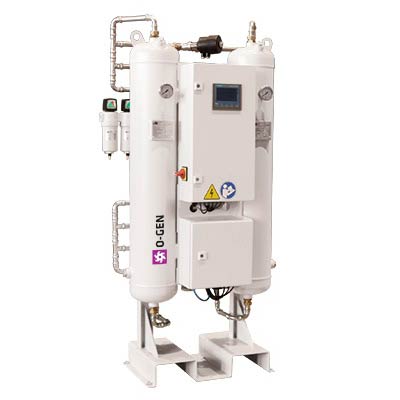
The O-GEN 23 is a heavy-duty unit designed for continuous operation in demanding industrial environments:
| Parameter | Value |
|---|---|
| Inlet operating pressure | 5–6 bar (recommended) / up to 10 bar max. |
| Maximum inlet pressure | 10 bar |
| Inlet air temperature | +15 … +50 °C |
| Oxygen dew point at outlet (atmospheric) | < −60 °C |
| Inlet / Outlet connections | 2″ / 1/2″ |
| Column material | Carbon steel |
| Pipework and fittings material | Stainless steel SS316 |
| Controller | Siemens PLC with WebControl |
| Standby mode | Automatic (when no consumption detected) |
| Height (A) | 2267 mm |
| Width (B) | 1010 mm |
| Depth (C) | 1848 mm |
| Unit weight | 1675 kg |
5 Key Advantages of the O-GEN 23
1. Siemens PLC Controller with WebControl — Industrial Automation Standard
While most competing units come equipped with basic controllers lacking integration capabilities, the O-GEN 23 features a Siemens PLC — the platform that is the industrial standard in Europe, used in production processes requiring 99.9% reliability. The WebControl function allows monitoring of oxygen purity, pressure, valve status, and alarm logs via a browser from any device — without requiring an on-site engineer visit. Automatic standby mode when no consumption is detected is managed in software, with no additional hardware required.
2. SS316 Stainless Steel in Oxygen Contact — Safety and Durability
Oxygen at high concentrations is a powerful oxidiser. The use of ordinary carbon steel or brass in the pipework and fittings of an oxygen line leads to the formation of metal oxides, which contaminate the gas and create a fire risk in an oxygen-enriched environment. In the O-GEN 23, all internal pipework and fittings are made from SS316 stainless steel — a material with maximum corrosion resistance and oxygen compatibility in accordance with EN 13782. This guarantees gas purity throughout the entire service life of the unit.
3. Oxygen Dew Point < −60 °C — Dry Gas Without Additional Drying
The oxygen produced by the O-GEN 23 has a dew point below −60 °C at atmospheric pressure. This means the gas contains no free moisture and will not cause corrosion in the oxygen pipework or downstream equipment. For medical applications this is critical: moist oxygen promotes the growth of pathogens in pipelines and impairs the performance of ventilators. For welding operations, dry oxygen ensures stable combustion and a clean, spatter-free cut.
4. Unlimited Molecular Sieve Life — Minimal Maintenance Costs
Provided that inlet air pre-filtration requirements are met (ISO 8573-1 class 1.4.1), the LiX zeolite molecular sieve in the O-GEN 23 adsorption columns essentially does not degrade and does not require scheduled replacement. Routine maintenance is limited to periodic inspection and replacement of the cycle pneumatic valves and inlet air filter elements. This is a fundamental difference from cylinder supply, where every cubic metre of oxygen carries its own cost regardless of volume.
5. Turnkey Configuration — Simplified Integration into Existing Pneumatic Systems
The O-GEN 23 is supplied with built-in inlet and outlet filters, exhaust silencers, and pressure regulators — everything needed for connection to an existing compressed air line is included in the standard configuration. This eliminates the need for separate engineering design and procurement of ancillary components, reduces installation costs, and minimises the number of potential leak points in the system.
Inlet Air Quality Requirements
The zeolite molecular sieve is sensitive to contamination in the inlet air. Failure to meet air quality requirements is the only cause of premature adsorbent failure.
Requirement per ISO 8573-1: Class 1.4.1
- Solid particles: Class 1 (≤ 0.1 µm, ≤ 0.1 mg/m³)
- Moisture: Class 4 (dew point ≤ +3 °C) — provided by a refrigerant dryer
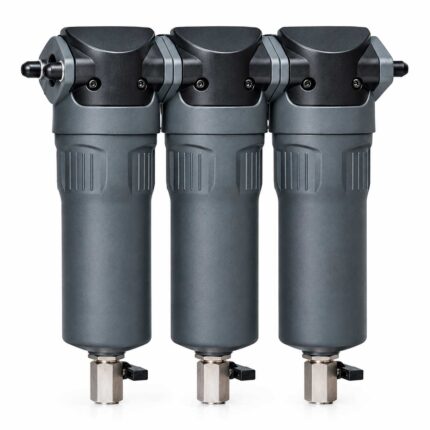
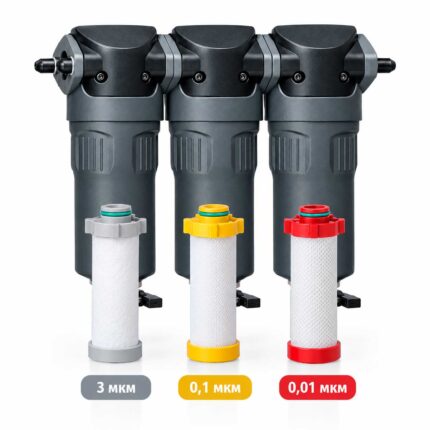
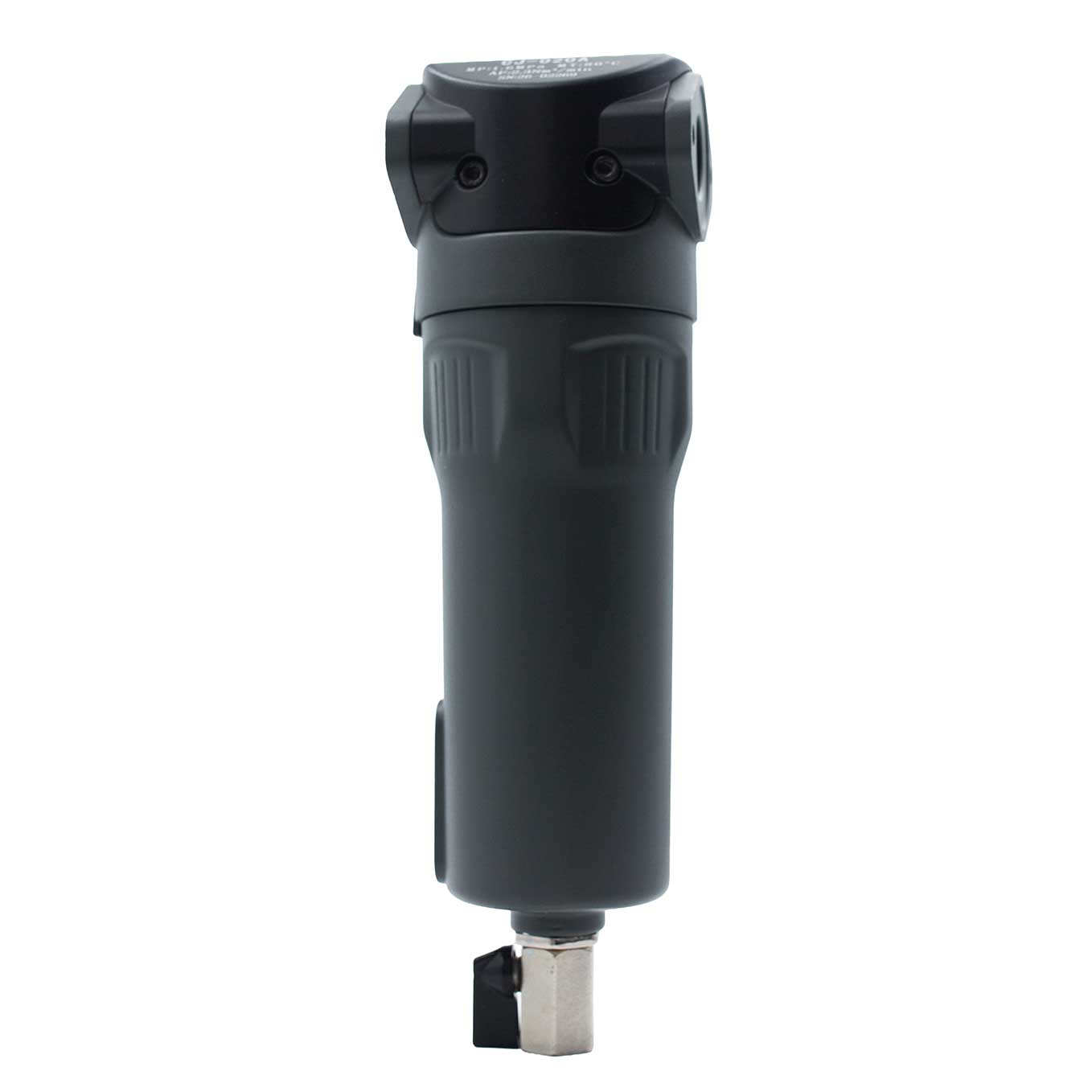
- Oil: Class 1 (≤ 0.01 mg/m³) — provided by a 0.01 µm superfine filter
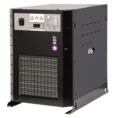
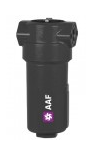
Required air pre-treatment scheme: Compressor → Buffer receiver → Refrigerant dryer RDT → [Filter AAF, element P] → Filter AAF, element S, 0.01 µm → O-GEN 23
Compressor oil is the primary enemy of the molecular sieve. An oil film on the surface of zeolite granules irreversibly blocks the adsorption pores. The sign of contamination is a gradual drop in oxygen purity below the set value. A contaminated sieve cannot be restored.
Applications
- Medicine and veterinary care — supplying hospitals, operating rooms, ICUs, and veterinary clinics with medical-grade oxygen at 93–95% purity; compliant with European Pharmacopoeia standard Ph. Eur. (93 ± 3%)
- Aquaculture and fish farming — water oxygenation for intensive fish farming; at a dissolved O₂ concentration of 8–12 mg/L, fish growth rate accelerates by 1.5–2× compared with air aeration
- Glass manufacturing — oxygen-enriched combustion in burners for flat glass, glassware, and fibreglass production; using O₂ instead of air raises flame temperature by 300–500 °C and reduces fuel consumption by 20–30%
- Ozone generators — oxygen feed for ozonators used in drinking water treatment, wastewater treatment, room disinfection, and food processing; replacing air with O₂ increases ozonator output by 2–3×
- Metalworking and cutting — oxygen cutting and welding of ferrous metals, oxygen supply to plasma and oxy-fuel torches; 90–93% purity is sufficient for most welding and cutting applications
- Pulp and paper industry — oxygen delignification and bleaching of pulp as part of environmental programmes to reduce chlorine discharges
Expert Opinion
Vitaly Boluchevsky — Compression Equipment Engineer, 18 years’ experience. Acvatron SRL.
“The O-GEN 23 is the workhorse for facilities with medium oxygen consumption. The key factor in the long service life of this model is inlet air quality: it must meet ISO 8573-1 class 1.4.1. I always recommend supplementing the system with an inlet moisture sensor and a zirconia purity analyser on the outlet — this completely eliminates the risk of molecular sieve damage and guarantees process stability. The Siemens PLC controller is a genuine advantage in my view: when an alarm fires, you can log into WebControl from your phone and understand what is happening before you even arrive on site.”
Omega Air O-GEN series equipment complies with: ISO 8573-1 (compressed air quality at inlet), EN 13782 (gas production equipment), ISO 9001:2015 (manufacturer’s quality management system), PED Directive 2014/68/EU (pressure equipment), European Pharmacopoeia Ph. Eur. (for medical oxygen 93 ± 3% applications).
FAQ
How does a PSA generator fundamentally differ from cylinder and liquid oxygen supply? Cylinder and liquid oxygen represent purchasing gas from an external supplier, with associated delivery, storage, and logistics. A PSA generator produces oxygen from air on-site, operating continuously. Gas quality is identical: 90–95% O₂ purity meets industrial and medical standards. The difference is economic: at a consumption level of 10–15 cylinders per day, a generator pays for itself in 18–36 months, after which the cost of oxygen falls by a factor of 5–10.
What compressor is required to run the O-GEN 23? At 7.5 bar, air consumption is 246–254 Nm³/h depending on the required purity. This corresponds to the output of a screw compressor rated at 37–45 kW with a comfortable margin. The compressor must be oil-injected (screw type) with a refrigerant dryer and two-stage filtration — to ISO 8573-1 class 1.4.1. An oil-free compressor is not required: oil is retained by the filters. Acvatron SRL can assist in selecting a matched compressor and generator package.
Can the oxygen from the O-GEN 23 be used for medical purposes? Omega Air PSA generators deliver 93 ± 3% purity, which meets the medical oxygen standard of the European Pharmacopoeia (Ph. Eur.) and is recognised by the WHO as equivalent to medical-grade O₂. For official use in medical institutions in the Republic of Moldova, the unit must be registered as a medical device in accordance with national legislation. Acvatron SRL will provide the technical documentation required for the regulatory process.
What additional equipment may be needed? Depending on the application: an oxygen buffer receiver of 200–500 litres (to smooth consumption peaks and stabilise pressure); a zirconia O₂ purity analyser on the outlet (mandatory for medical applications); a booster compressor for filling high-pressure cylinders (200–300 bar), if a mobile reserve is required. An Acvatron SRL engineer will design the complete system for your specific requirements.










Reviews
Clear filtersThere are no reviews yet.