











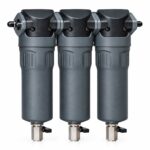
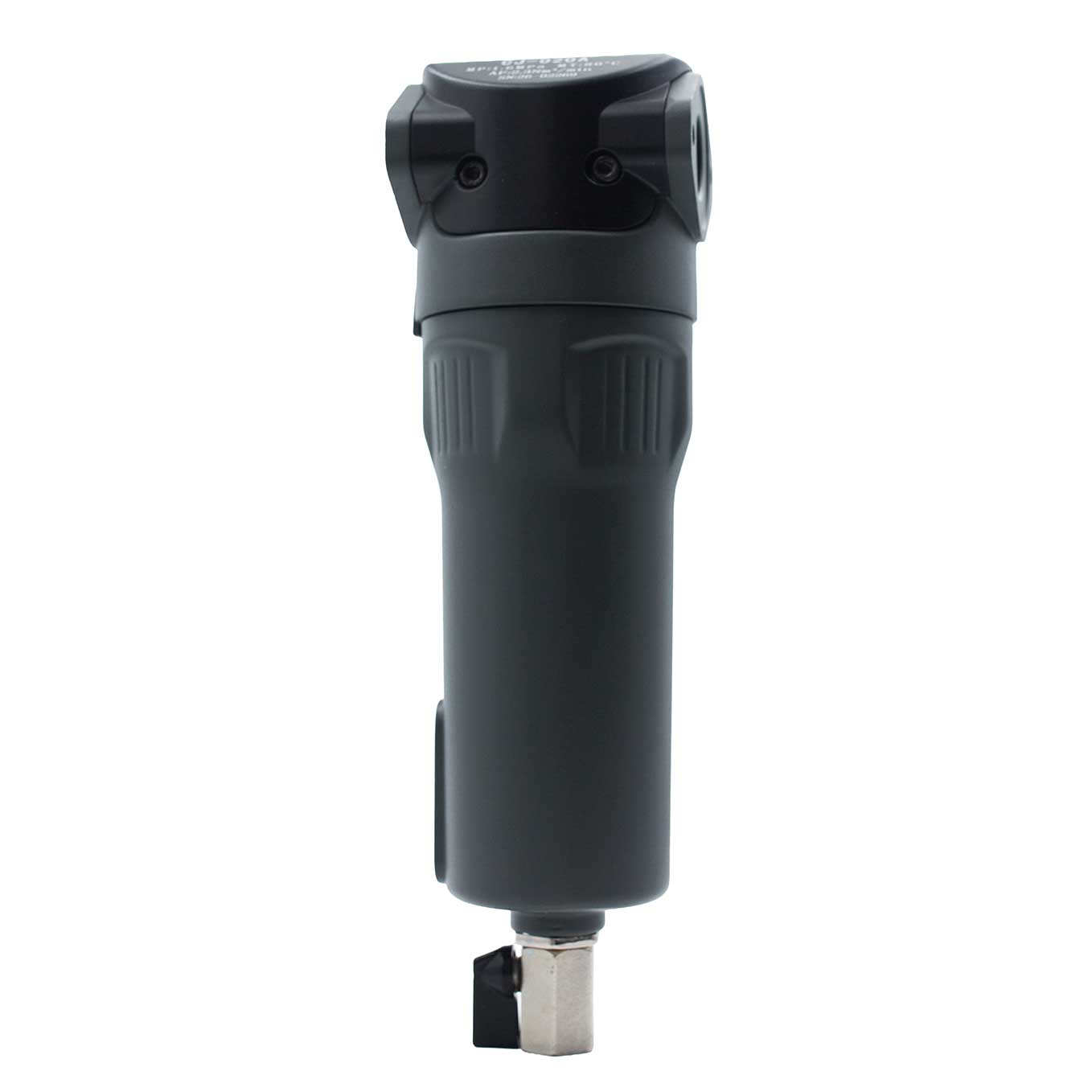
Compressed Air Filter Set for Painting CJ-020 C + CJ-020 T + CJ-020 A
5.940,00 MDL
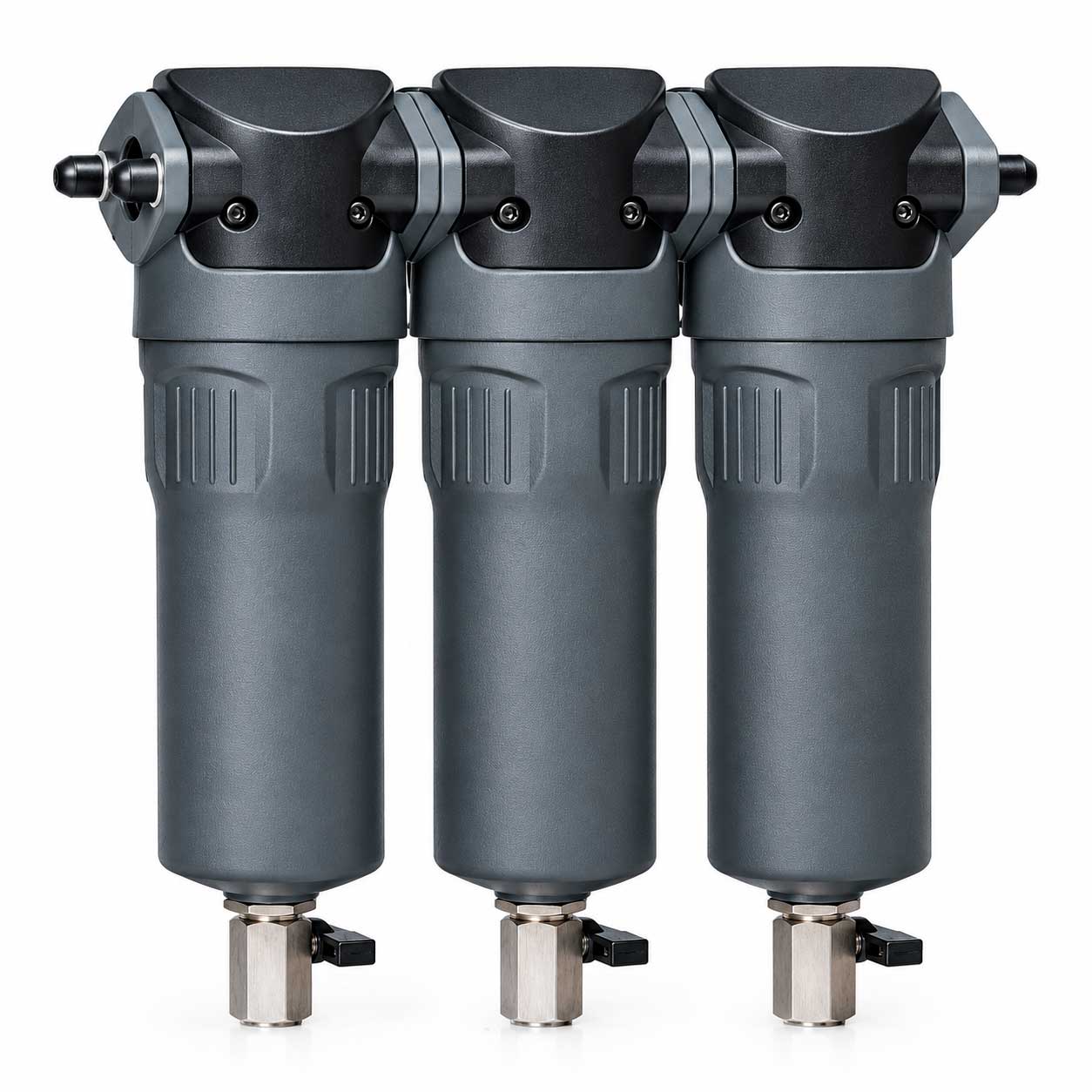
The set of three precision filters in the CJ-020 series is designed to prepare compressed air supplied to a spray gun: removing oil, moisture, and solid particles before atomizing the coating material.
1. Purpose and Operating Principle
Operating principle is based on sequential three-stage filtration:
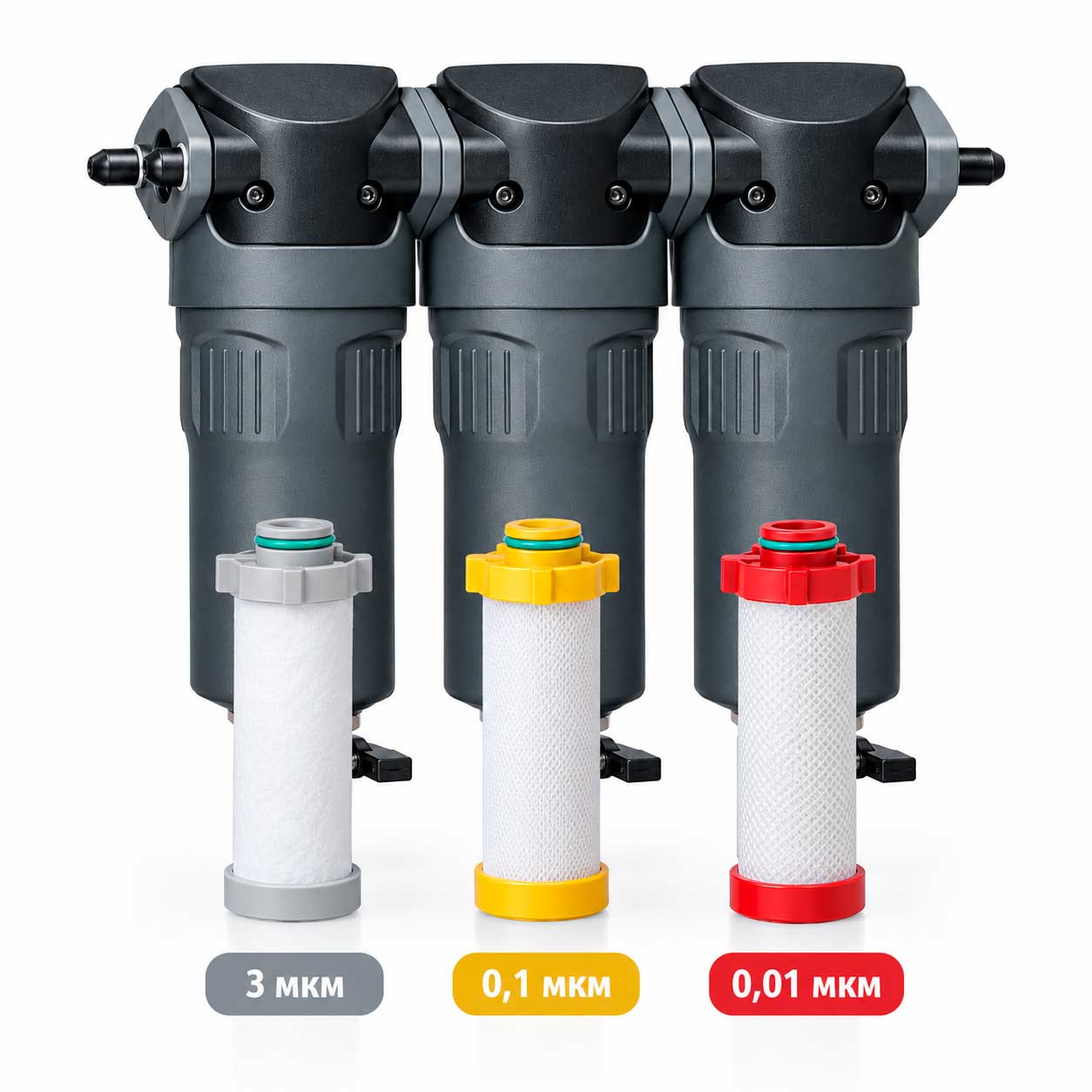
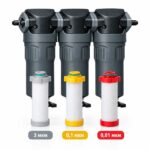
- CJ-020 C (coarse filter, residual oil 3 ppm) — captures large particles and oil droplets.
- CJ-020 T (fine coalescing filter, 0.1 ppm) — coalesces and removes oil and moisture aerosols.
- CJ-020 A (high-purity coalescing filter, 0.01 ppm) — provides final air purification right before it reaches the spray gun.
The set achieves a compressed air purity class close to ISO 8573-1:2010 Class 1 for oil and solid particles (provided a suitable dryer is installed ahead of the filters).
2. Technical Specifications
| Parameter | Value |
|---|---|
| Housing model | CJ-020 |
| Rated flow | 2.3 Nm³/min (81.2 CFM) at 7 bar |
| Maximum working pressure | 1.6 MPa (16 bar) |
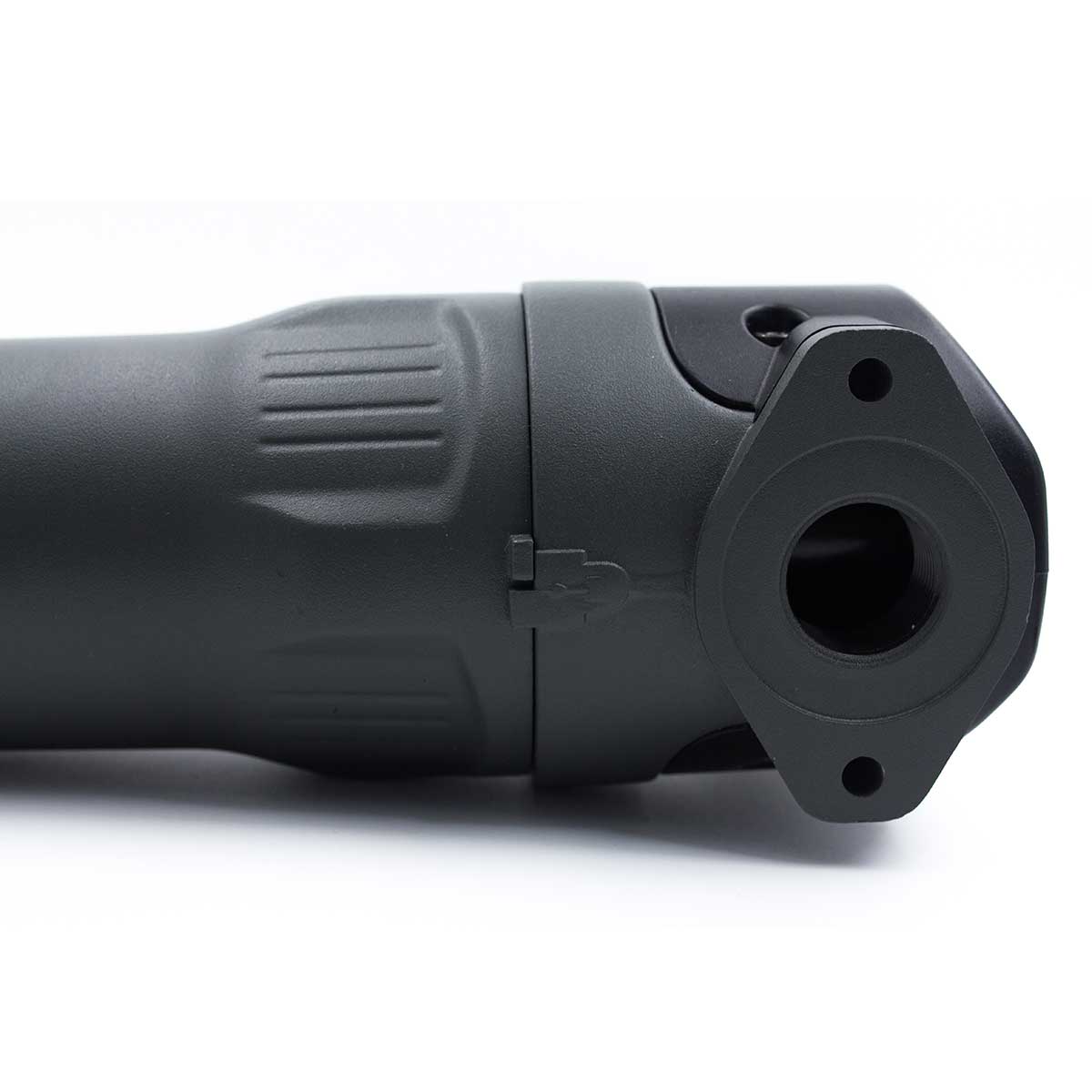
| Connection | G 1/2″, G 3/4″, or G 1″ (BSPP) |
| Housing material | Aluminum alloy, anodized |
| Working medium temperature | 1.5…65°C |
| Filter C grade | Residual oil 3 ppm, initial ΔP 0.02 bar |
| Filter T grade | Coalescing, residual oil 0.1 ppm, initial ΔP 0.06 bar |
| Filter A grade | Coalescing, residual oil 0.01 ppm, ≤100,000 particles 1–5 μm/m³, initial ΔP 0.07 bar |
| Replacement element | FJ-020 (with suffix C / T / A) |
| Dimensions per filter (L×W×D) | 316 × 277 × 33 mm |
| Housing diameter | 91.5 mm |
| Housing height | 95 mm |
Important note on units: the values C 3 ppm / T 0.1 ppm / A 0.01 ppm represent the concentration of residual oil in the air leaving each stage (parts per million), not a particle size in microns. Micron (μm) is a separate characteristic of the filter element itself (the size of solid particles it captures); ppm and microns measure different things and don’t convert directly into one another. For stage A, the manufacturer additionally specifies a particle-count criterion — ≤100,000 particles sized 1–5 μm per m³.
Flow correction factor by pressure (for 7 bar = 1.0):
| Pressure, bar | 1 | 2 | 3 | 4 | 5 | 6 | 7 | 8 | 10 | 12 | 14 | 16 |
|---|---|---|---|---|---|---|---|---|---|---|---|---|
| Factor | 0.38 | 0.53 | 0.65 | 0.75 | 0.83 | 0.92 | 1.0 | 1.06 | 1.2 | 1.31 | 1.41 | 1.5 |
3. Design Features
Decoding the part number CJ-020 C/T/A:
| Element | Meaning |
|---|---|
| CJ | Precision filter series for air preparation ahead of painting (1.6 MPa) |
| 020 | Size (flow rate 2.3 Nm³/min) |
| C / T / A | Filtration grade of the element (coarse / fine coalescing / high-purity coalescing) |
Key design solutions:
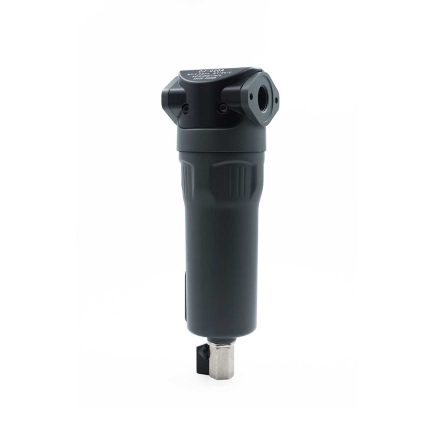
- High-strength aluminum alloy housing with internal and external anodizing — corrosion protection.
- Stainless steel diamond mesh — large air passage area, low flow resistance.
- Condensate drain (manual or automatic) with a sealing ring — no PTFE tape needed at installation.
- Parallel mounting of multiple housings possible — convenient for scaling flow capacity for a larger paint station.
- Replaceable FJ-020 elements with color-coded grade markings — simplifies verifying correct assembly during scheduled replacement.
4. Installation Recommendations
- Install the set after the dryer (refrigerant or desiccant) and before the spray gun.
- Follow the airflow installation order: C → T → A.
- Connection — BSPP (G), parallel thread. Seal only with a flat gasket (copper, aluminum, or paronite). Do not use PTFE tape.
- Mount vertically, with the condensate drain facing down. Ensure free access to the drain valves.
- Before first startup, purge the line without the filter elements installed, then fit clean elements.
- Installing pressure gauges before and after the set is recommended, to monitor the pressure drop.
- At flow rates close to the rated value (2.3 Nm³/min), use the correction factor from the table in Section 2.
Optional add-on: for precise pressure adjustment right before the spray gun, the set can be complemented with a panel-mount pressure regulator GRS300-10-J-C3-G (3/8″, SHPI Taiwan). The regulator has no filter of its own and is designed for already-clean air — exactly the preparation the C→T→A chain provides. Note the difference in connection sizes: CJ-020 has G1/2″/G3/4″/G1″ ports, while the GRS300-10 has a 3/8″ port, so a reducing fitting will be needed.
Important: filters in the CJ series do not include a lubricator. If your pneumatic tool requires lubrication, install a separate lubricator after filter A.
5. Analogues and Comparison
No exact cross-references with SMC, Festo, Camozzi, Parker, Atlas Copco, or Domnick Hunter part numbers are available in open sources. Equivalent selection is based on parameters:
| Parameter | CJ-020 C/T/A | Reference for selecting an equivalent |
|---|---|---|
| Flow | 2.3 Nm³/min | SMC AFF/AFD/AFM (size ~20–30), Festo MS6/MS9, Camozzi MX |
| Pressure | 1.6 MPa | Most industrial filters are rated for 1.0–1.6 MPa |
| Purity classes | C 3 ppm / T 0.1 ppm / A 0.01 ppm | Correspond to ISO 8573-1 oil classes 3 / 2 / 1 |
Ready-made painting filter sets from other brands (real functional equivalents):
| Model | Stages | Flow | Inlet/Outlet | Features |
|---|---|---|---|---|
| SATA filter 484 (three-stage) | Ceramic pre-filter (bronze powder agglomerate, 5 μm) → microfiber fine filter (0.01 μm) → activated carbon filter | 3600 Nl/min at 6 bar | 1/2″ inlet | Built-in pressure regulator and exhaust module, two quick-connect couplings for respiratory protection, max inlet pressure 15 bar, max outlet 10 bar, up to 60°C |
| Walcom FSRD 3 (60123/11) (four-stage, modular) | Condensate filter (synthetic fiber, 5 μm, auto-drain) → oil separator (0.01 μm, manual drain) → silica gel dryer (99.99%) → silica gel dust filter (5 μm) | 1200 l/min at 6 bar | F3/4″ inlet, 2×M1/4″ outlet | Diaphragm regulator with automatic overpressure relief, contamination indicator, silica gel condition sight windows, max inlet pressure 12 bar |
Neither option is a direct one-to-one replacement for CJ-020: SATA and Walcom have a different stage composition (including drying and/or carbon adsorption, which CJ-020 doesn’t have separately from C/T/A) and different connection sizes. Compare based on the actual flow and pressure of your paint line, not just the number of stages.
Comparison within the CJ lineup:
| Model | Flow |
|---|---|
| CJ-010 | 1.2 Nm³/min (smaller) |
| CJ-020 | 2.3 Nm³/min (this set) |
| CJ-030 | 3.5 Nm³/min (larger) |
6. Common Mistakes
- Installing filters in the wrong order (for example, A before C) — quickly clogs the fine elements with particles the coarse stage should have captured.
- Using PTFE tape on the parallel G thread — risk of tape shredding into the airflow and contaminating the paint with sealant particles.
- Installing without a dryer ahead of the set — condensate quickly disables the coalescing T and A elements.
- Ignoring the pressure drop — operating with ΔP above 0.5–0.7 bar sharply degrades air purification quality and increases compressor energy consumption.
- No regular condensate draining — leads to water and oil accumulating inside the filter housing.
- Using the CJ set without a separate lubricator on tools that require constant lubrication.
- Comparing filters by ppm alone or by microns alone — these are different characteristics (see Section 2); when comparing to equivalents (SATA, Walcom), check both figures separately rather than substituting one for the other.
7. Application Areas
- Spray guns (HVLP, LVLP) — air preparation right before atomization
- Paint booths — supplying clean air to painting stations
- Lacquer and protective coating application lines by spraying
8. Expert Opinion
Vitali Boluchevski, Lead Engineer, Acvatron SRL, 18 years of experience:
“The CJ-020 C+T+A set is a practical, economical solution for small and medium paint stations with flow up to 2–2.5 m³/min. The anodized aluminum housing and quality coalescing elements consistently deliver air with 0.01 ppm residual oil. The key is to install a dryer correctly ahead of the filters and keep an eye on the pressure drop. If you need precise pressure stabilization right at the gun, not just at the line’s inlet, it’s worth fitting a panel regulator like the GRS300-10 after filter A: it doesn’t replace filtration, but it removes the pressure fluctuations that otherwise show up as an uneven spray fan. With timely element replacement, the set lasts a long time and pays for itself through reduced paint defects.”
9. FAQ
Can I use only filter A, without C and T? No. Filter A will quickly clog with large particles and oil. The three-stage C → T → A scheme is mandatory.
What dryer is needed ahead of this set? A refrigerant dryer with a dew point of +3…+5°C is sufficient for most painting work. For critical coatings, a desiccant dryer is recommended.
How often should the elements be replaced? Based on pressure drop (recommended no more than 0.5–0.7 bar) or per the manufacturer’s schedule (typically 6–12 months). Element A is replaced more often with high oil content at the inlet.
Is the set suitable for 10 bar pressure? Yes, the maximum working pressure is 1.6 MPa (16 bar). At 10 bar, flow increases by roughly 1.2x (see the correction table in Section 2).
What’s the difference between ppm and microns in filter specifications? These are different quantities. Micron is the size of particles captured by the filter element (mechanical filtration). Ppm is the concentration of residual oil in the air leaving a stage (chemical/aerosol purification). CJ-020 states ppm oil figures for all three stages, plus a separate particle-count criterion for stage A; equivalents like SATA and Walcom often describe their final stage in microns (~0.01 μm) — that’s not the same unit as ppm, even though both figures describe, in a general sense, the “fineness” of purification.
Can this set be complemented with a pressure regulator? Yes, a separate pressure regulator (such as the panel-mount GRS300-10-J-C3-G) can be installed after filter A for precise pressure adjustment right before the gun. It has no filter of its own, so it must be installed downstream of already-clean air, not in place of one of the C/T/A stages.











Reviews
Clear filtersThere are no reviews yet.