











Filters for Screw Compressors: Oil Filter, Air Filter and Oil Separator — Replacement and Selection Guide

Air Filter
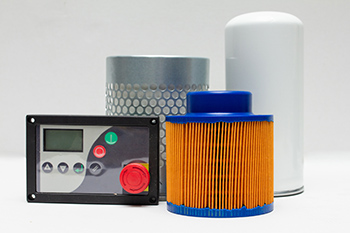
The air filter is the first barrier between the environment and the screw block. It traps dust, abrasive particles, and foreign matter before they enter the compression chamber.
The operating clearances of a screw block are measured in microns. Even fine dust acts like sandpaper inside those clearances, gradually destroying the mirror-polished rotor surfaces and the bearings. The air filter keeps those surfaces intact.
What happens when the air filter is blocked: Micro-particles bypass the filter and enter the screw pair. Rotor wear accelerates sharply. Compressor output drops 15–25% with no reduction in power consumption.
Replacement interval: 2,000–3,000 operating hours under normal conditions; 500–1,000 hours in dusty environments (woodworking, agriculture, construction sites).
Oil Filter
The oil filter cleans the compressor oil that circulates through the lubrication and cooling system of the screw block. It removes metal shavings, wear products, and mechanical particles before they reach the rotor bearings.
What happens when the oil filter is blocked: Oil stops circulating normally through the block — the bypass valve opens. Contaminated oil flows directly to the bearings, sharply accelerating their wear. Oil temperature rises, causing oil film degradation and rotor scoring. The thermal protection system triggers an emergency shutdown.
Replacement interval: 2,000–4,000 operating hours depending on oil type (mineral or synthetic) and operating conditions.
Oil Separator (Oil-Mist Separator)
The oil separator is the most expensive and most critical of the three filters. Located inside the oil-air vessel, it separates oil droplets from the compressed air before it is delivered to the distribution line. A functioning oil separator keeps residual oil content in the output air below 3–5 mg/m³.
What happens when the oil separator is blocked: Pressure drop across the separator exceeds 0.8–1.0 bar — energy consumption rises 7–12%. Oil breaks through into the distribution line, contaminating tools, fixtures, and products. In spray painting or food processing this means scrapping an entire batch. Excessive pressure on the separator housing creates a risk of rupture.
Replacement interval: 3,000–4,000 operating hours or once per year — whichever comes first.
Technical Parameters: What to Check When Selecting a Filter
| Parameter | Air Filter | Oil Filter | Oil Separator |
|---|---|---|---|
| Filtration rating | 10–25 µm | 10–20 µm | ≤ 0.1 µm (residual oil < 3 mg/m³) |
| Working pressure | — | up to 25 bar | up to 14–20 bar |
| Replacement interval | 2,000–3,000 h | 2,000–4,000 h | 3,000–4,000 h |
| Housing material | Paper / non-woven | Metal + paper | Multi-layer glass fibre |
| Pressure drop (new) | 15–25 mbar | 30–50 mbar | 100–150 mbar |
| Pressure drop (replace) | >80 mbar | >150 mbar | >800–1,000 mbar |
| Replacement indicator | Inlet vacuum gauge | Differential pressure gauge | Differential pressure gauge |
Filter Compatibility with Compressors from the Acvatron Catalogue
MZB Screw Compressors (China)
MZB-10A (7.5 kW, direct drive) and MZB-20A-400FD (15 kW, inverter, 16 bar for laser cutting) use unified Chinese-type filter elements. The air filter on these models is a cartridge with threaded or bayonet mounting; the oil filter is a threaded spin-on canister; the oil separator is a cylindrical glass-fibre element inside the oil-air vessel.
The ZM-5.5-160 (5.5 kW, inverter, with 160 L receiver) — a model for small workshops and service stations — uses the same filter family as the MZB line. Oil filter replacement is combined with the scheduled oil change every 2,000 operating hours.
Important: on MZB compressors with inverter control, filters are replaced strictly by operating hours, not by calendar — the hour counter reading is displayed on the controller panel.
AIRPOL Screw Compressors (Poland)
AIRPOL belt-drive compressors with receivers use European filter elements. A distinctive feature is an air filter clogging indicator (vacuum sensor) that signals the need for replacement before output begins to fall. AIRPOL oil separators are rated for residual oil content <3 mg/m³ per ISO 8573-1 class 3.
Mattei Rotary Vane Compressors (Italy)
Mattei BLADE series compressors have a fundamentally different lubrication design: the oil volume in the system is significantly lower than in screw compressors, and the oil filter operates in a less demanding regime. Oil filter service life on Mattei reaches 4,000 operating hours on synthetic oil. The Mattei oil separator is a proprietary design rated at residual oil content <1 mg/m³.
5 Reasons to Replace Filters on Schedule — and Not to Save on Them
1. Protecting a screw block worth 30–60% of the compressor price. A full filter set replacement costs €80–200 depending on compressor power. Replacing a worn screw block costs €1,500–10,000. Saving on filters is a direct route to a major overhaul.
2. Stable output without degradation. A clogged air filter reduces compressor output by 15–25% with no reduction in power consumption. Timely replacement restores rated airflow without any other intervention.
3. Energy savings. A compressor running with a blocked oil separator consumes 7–12% more electricity. For a 22 kW compressor running continuously, that is 1.5–2.5 kWh of excess consumption per hour, or 1,000–2,000 kWh per month.
4. Meeting compressed air purity requirements. A properly functioning oil separator delivers residual oil content <3 mg/m³ per ISO 8573-1 class 3. This is a mandatory requirement for food production, pharmaceutical manufacturing, and spray painting operations. Using contaminated air is a process regulation violation.
5. Maintaining manufacturer warranty. MZB, AIRPOL, and Mattei specify mandatory filter replacement intervals in their warranty conditions. Failure to comply is grounds for voiding warranty claims.
Applications: Where Regular Filter Replacement Is Critical
Metalworking and mechanical engineering — abrasive dust from metal machining clogs air filters on MZB and AIRPOL compressors exceptionally quickly.
Woodworking and furniture production — fine wood dust penetrates a compromised air filter housing; replacement every 500–800 hours.
Spray painting and lacquering — even trace oil breakthrough past the separator contaminates an entire production batch; ISO 8573-1 class 1–2 is mandatory.
Food production and winemaking — compressed air contacts the product; a certified oil separator and inline filters to class H (sterile) are required.
Tyre fitting and automotive service — oil-contaminated air damages paint finishes and contaminates brake systems during blow-off.
Medical and pharmaceutical — oil-free compressed air class is achieved in part by a correctly functioning oil separator.
Filter Replacement Schedule
| Filter type | Standard interval | In high-dust environments | Combined with |
|---|---|---|---|
| Air filter | every 2,000–3,000 h | every 500–1,000 h | scheduled maintenance |
| Oil filter | every 2,000–4,000 h | every 1,000–2,000 h | oil change |
| Oil separator | every 3,000–4,000 h or once per year | every 2,000 h | major compressor service |
Acvatron rule: at every oil change, replace the oil filter and the separator. This simple scheme works without additional tracking.
“We regularly see MZB and AIRPOL compressors arriving for service with 8,000–10,000 operating hours and no filter replacements whatsoever. The picture is always the same: the oil separator has lost effectiveness, oil is in the distribution line, and the air filter is so blocked that the compressor is running with inlet vacuum of −0.2 bar instead of the rated −0.05 bar. The result — premature rotor wear and a screw block replacement at 30–40% of the cost of a new compressor. All of this could have been avoided by replacing three filters for €150–200 once a year. Don’t economise on consumables — it is the most expensive economy in the compressor business.”
Vitalie Bolucevski, Lead Engineer, Acvatron SRL — 15 years in compressor equipment
Standards and Regulations
- ISO 8573-1:2010 — compressed air purity classes (particles, moisture, oil)
- ISO 12500 — test methods for compressed air filters
- GOST 12.2.016-81 — safety requirements for compressor equipment
- ISO 1217:2009 — compressor performance measurement methods
FAQ
❓ Can non-original (equivalent) filters be used for MZB and AIRPOL compressors?
Yes, provided the equivalent exactly matches the geometry, thread specification, and declared filtration rating of the original. The main risk with a non-original filter is a mismatched pressure drop: a filter that is too dense creates excessive resistance; one that is too permissive passes contaminants. Acvatron supplies filters selected for specific models from the catalogue, with verified performance characteristics.
❓ How to tell it’s time to replace the oil separator if there is no differential pressure gauge?
Indirect signs: oil staining on the receiver walls and distribution line, increased oil consumption (top-ups more frequent than usual), rising discharge temperature under constant load, longer time to reach working pressure. Any of these signs is grounds for an instrumental pressure drop check and separator replacement.
❓ Can the air filter life be extended by blowing it out with compressed air?
Yes, a single blow-out from outside inward removes surface contamination and can extend filter life by 20–30%. However, blowing the same element more than twice is not recommended: the filter medium structure is damaged, micropores enlarge, and the filter begins to pass particles of the rated size. Replacement remains the only reliable solution.