











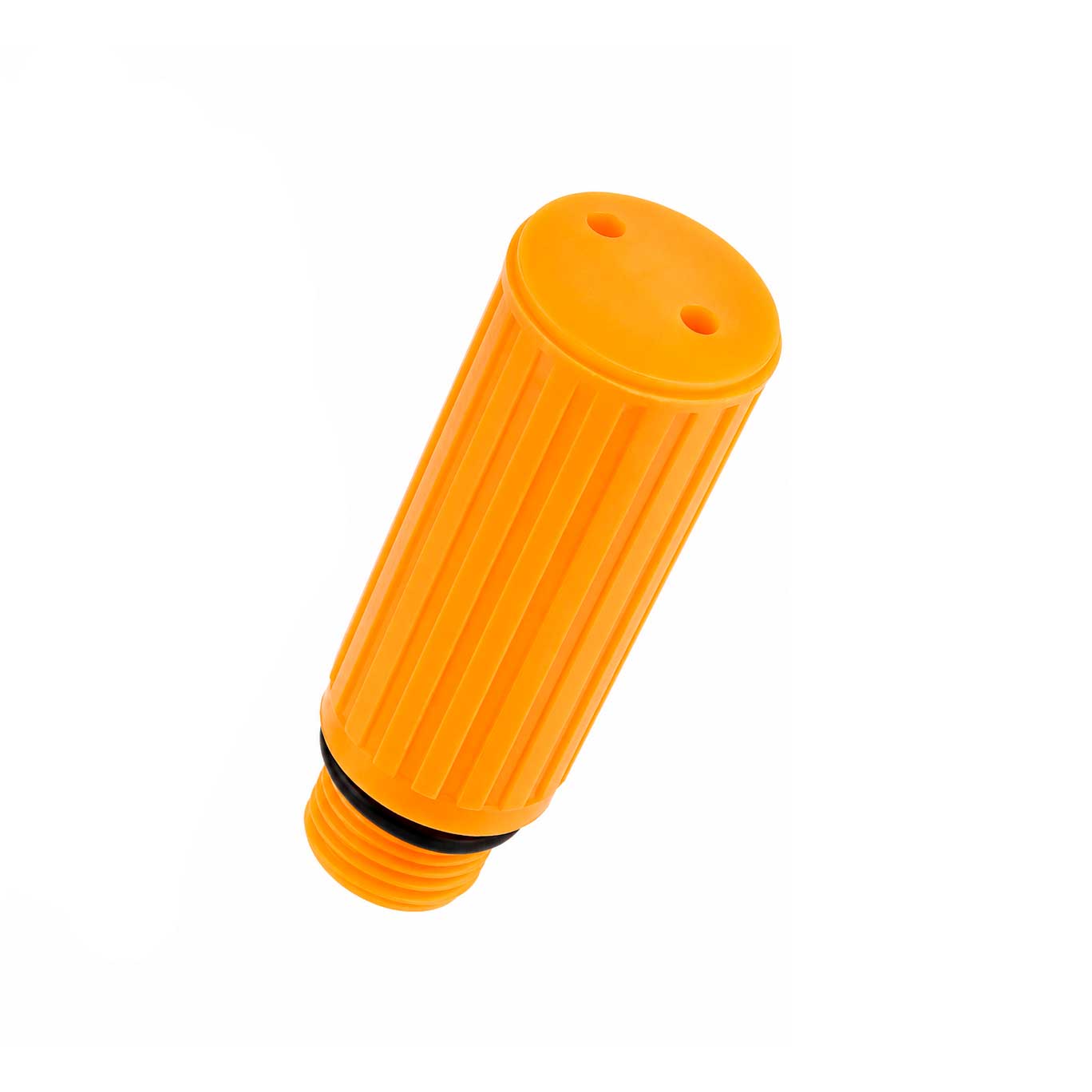

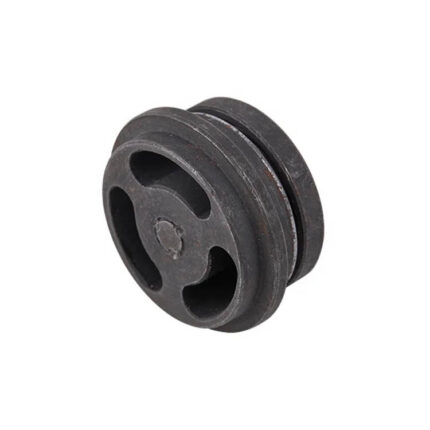
A breather valve is a ventilation valve with a filtering element installed on the oil filler neck of a reciprocating compressor or receiver. During compressor operation, excess pressure builds up in the crankcase due to heating of air and oil; the breather valve allows this air to escape to the atmosphere without letting oil be thrown out through the crankshaft oil seals. At the same time, the filter element retains dust that enters the crankcase during cooling and contraction of air inside.
The body is made of plastic (polyamide PA6), resistant to mineral oils and condensate. Inside — brass or nylon mesh with 100–150 μm cell and a labyrinth oil separator: air passes through a zigzag channel, oil particles settle on the walls and drain back into the crankcase. Thread G 3/8″ is parallel, requires sealing with a copper washer or PTFE tape. Head diameter for wrench — 22 mm. Weight — approx. 18 g. Filter element service life — 500–1000 motor hours in clean conditions, 250–500 motor hours in dusty workshops.
Technical Specifications
| Parameter | Value |
|---|---|
| Purpose | Breather valve (ventilation cap) for compressor |
| Thread type | G 3/8″ (male parallel, ISO 228) |
| Thread outer diameter, mm | 16.66 |
| Overall body height, mm | 60 |
| Wrench head diameter, mm | 22 |
| Body material | Plastic (polyamide PA6) |
| Filter mesh material | Brass / nylon |
| Filter mesh cell, μm | 100–150 |
| Oil separator presence | Labyrinth, built-in |
| Operating temperature, °C | −20…+80 |
| Maximum pressure in crankcase, bar | up to 1.5 |
| Air flow capacity, l/min | up to 50 |
| Air filtration degree, μm | 100–150 |
| Thread sealing | Copper washer or PTFE tape |
| Standard | ISO 4414 |
| Compatibility | Reciprocating compressors with G 3/8″ thread on neck |
| Filter element service life, motor hours | 500–1000 |
| Weight, g | ~18 |
💡 Expert tip: Do not confuse the breather valve with a blank plug. If you screw in a blank plug instead of the breather — pressure in the crankcase will rise to 2–3 bar when heated, and oil will leak through the crankshaft oil seals. Sign of a clogged breather: oil leaks from the bottom of the compressor with good oil seals and correct oil level. 10-second check: remove the breather, run the compressor for 30 seconds — if oil gushes from the neck, the breather was completely clogged.
Brand Equivalents
| Brand | Equivalent article | Series | Standard | Key parameter | Note |
|---|---|---|---|---|---|
| FIAC | 1121230015 | — | — | G 3/8″, H=60 mm | Italian original, premium segment |
| Abac | 8973035550 | — | — | G 3/8″, H=58 mm | Full compatibility by thread and dimensions |
| Balma | NS18L | — | — | G 3/8″, H=60 mm | Italian production, stainless steel mesh |
| Fubag | 31010 | — | — | G 3/8″, H=62 mm | Height 2 mm greater — check hood clearance |
| Калибр | Сапун 3/8″-60 | — | — | G 3/8″, H=60 mm | Russian equivalent, steel body |
⚠️ Note: Breather valve 3/8″×60 mm is fully compatible by G 3/8″ thread, 60 mm height, and 22 mm head diameter with Italian originals FIAC and Abac. Labyrinth oil separator geometry and filter surface area are identical. PA6 plastic body withstands standard crankcase temperatures of reciprocating compressors up to +80 °C and oil media at a price 40–60 % lower than premium brands.
5 mandatory parameters for compatibility check:
-
Thread type on oil filler neck — G 3/8″ (parallel) or M16×1.5 (metric). Our breather is G 3/8″.
-
Breather height — no more than 65 mm with limited clearance under compressor protective hood.
-
Wrench head diameter — 22 mm (standard for compressor breathers).
-
Oil separator presence — for compressors with intensive oil splashing, a labyrinth breather is required, not just mesh.
-
Temperature in installation zone — above +80 °C, plastic body deforms; our breather is rated up to +80 °C.
Signs of Wear and When to Replace
-
Oil leaks from bottom of compressor with good oil seals — breather is clogged, crankcase pressure increased, oil is forced out through seals.
-
Excessive pressure in crankcase — sharp hiss of air when removing oil plug; norm is weak exhalation.
-
Contaminated filter mesh — visible deposits of dust, oil mixture, and carbon on mesh surface; cell clearance reduced.
-
Damaged body thread — thread stripped during tightening, head deformation; cause — excessive force or misalignment during installation.
-
Cracking of plastic body — consequence of wrench tightening above 15 N·m or contact with aggressive solvents.
Replacement Algorithm
-
Stop the compressor and wait for cooling. Working with a hot crankcase (above +60 °C) is dangerous due to burns; oil is more fluid and will leak when unscrewing the breather.
-
Unscrew the old breather. Use a 22 mm wrench. If seized — treat thread with penetrating lubricant and wait 10 minutes.
-
Clean the thread in the neck. Remove carbon, old sealant, and copper washer remnants with a scraper or brush. Thread must be clean — otherwise the new breather will sit crooked.
-
Install the seal. New copper washer 1–1.5 mm thick or apply 2–3 turns of PTFE tape clockwise on the breather thread.
-
Screw in the new breather. Tighten by hand until stop, then tighten with 22 mm wrench at 10–15 N·m (approximately “by hand + quarter turn”). Do not overtighten — plastic body cracks and thread in aluminum crankcase cover strips.
-
Start the compressor and check for leaks. Run 10–15 minutes, check threaded joint with a tissue — there should be no leaks or oil mist.
Why Acvatron SRL
Engineering selection, not “add to cart”
Acvatron SRL managers clarify your compressor model before sale. Breather 3/8″×60 mm fits FIAC, Abac, Balma and their Chinese equivalents with tall necks. If you have a compressor with a low hood — we recommend the 52 mm version. We check against the catalog and send photos for confirmation.
Complete maintenance kit and consumables in stock
For the breather we have in stock in Chișinău: crankshaft oil seals 22×35×7, compressor oil, copper sealing washers, PTFE tape. If leaks are found during breather replacement — order everything for repair in one shipment.
Available at Chișinău warehouse
Stock item. Pickup on the day of order or delivery across Moldova. For legal entities — VAT shipment and full documentation.
After-sales technical support
The engineer call does not end after payment. We explain how to distinguish a clogged breather from worn oil seals, what clearance is needed under the hood, how often to change the filter in your operating conditions.
Documents for legal entities
Invoice, waybill, conformity certificate. We work with auto services, furniture factories, construction crews, and government tenders. Payment by bank transfer, deferred payment for regular customers.
Expert Opinion
Vitali Bolucevschi, Chief Engineer at Acvatron SRL, 15 years in the industry“The most common mistake when diagnosing oil leaks is automatic replacement of crankshaft oil seals. A mechanic sees oil from the bottom of the compressor, orders seals, disassembles the head, replaces them, and a week later the leaks are back. The cause is not the seals, but the clogged breather. When the breather is clogged with dust and carbon, crankcase pressure rises to 0.5–0.8 bar above atmospheric. Seals are designed to work at zero differential pressure; at excessive pressure, oil breaks through them in 2–3 days. My advice: before disassembling the head, remove the breather and check blow-through. Blow into it with your mouth — if the resistance is like a clogged pipe, change the breather. It costs 50 lei and 5 minutes of work instead of 500 lei and 3 hours of disassembly.”
Handling Objections
“I will buy cheaper at the market/junkyard”
Breathers from auto markets or junkyards often have clogged mesh, stripped thread, or body cracks from overtightening. Saving 20–30 lei turns into repeated compressor disassembly within a month. At Acvatron SRL — new breathers with clean thread and intact mesh, stock replacement of defective items.
“The required size/article is not available”
If breather FL 3/8″×60 mm does not fit — we have breathers in stock with threads G 1/4″, G 1/2″, M16×1.5, M22×1.5; heights 30, 40, 52, 55 mm; with plastic and metal heads. Send a photo of the old breather with a ruler — we will select an equivalent by dimensions.
“I don’t know if it is compatible with my compressor”
Send a photo of the compressor nameplate (brand, model) and a photo of the old breather next to a ruler. We check against the catalog and confirm compatibility in 5 minutes. If you have a rare model — we will manufacture an adapter to order.
The Problem You Have Already Faced
-
Oil leaks from the bottom of the compressor, although the seals are new — cause: breather is clogged, crankcase pressure forces oil out through seals.
-
Loud hiss when removing oil plug — splashes on the wall — cause: excessive crankcase pressure due to breather blockage; norm is weak exhalation.
-
Compressor oil turns black quickly, sand appears — cause: torn breather mesh, dust enters directly into crankcase and mixes with oil.
-
Thread in neck is stripped, new breather won’t screw in — cause: previous breather was overtightened above 20 N·m; thread restoration with tap or insert installation required.
-
Plastic breather body cracked during tightening — cause: excessive wrench force used; plastic requires careful hand installation + light tightening.
The hidden cost of the wrong choice: one head disassembly due to false diagnosis (“replacing seals instead of breather”) costs more than 10 new breathers. Do not calculate the purchase price — calculate the cost of the mistake.
FAQ
❓ How often should the breather be changed on a reciprocating compressor?
In standard conditions (clean workshop, low dust) — every 500 motor hours or once every 6 months. In construction conditions, carpentry shops with sawdust — every 250 motor hours or once every 3 months. Urgent replacement sign — oil leaks from below with good oil seals.
❓ Can the old breather be washed and reinstalled?
It can be washed with gasoline or solvent, but the filter mesh resource is only partially restored. After washing, mesh cells remain clogged with carbon microparticles, and flow capacity drops by 30–50 %. For a working compressor, replacement is recommended, not washing.
❓ Why does oil still escape through the breather?
Three causes: 1) oil is filled above the maximum mark — level reaches the neck; 2) compressor operates in an inclined position — oil “splashes” into the breather; 3) piston rings are worn — gas blows from the cylinder create excessive pressure, the breather cannot cope. Check oil level and installation horizontalness.
❓ What is the difference between a breather valve and a blank plug?
The breather has a ventilation channel and filter mesh — it “breathes,” equalizing pressure in the crankcase. The blank plug seals the neck completely. If you screw in a blank plug instead of the breather — within 10–15 minutes of operation oil will leak through the seals, and within an hour the seal unit may rupture.
❓ Is this breather suitable for a screw compressor?
No. Screw compressors have a closed oil circuit with a separator and a special breather with a check valve rated for 4–8 bar pressure. The FL breather is rated for atmospheric pressure and is intended only for reciprocating compressors and receivers.








Reviews
Clear filtersThere are no reviews yet.