







Air Brake Tubing for Heavy Commercial Vehicles: A Complete Guide — Materials, Standards, Selection

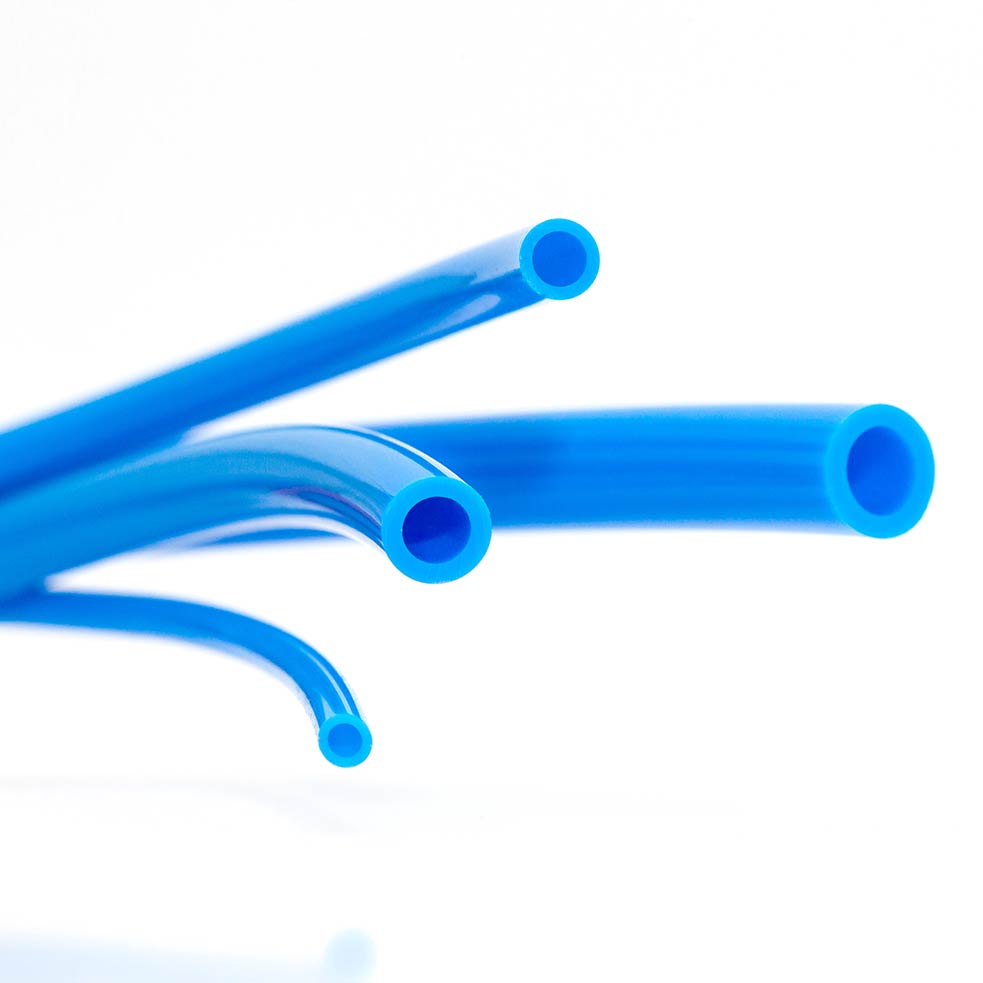
Air brake tubing is not general-purpose pneumatic hose. These are safety-critical components governed by separate international standards. A mistake in material or size selection is not grounds for a warranty claim: it is a potential brake failure at speed. This article covers everything: how pneumatic braking systems work, which materials are approved, what the DIN 73378, DIN 74324, ISO 7628, SAE J844 and DOT FMVSS 571.106 standards actually require, and how to select the right tubing for a specific application.
Part 1. How the Pneumatic Braking System of a Heavy Vehicle Works
Trucks, buses and trailers use a pneumatic braking system (air brake system) — unlike the hydraulic system of passenger cars. The operating principle is the opposite in terms of safety logic: under normal conditions, pressurised air holds the brakes in the released position; if pressure is lost (broken tube, leak, trailer disconnection), the brakes apply automatically. This is the built-in «fail-safe» protection.
Typical system pressure: 6.5–8.5 bar (90–125 PSI). Standard operating parameters: 10.3 bar (150 PSI) working pressure; up to 34–55 bar (500–800 PSI) short-term permissible pressure; 80+ bar (1,150–1,160 PSI) burst pressure for certified tubing.
The system uses tubing for different functions:
- Main supply lines — connect the compressor to the reservoir and main valves
- Control lines (tractor → trailer) — «yellow» (emergency) and «blue» (service) coiled hoses
- Auxiliary lines — air suspension bag control, parking brake, clutch
- ABS/EBS lines — with heightened requirements for dimensional accuracy and stability
Part 2. Why Tube Material Is a Question of Approval, Not Preference
An air brake system tube must operate reliably in conditions that destroy ordinary pneumatic tubing:
| Stress factor | Typical values | Consequence of tube failure |
|---|---|---|
| Working pressure | 6.5–8.5 bar (90–125 PSI) | Leak → loss of braking |
| Under-bonnet temperature | up to +120–130°C | Tube softening and deformation |
| Frost | down to −40°C and below | Brittle fracture at a joint |
| Fuel and oil | Continuous spray contact | Swelling and loss of strength |
| Road salt/de-icers | Winter operation | Corrosion and material degradation |
| Vibration | Constant, thousands of km | Fatigue cracking at fastening points |
| Abrasive (grit, stone chips) | Roads and off-road | Abrasion of the tube outer wall |
| UV radiation | Exposed sections under the chassis | Embrittlement and cracking |
A standard polyurethane tube (PU) that performs excellently in industrial pneumatics will not pass certification in a truck air brake system — it cannot withstand temperatures above +60°C and swells on contact with hydrocarbons. The only material approved for brake lines under the main international standards is polyamide (PA), primarily PA12 and PA11.
Part 3. Materials: PA11 vs PA12 — What’s the Difference
Both materials are varieties of nylon (polyamide) but differ in origin, properties and applications.
| Parameter | PA11 (Polyamide 11) | PA12 (Polyamide 12) |
|---|---|---|
| Raw material | Castor oil (bio-based) | Petrochemical feedstock |
| Operating temperature | −40°C … +120°C | −40°C … +120°C |
| Moisture absorption | ~1.8% (higher than PA12) | ~0.25% (very low) |
| Flexibility | Slightly softer than PA12 | Good, slightly stiffer than PA11 |
| Fuel/oil resistance | High | High |
| Chemical resistance | Good | Good |
| UV resistance (black) | Excellent (carbon black) | Excellent (carbon black) |
| Dimensional stability | Good | High (absorbs less moisture) |
| Sustainability | Bio-based (renewable feedstock) | Petrochemical |
| Price | Typically more expensive than PA12 | More affordable than PA11 |
| Key brands | Rilsan® (Arkema) | Vestamid® (Evonik), Grilamid® (EMS) |
| Typical market | European market, aerospace, medical | Global market, heavy transport |
💡 Practical conclusion: for most heavy vehicle air brake applications, PA12 is the de facto standard due to its exceptionally low moisture absorption (7× lower than PA11) and high dimensional stability. PA11 is preferred where sustainability is important or where traditional European OEM specifications apply.
Important: air brake tubing must use only 100% virgin material — recycled polyamide is not permitted. This is a requirement of all major standards and a mandatory condition for certification.
Part 4. International Standards for Air Brake System Tubing
Air brake tubing for heavy vehicles must conform to at least one of the following standards depending on the market. Here is what each actually requires:
DIN 73378 (Germany / Europe) — the basic polyamide tubing standard
The main European standard for polyamide tubing for motor vehicles. Sets requirements for dimensions, tolerances, working pressure, burst testing, oil and fuel resistance, low-temperature flexibility. Temperature range: −40°C … +130°C (heat-stabilised grades). Applies to PA11 and PA12 tubing in outside diameters from 4 to 25 mm.
DIN 74324 (Germany / Europe) — specifically for braking systems
A more rigorous standard developed specifically for pneumatic brake lines of trucks and trailers. In addition to DIN 73378 requirements it specifies: enhanced burst pressure requirements, testing for resistance to road de-icers (salt), cyclic vibration testing, tubing marking requirements. Available in black only — for maximum UV resistance through carbon black pigmentation.
ISO 7628 (International standard)
An ISO international standard harmonised with DIN 73378. Sets requirements for polyamide tubing for braking and control systems of motor vehicles. Used in European and Asian markets; the primary standard for international truck manufacturers (Mercedes, Volvo, Scania, DAF, MAN). Frequently cited together with DIN 74324 in OEM specifications.
SAE J844 (USA / North America)
The Society of Automotive Engineers standard for nylon tubing used in braking systems. Defines two types:
- Type A (non-reinforced) — for tubing under 5/16″ (8 mm) OD. Used for auxiliary control lines.
- Type B (reinforced) — for tubing 3/8″ (10 mm) OD and above. Has a polyester fibre braid for higher burst strength. Used in main brake circuits.
Imperial sizes: 1/8″ to 3/4″ OD. Working pressure: up to 10.3 bar (150 PSI).
DOT FMVSS 571.106 (USA — Federal Safety Standard)
The US Federal Motor Vehicle Safety Standard, paragraph 571.106. This is a mandatory requirement for all brake hoses and tubing operated on US roads — unlike SAE J844, which is voluntary. It specifies: marking requirements (manufacture date, type, pressure), burst testing, low-temperature bend testing, oil and fuel resistance testing, corrosion resistance testing. Tubing marked «DOT» has passed all these tests.
⚠️ Important when selecting: tubing certified only to DIN 73378 is not automatically certified to DIN 74324 or SAE J844. For brake lines, require a certificate specifically for the standard relevant to your market and application.
Part 5. Sizes and Marking
European sizes (metric, DIN 73378 / ISO 7628)
| OD, mm | ID, mm | Wall, mm | Typical application |
|---|---|---|---|
| 4 | 2.5 | 0.75 | ABS/EBS sensors, control lines |
| 6 | 4.0 | 1.0 | Auxiliary control lines |
| 8 | 5.5 or 6.0 | 1.0–1.25 | Control and auxiliary lines |
| 10 | 7.5 or 8.0 | 1.0–1.25 | Brake circuits, air suspension |
| 12 | 9.0 or 10.0 | 1.0–1.5 | Main tractor brake lines |
| 14 | 11.0 | 1.5 | Main tractor/trailer circuits |
| 16 | 12.5–13.0 | 1.5–1.75 | Main lines on heavy-haul vehicles |
US sizes (imperial, SAE J844)
| OD, inch | OD, mm | ID, mm | SAE J844 type |
|---|---|---|---|
| 1/8″ | 3.18 | 1.60 | Type A |
| 5/32″ | 3.97 | 2.38 | Type A |
| 1/4″ | 6.35 | 4.35 | Type A |
| 5/16″ | 7.94 | 5.55 | Type A |
| 3/8″ | 9.52 | 7.15 | Type B (reinforced) |
| 1/2″ | 12.70 | 9.52 | Type B (reinforced) |
| 5/8″ | 15.88 | 12.70 | Type B (reinforced) |
| 3/4″ | 19.05 | 15.88 | Type B (reinforced) |
Colour coding
- Black — DIN 74324, maximum UV resistance, main brake circuits (mandatory colour under DIN 74324)
- Blue — tractor service brake line (to ISO/DIN)
- Yellow — emergency/supply line (parking brake)
- Red — high-pressure designation (in some standards)
- Green — ABS system
- Orange / brown — auxiliary lines
Part 6. Stabilised Grades: HIPHL, PHL, PHLY
| Grade | Stabilisers | Typical application |
|---|---|---|
| PHL | Heat and light stabiliser | Standard applications, enclosed routing |
| PHLY | Heat stabiliser, light stabiliser + enhanced UV stabiliser | Exposed sections, direct solar radiation |
| HIPHL | High-performance heat and light stabiliser | Engine bay, high temperatures (up to +130°C) |
| PA12 with carbon black (black) | Carbon black pigment | Mandatory for direct UV exposure (per DIN 74324) |
💡 Practical rule: if the tube runs near the exhaust manifold or in the engine bay zone where temperatures may reach +100–130°C, choose grade HIPHL or a specially heat-stabilised type. Standard PHL is rated to +80°C for sustained exposure; above this temperature the tube gradually loses strength and hardens.
Part 7. Coiled Hoses — Tractor → Trailer
A separate category is coiled (spiral) connecting hoses between the tractor and trailer. They are made from the same polyamide materials (PA11 or PA12) but have a coiled form that provides:
- Shock absorption during manoeuvring (extension to 3–4× the relaxed length)
- Protection against ground contact when tension is lost
- Compact storage in the coiled state
Standard length: 3.5 m (4.5 m extended). Colour: yellow (emergency line) and blue (service line).
Part 8. Installation: What You Need to Know
Compression fittings vs crimp fittings
- Compression fittings (push-to-connect) — for tubing OD up to 12 mm in low- and medium-load lines
- Crimp fittings — for Type B (reinforced) tubing and all connections in main brake circuits
Note: push-in collet (one-touch) fittings such as XCPC SCF/ASC types used in industrial pneumatics are not intended for brake lines. Fittings conforming to SAE J844 or DIN 74324 are required for braking systems.
Routing rules
- Minimum bend radius 8–10 × OD (stiffer than PU tubing)
- Secure with clamps every 600–800 mm on straight runs
- Protect against abrasion at passes through metal edges — rubber or plastic grommet
- Thermal clearance from hot components (exhaust, brake discs) minimum 50 mm without additional shielding
- Tubes must have a small amount of slack (not run taut): longitudinal loads are possible as chassis geometry changes during travel
Part 9. Common Mistakes and Their Consequences
| Mistake | Consequence |
|---|---|
| Using PU tubing instead of PA in a brake circuit | Swelling from oil, deformation at temperature, brake failure |
| Using tubing without UV stabiliser (non-black) in exposed sections | Brittle cracking after 1–2 seasons, pressure loss |
| Wrong SAE J844 type: Type A instead of Type B in the main circuit | Insufficient burst pressure, deformation under working pressure |
| Using recycled polyamide | Unpredictable strength, failure at certification testing |
| Installation with excessive tension and small bend radius | Fatigue cracks at bends after a few thousand km |
| One-touch collet fittings instead of certified compression fittings | Tube pull-out under pressure, instant air loss |
Part 10. Air Brake Tubing vs Industrial Pneumatic Tubing: Key Differences
| Parameter | Air brake tubing | Industrial pneumatic (PU/PA) |
|---|---|---|
| Material | PA11 or PA12 (mandatory) | PU, PA, PE — any suitable material |
| Standard | DIN 74324 / SAE J844 / DOT FMVSS 571.106 | Industry norms, no mandatory standard |
| Temperature | −40…+130°C (heat-stabilised grades) | PU: −40…+60°C |
| Fuel/oil resistance | Mandatory (tested to standard) | Depends on material (PU — poor) |
| UV resistance | High (carbon black) | PU — poor; PA — good |
| Burst pressure (12 mm) | over 80 bar (per standard) | 30–50 bar (PU) |
| Raw material | 100% virgin material | Not regulated |
| Marking | Mandatory: date, standard, type | Not mandatory |
| Price | Higher (certification cost) | Lower for PU, comparable for PA12 |
Expert Opinion
“In my experience repairing pneumatic systems, the most common mistake is replacing brake tubing with whatever is on hand. A polyurethane tube seems to fit on pressure and size, but after six months it comes back with walls swollen from oil or stiff from cold. The braking system is not the place to cut corners on materials. PA12 to DIN 74324 costs more than an ordinary pneumatic tube, but that is the cost of safe operation. If you are buying tubing for brakes — demand a document proving conformity to the standard, not just the seller’s assurance that it’s PA12.”
Vitali Bolucevschi, Chief Engineer at Acvatron SRL, 15 years in the industry
FAQ
❓ Can an ordinary industrial PA12 tube be used in a truck air brake system?
No. An industrial PA12 tube may be made from recycled feedstock, without heat stabilisers and without testing to DIN 74324 or SAE J844. Brake lines require tubing with an explicit marking of the applicable standard and confirmed virgin material origin. Visually they may be indistinguishable.
❓ Why is DIN 74324 tubing only available in black?
Black means carbon black pigment has been added, which is the most effective and durable UV stabiliser for polyamides. Brake tubing is exposed to ultraviolet radiation throughout the vehicle’s life, and other colours (without carbon black) become brittle in exposed sections after a few years. The DIN 74324 standard made a clear decision — black only.
❓ What does «DOT approved» on tubing mean?
The «DOT» marking means conformity with the US Federal Motor Vehicle Safety Standard FMVSS 571.106. This is a mandatory requirement for vehicles operated on US roads. The tubing has passed burst pressure, low-temperature bend, oil and fuel resistance, and corrosion resistance testing, and carries the corresponding marking with date and manufacturer code.
❓ What is the difference between SAE J844 Type A and Type B?
Type A is non-reinforced tubing for diameters under 5/16″ (8 mm), used for auxiliary control lines. Type B is reinforced tubing with a polyester fibre braid for diameters of 3/8″ (10 mm) and above, used in main brake circuits. The burst pressure of Type B is significantly higher.
❓ What diameter tubing is needed for the main brake circuits of a truck?
It depends on the specific vehicle’s design. On European tractors (Mercedes, Volvo, Scania) the main circuits are most commonly 10–12 mm OD; ABS control lines are 4–6 mm OD. On US trucks the standard is 3/8″–1/2″ OD. For exact selection, consult the vehicle manufacturer’s service documentation.