









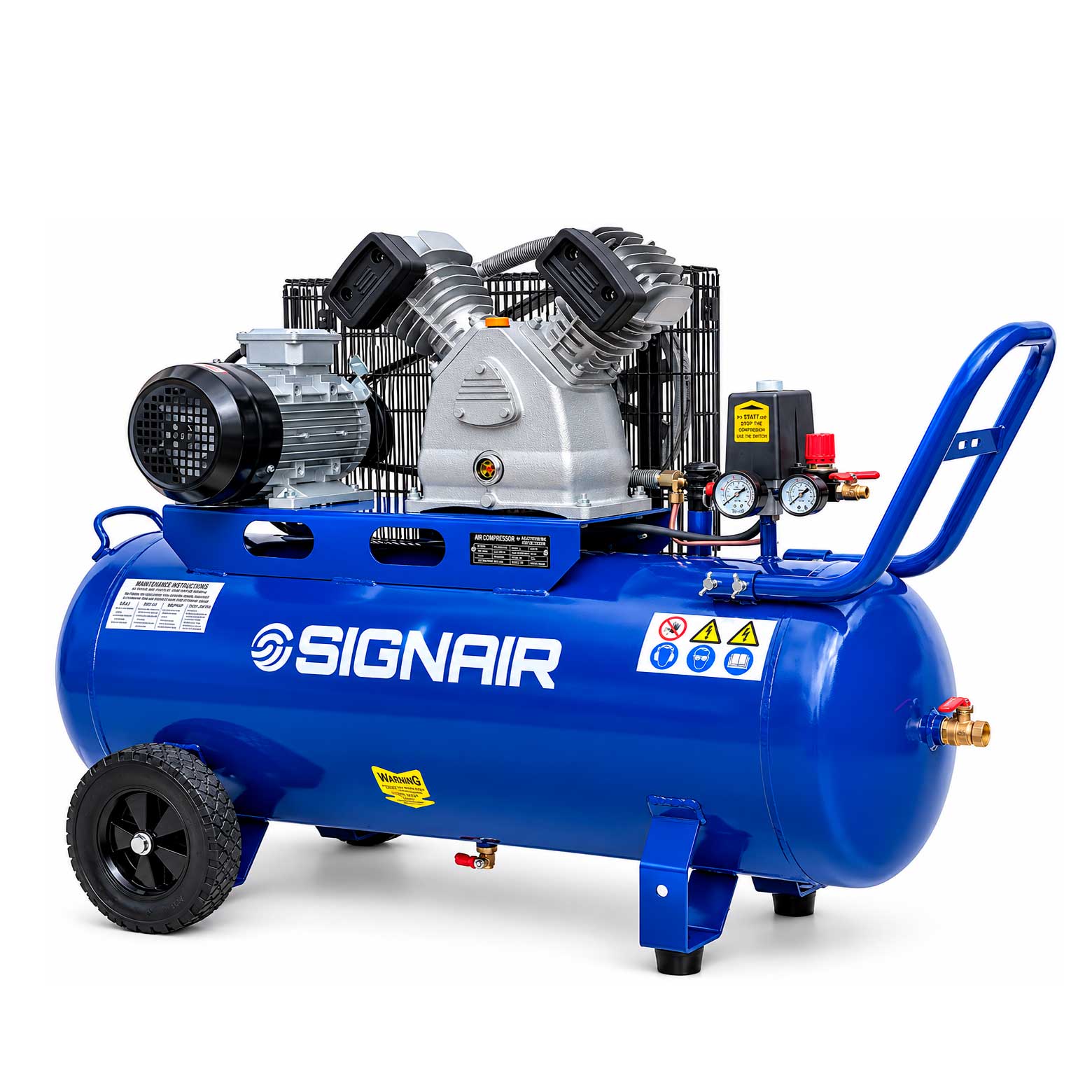

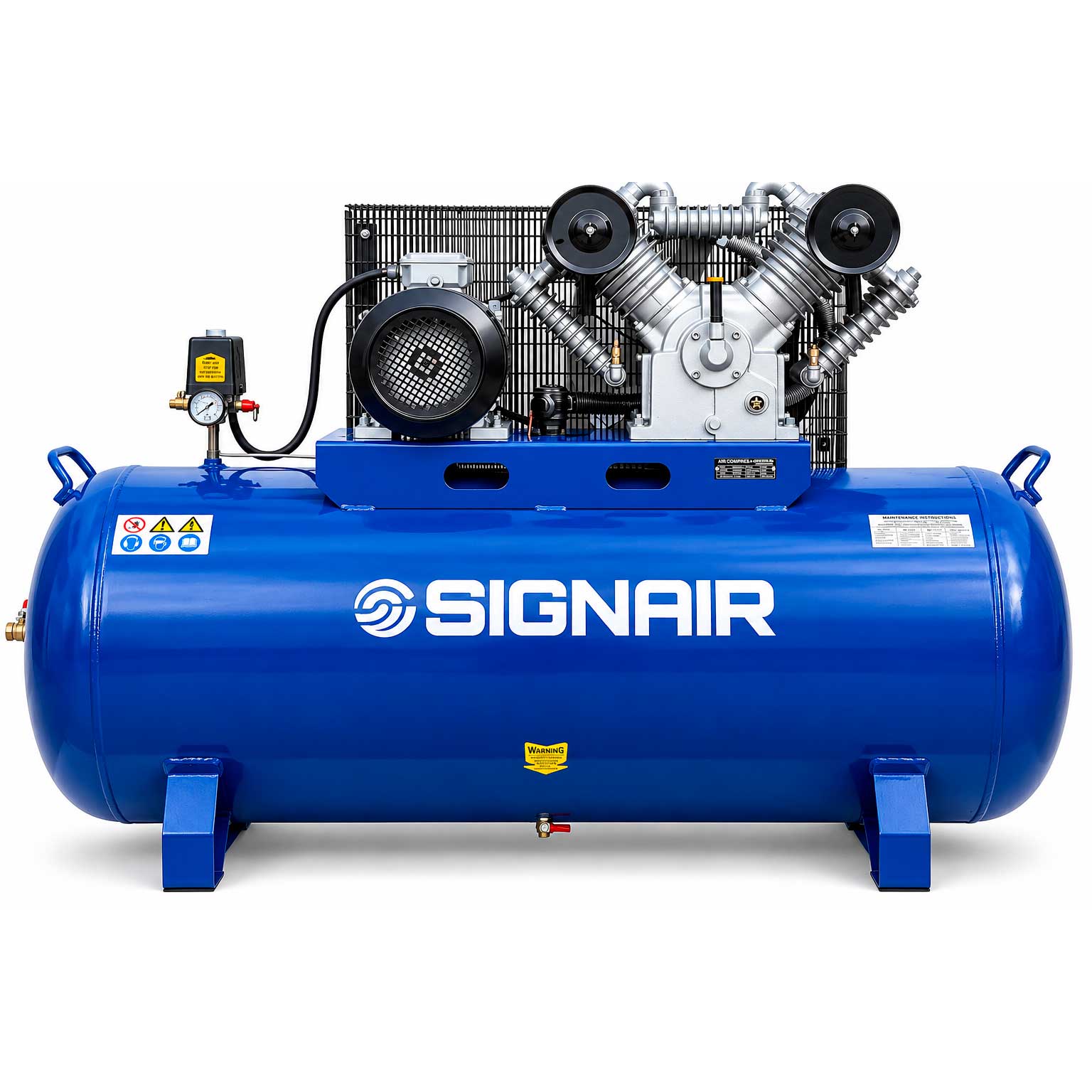
Piston Compressor SC-100 LB30 (380 V, 100 L, 420 L/min, 10 bar)
SC-100 LB30 is an oil-lubricated reciprocating piston compressor with belt drive and a 100 L horizontal air receiver, designed for a 380 V three-phase power supply. It delivers compressed air up to 10 bar (1.0 MPa) for pneumatic tools, painting and assembly stations, tire service shops, and small production lines.
1. Purpose and Operating Principle
How it works. A 2.2 kW three-phase electric motor drives the crankshaft of the LB30 compressor pump—a two-cylinder, single-stage unit with a cast-iron block—via a V-belt drive. The belt drive reduces crankshaft speed to approximately 1150 rpm, lowering wear and heat generation in the pump head. Air is drawn in through the air filter, compressed in the cylinders, and delivered into the receiver through a check valve. A pressure switch shuts off the motor at maximum pressure and restarts it when pressure drops to the lower threshold; upon stopping, a built-in unloader valve vents air from the discharge line to ensure an easy next start. The receiver smooths pressure pulsations and stores an air reserve for loads with peak demand.
Why 380 V. A three-phase motor does not require start capacitors, starts more smoothly, and draws a significantly lower current per phase than a single-phase motor of the same power rating. Where a three-phase supply is available, it is a more reliable choice than the 220 V version (SC-100 LB30A).
2. Technical Specifications
| Parameter | Value |
| Model | SC-100 LB30 |
| Type | reciprocating piston, oil-lubricated, belt-driven |
| Compressor pump | LB30, cast-iron block |
| Number of cylinders / compression stages | 2 / 1 |
| Receiver capacity | 100 L (horizontal) |
| Cylinder bore / piston stroke | 65 mm / 50 mm |
| Piston displacement (FAD / intake) | 420 L/min |
| Effective free air delivery (output) | ~340 L/min |
| Maximum pressure | 10 bar (1.0 MPa) |
| Cut-in pressure | 8 bar (0.8 MPa) |
| Electric motor power | 2.2 kW (3.0 hp) |
| Power supply | 380 V / 50 Hz, 3-phase |
| Motor (type AIR 80 B2) | 2.2 kW, 2870 rpm, 400 V, 50 Hz, rated current 4.6 A |
| Crankshaft speed | ~1150 rpm |
| Oil fill volume | 0.93 L |
| Pressure switch | CONDOR (Germany) with built-in unloader valve |
| Valve plates | SANDVIK 7C27Mo2 (Sweden) |
| Cylinder head gasket | INTERFACE (USA), asbestos-free |
| Piston rings | CYPR |
| Crankshaft bearings | C&U |
| Drive belts | V-belts SANLUX |
| Outlet port | ball valve G 1/2″ (BSPP) |
| Weight | ~88–90 kg |
| Dimensions (L × W × H) | 1150 × 490 × 850 mm |
| Estimated receiver service life | 7–10 years with regular condensate draining |
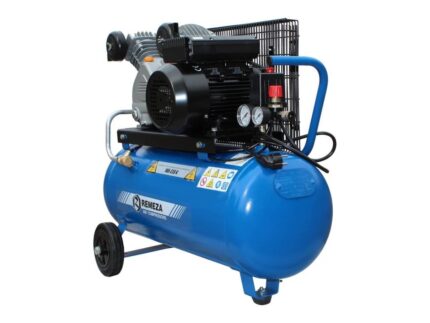
| Reference equivalent | Remeza (AirCast) СБ4/С-100.LB30 |
⚠️ Package contents (whether a magnetic starter is included) and warranty terms should be confirmed with a sales manager when placing an order.
3. Design Features
Model Designation Breakdown
| Element | Meaning |
| SC | SIGNAIR reciprocating compressor series (industrial series) |
| 100 | receiver capacity, L |
| LB30 | compressor pump type: two-cylinder single-stage, cast-iron block |
| (without “A”) | 380 V three-phase version. The “A” suffix in the 220 V designation indicates a single-phase version (LB30A) |
Design Highlights
- Cast-iron cylinder block with cooling fins — stable operation in intermittent duty and high maintainability: key components (pistons, rings, valves, gaskets) can be replaced individually.
- Speed-reducing belt drive: the crankshaft rotates slower than the motor, reducing friction, discharge temperature, and valve stress.
- 100 L horizontal receiver mounted on a wheeled chassis with vibration-damping mounts.
- CONDOR (Germany) pressure switch with unloader valve — vents discharge line pressure upon stop for easy restarting.
- SANDVIK 7C27Mo2 (Sweden) valve plates — spring alloy steel with high fatigue endurance under cyclic loads.
- INTERFACE (USA) cylinder head gasket — heat-resistant asbestos-free material that reduces the risk of bridge burnout and micro-leaks.
- CYPR piston rings, C&U crankshaft bearings, SANLUX V-belts — core wear parts sourced from selected suppliers.
- Pressure gauges on the receiver and outlet.
- Safety relief valve on the receiver — standard vessel protection against overpressure.
- Coating per supplier data — water-borne anti-corrosion finish.
4. Installation and Commissioning Guidelines
- Installation location. Flat, horizontal surface in a dry, well-ventilated room. Keep at least 50 cm clearance from walls on the flywheel-fan side; otherwise the cylinders will not receive sufficient cooling. Intake air must be clean: free of dust, paint mist, and solvent vapors.
- Electrical connection (380 V). Dedicated circuit with a copper cable and a three-pole circuit breaker, type “C”. Rated motor current is 4.6 A at 400 V, so a suitable breaker guideline is 10–16 A, type “C”. Cable cross-section depends on run length; for runs over 20–30 m, check voltage drop at startup. Motor protection — thermal overload relay in the starter or built-in protection in the pressure switch.
- Motor winding connection. Select the winding connection strictly according to the motor nameplate and terminal box. If the nameplate specifies 220/380 V, connect the windings in “star” (Y) for a 380 V supply: a “delta” (Δ) connection on 380 V will cause overheating and motor failure.
- Rotation direction. After connecting all three phases, check shaft rotation against the arrow on the belt guard or flywheel. If rotation is reversed, swap any two phases. Operating in reverse disrupts cylinder cooling by the flywheel-fan.
- Oil. Before initial startup, check the oil level in the sight glass (at the midpoint mark), with the unit standing strictly level. Oil fill volume is 0.93 L. Use dedicated compressor oil of viscosity grade ISO VG 100 (for example, Shell Corena S2 P 100 or Mobil Rarus 427). Do not use automotive engine oil: additives tend to form carbon deposits on valves.
- Break-in. Run the first ~50 operating hours under light load (per supplier recommendation, duty cycle no more than 60%), then change the oil and retorque cylinder head fasteners on a cold compressor. Subsequent oil changes — every 300–500 operating hours, and at least once a year.
- Condensate draining. At the end of each shift, open the drain valve at the lowest point of the receiver at 1–2 bar residual pressure and completely drain the water-oil condensate into a container.
- Outlet valve thread. The outlet ball valve has a parallel pipe thread G 1/2″ (BSPP). Seal it with a flat gasket or bonded seal, without PTFE tape. If an adapter with a taper thread (R / BSPT) is fitted after the valve, apply PTFE tape only to the tapered portion. Seal cylindrical metric threads (for example, M16×1.5) with an O-ring at the shoulder.
- Main line connection. Install a flexible hose (500 mm or longer) between the compressor and rigid piping to damp vibration that would otherwise transfer to the receiver and pipeline.
- Air treatment. Because this is an oil-lubricated compressor, the air contains condensate and traces of oil. For spray painting, precision pneumatic systems, and pneumatic tools requiring clean air, install a water separator filter, a dryer (refrigerant or desiccant), and, if needed, an oil separator in the line.
5. Equivalents and Comparison
Cross-Reference (Verified Against Datasheets and Specifications)
| Manufacturer | Model | Specifications | Notes |
| Remeza (AirCast) | СБ4/С-100.LB30 | 100 L, 2.2 kW, 380 V, 420 L/min, 10 bar; dimensions 1150 × 490 × 850 mm | benchmark by LB30 pump and dimensions |
| Remeza (AirCast) | СБ4/С-50.LB30 | 50 L, 2.2 kW; dimensions 850 × 400 × 770 mm | same pump, smaller receiver |
| SIGNAIR | SC-100 LB30A | 100 L, 220 V, 2.2 kW, 420 L/min | single-phase version, available on acvatron.md |
⚠️ Before replacement, verify pump type and dimensions (mounting dimensions, pulley, belt), voltage, pressure, and overall dimensions. Compatibility of LB30 block parts with Remeza parts is confirmed by the supplier; when ordering spare parts, confirm the part number from the parts breakdown. Part numbers from other manufacturers are not listed without verification.
Comparison with Neighboring Models (Per Remeza 2019 Catalog and acvatron.md)
| Model | Pump | Receiver | Power | Output / Airflow | Power Supply |
| SC-100 LB30 | LB30 | 100 L | 2.2 kW | 420 L/min (intake) | 380 V |
| SC-100 LB30A | LB30A | 100 L | 2.2 kW | 420 L/min (intake) | 220 V |
| Remeza СБ4/С-100.AB360 | AB360 | 100 L | 2.2 kW | 360 L/min | 220/380 V |
| Remeza СБ4/С-100.AB515 | AB515 | 100 L | 3.0 kW | 515 L/min | 380 V |
| Remeza СБ4/С-270 LB75 | LB75 | 270 L | 5.5 kW | 740 L/min (output) | 380 V |
How to choose:
- SC-100 LB30 or LB30A. If three-phase power is available, choose LB30 (380 V): no capacitors, lower current, more reliable starting over long cable runs. Choose LB30A for sites without 380 V.
- LB30 or AB515. If one 420 L/min compressor is not enough for 2–3 workstations, consider higher-output models; current draw increases and different protection is required.
- If you need air volume reserve rather than flow rate (occasional high-demand peaks), choose a model with a 200–270 L receiver.
6. Common Mistakes
- Wrong rotation direction after wiring: the flywheel-fan blows in the wrong direction, causing cylinders to overheat.
- Motor windings wired in “delta” (Δ) on a 380 V supply when the nameplate specifies 220/380 V.
- No phase-loss protection on sites with an unstable grid: the motor runs on two phases, overheats, and burns out. A phase monitoring relay is inexpensive.
- Undersized cable cross-section or oversized circuit breaker: on long runs, voltage drop overheats the motor, while an oversized breaker fails to protect the wiring.
- Draining condensate “when convenient”. In a 100 L receiver, liters of water-oil condensate accumulate over a couple of months, leading to weld corrosion and water entering tools and spray guns.
- Automotive engine oil instead of compressor oil: carbon deposits on valves, reduced output, overheating.
- Installing in a dusty room without filter maintenance: abrasive dust wears cylinders and rings, reducing output. Replace the filter element based on condition, and more frequently in dusty environments.
- Pulley misalignment or improper belt tension after servicing: the belt heats up and wears rapidly, overloading the crankshaft bearing.
- Placing in an unventilated area flush against a wall — overheating and thermal protection trips.
7. Applications
- Auto repair and tire shops: pneumatic impact wrenches, ratchets, tire inflation, blow-off, lubrication units. For high-consumption impact wrenches, account for effective output rather than intake displacement alone.
- Paint and body shops: spray painting with proper air treatment: water-oil separator, dryer, fine filters.
- Woodworking and furniture shops: staplers, nail guns, blow-off.
- Small metalworking shops: pneumatic tools, clamping fixtures, low-consumption plasma cutting (compare plasma cutter air demand against the ~340 L/min effective output).
- Construction and finishing work: paint and plaster spray guns, blow-off, pneumatic tools (on sites with a three-phase supply).
8. Expert Opinion
“If three-phase power is available on site, I would choose the 2.2 kW compressor with the LB30 pump in the 380 V version over the single-phase LB30A: starting is smoother, there are no capacitors, and current per phase is noticeably lower. What to check at commissioning—rotation direction and winding connection per the nameplate. What to do regularly—drain condensate and change oil on schedule. And most importantly: determine the real air consumption of your tools. 420 L/min at intake is not the same as ~340 L/min delivered, and for impact wrenches and spray guns you need to calculate based on actual delivered air.”
— Vitali Boluchevski, Lead Engineer, Acvatron SRL, 18 years of experience
9. FAQ
1. How does SC-100 LB30 differ from SC-100 LB30A? Power, receiver, pump, and intake displacement (420 L/min) are the same. The difference is the power supply: LB30 runs on 380 V three-phase, while LB30A runs on 220 V single-phase. At 380 V, starting is easier and current per phase is lower, but a protected three-phase line is required.
2. What circuit breaker and cable are needed for SC-100 LB30? A three-pole circuit breaker, type “C”, and a copper cable of suitable cross-section. Rated motor current is 4.6 A at 400 V, with a 10–16 A breaker as a reference. Cable cross-section depends on the run length.
3. What oil should be used? Dedicated compressor oil of viscosity grade ISO VG 100 (for example, Shell Corena S2 P 100 or Mobil Rarus 427); oil fill volume is 0.93 L. Automotive engine oil should not be used. The first change is done after the first ~50 operating hours, then every 300–500 hours, and at least once a year.
4. How do I check if the motor rotates in the right direction? Compare flywheel rotation with the arrow on the belt guard. If rotation is reversed, swap any two power phases. Do this with power disconnected.
5. Is this compressor suitable for painting? Yes, provided air treatment is installed: because the compressor is oil-lubricated, a water-oil separator, dryer, and fine filters are needed in the line. Check the spray gun air consumption (HVLP/LVLP) against the compressor’s effective output (~340 L/min).












Reviews
Clear filtersThere are no reviews yet.