










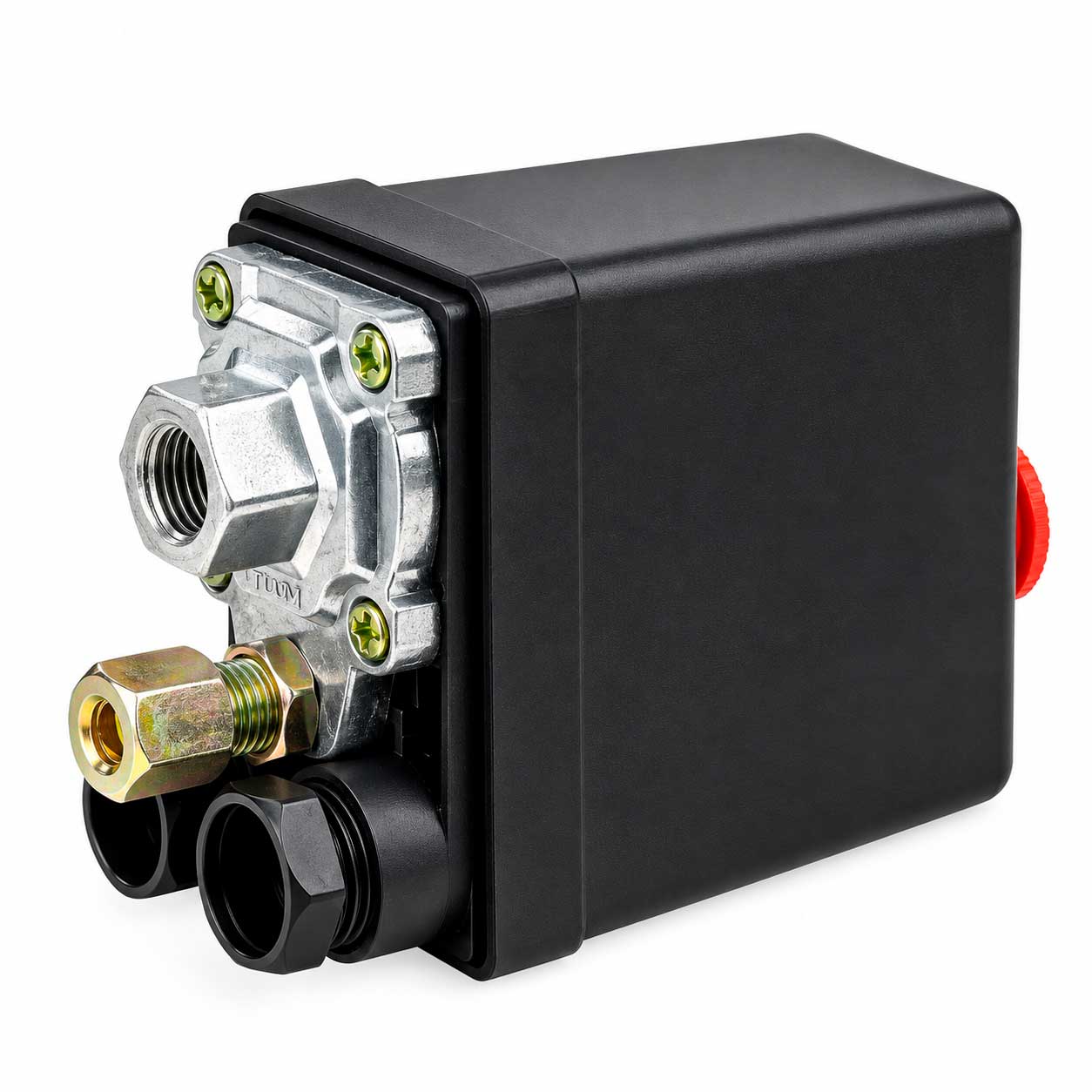

220V Pressure Switch for Compressor — G 1/4″ F × 1 Outlet, with Unloader Valve
360,00 MDL
Purpose and Operating Principle
The 220V pressure switch with G 1/4″ Female thread, one outlet, and a built-in unloader valve is a compact model for single-phase piston compressors that lack their own unloading mechanism in the cylinder head or check valve.
1. The switch performs two functions simultaneously:
- Motor control — a diaphragm inside the housing reacts to the tank pressure: when pressure drops below the lower threshold, the contact closes and the motor starts; when it reaches the upper threshold, the contact opens and the motor stops.
- Head unloading at start-up — the built-in valve releases residual pressure from the discharge line between the cylinder head and the check valve at the moment the motor stops. This relieves load on the piston before the next start and eases motor start-up (especially important for single-phase motors with a start capacitor, which struggle to start under pressure).
A single G 1/4″ outlet means the switch connects at only one point (a tank or manifold port) — the pressure gauge and safety valve must be routed separately, through a manifold or directly on the tank.
2. Technical Specifications
| Parameter | Value |
|---|---|
| Supply voltage | 220 V AC, single-phase, 50 Hz |
| Connection thread | G 1/4″ F (female, parallel/cylindrical) |
| Number of outlets | 1 (F × 1) |
| Unloader valve | Built-in |
| Unloader valve fitting | 6 mm |
| Pressure adjustment | Bolt P (cut-out threshold) + bolt dP (differential) |
| Pressure adjustment range | ≈ 3–10 bar |
| Housing material | Die-cast aluminum alloy |
| Maximum contact current | ⚠️ confirm with manager (depends on motor power) |
| Application | Single-phase piston compressors without a separate unloader |
| Compatibility | Remeza AirCast, MZB, and equivalents with G 1/4″ thread |
⚠️ Maximum contact current depends on the batch supplied — not listed on the manufacturer’s page, please confirm with the manager: +373 22 503-580.
3. Design Features
Designation Breakdown
| Designation element | Meaning |
|---|---|
| 220V | Supply voltage — single-phase 220 V AC |
| G 1/4″ F | Connection thread — female, parallel, 1/4 inch |
| F × 1 | One G 1/4″ threaded outlet |
| with valve | Built-in unloader valve inside the switch housing |
Design Solutions
- Die-cast housing with a diaphragm block that reacts to pressure through the threaded port
- Two independent adjustment bolts under a removable cover — separate settings for cut-out pressure and differential
- The unloader valve is mechanically linked to the switching mechanism — it triggers synchronously with contact opening, no separate control needed
- Single G 1/4″ outlet instead of four — compact mounting footprint, suitable for tight spaces near the tank
4. Installation Recommendations
- G 1/4″ thread is parallel (BSPP). It seals with a flat gasket at the face of the thread, not by thread interference. PTFE (thread seal) tape is not required and not recommended — it doesn’t solve sealing issues on this thread type and can clog the switch’s internal channels.
- Before installing, inspect the thread visually: G thread has a constant diameter along its length; if it tapers toward the end, it’s R/NPT 1/4″ (tapered), and this switch won’t seal properly on it.
- The unloader fitting connects via a small-diameter tube to the compressor’s discharge port (between the head and the check valve) — exactly where residual pressure accumulates after shutdown.
- Fully release tank pressure and disconnect power before installation.
- After installation, check gasket tightness without over-torquing the thread — the die-cast housing is sensitive to excessive torque.
- Electrical connection — follow the diagram on the inside of the switch cover; the phase wire runs through the switch contacts to the contactor/motor winding.
5. Cross-References and Comparison
Cross-Reference Table
⚠️ Exact cross-reference part numbers from other manufacturers (Condor, SMC, etc.) for this specific model have not been verified at this time. We avoid the vague claim “equivalents are available” — send a photo or the marking on your existing switch and we’ll match it to the exact equivalent (thread, pressure range, valve presence).
Comparison with Other Versions in the Acvatron Line
| Model | Outlets | Unloader Valve | When to Choose |
|---|---|---|---|
| 220V G 1/4″ F × 1, no valve | 1 | No | Compressor with a separate external unloader, compact footprint |
| 220V G 1/4″ F × 1, with valve (this product) | 1 | Yes (6 mm) | Compact footprint + unloading needed, compressor has no unloader |
| 220V G 1/4″ F × 4, no valve | 4 | No | Compressor without a manifold, external unloader |
| 220V G 1/4″ F × 4, with valve | 4 | Yes (6 mm) | Standard 220V piston compressor without a manifold |
Choosing between F×1 and F×4 with valve: if your compressor’s tank already has a separate manifold for the pressure gauge and safety valve, choose F×1 (this product) — it fits into a single available port without extra plugs. If there’s no manifold and all connections need to be handled at the switch itself, the F×4 with valve is the right choice.
6. Common Mistakes
- Installing on R/NPT 1/4″ thread instead of G 1/4″ — the thread screws in with effort but doesn’t seal, resulting in an air leak after days or weeks of operation.
- Using PTFE tape on the parallel G thread — the tape clogs the diaphragm block or unloader channel, causing the switch to stick or leak air through the valve.
- Trying to connect a pressure gauge directly to the single outlet — on the F×1 version, the port is already occupied by the tank/manifold connection; there’s physically nowhere to add a gauge without an extra tee fitting.
- Forgetting the unloader valve tubing — if the valve fitting isn’t connected to the discharge line, the valve simply vents air to atmosphere on every shutdown, increasing air consumption and noise.
- Over-tightening the housing during installation — the die-cast housing can crack under excessive torque, especially if the thread is already binding due to a G/NPT mix-up.
7. Application
- Single-phase piston compressors up to ~2.2 kW without a built-in unloader valve in the cylinder head
- Remeza AirCast, MZB, and equivalent compressors with G 1/4″ thread at the switch’s mounting location
- Cases where the motor’s start capacitor is overloaded when starting under residual head pressure
- Compact installations where the manifold for the gauge and safety valve is already routed separately from the switch
8. Expert Opinion
“The unloader valve in a pressure switch isn’t a cosmetic option — it’s a way to relieve piston load at the moment of start-up. On single-phase compressors with a standard start capacitor, this really shows: without unloading, the motor can fail to ‘catch’ the start under 6–8 bar of residual pressure, especially if that capacitor is already aging. The single-outlet version still stays compact — if you already have a manifold for the gauge and safety valve, there’s no point taking the four-outlet version just for the unloader function. The one thing worth insisting on when ordering is confirming that the valve is actually present in that particular batch, and its fitting size — it’s better to check this with the manager before payment than to rely on the general model name alone.”
Vitali Boluchevski, Lead Engineer, Acvatron SRL, 18 years of experience
9. FAQ
❓ How does this model differ from the F×1 version without a valve? Only in the presence of the built-in unloader valve. The thread, number of outlets, and motor control principle are identical. The difference is whether residual pressure in the compressor head is released automatically at shutdown.
❓ Do I need an unloader valve if my compressor already starts normally? Not necessarily. If your compressor has its own unloading mechanism (in the head or a separate solenoid valve), duplicating the function isn’t needed — the version without a valve is suitable. The valve in the switch is needed specifically when the compressor has no built-in unloading.
❓ Where does the unloader valve fitting connect to? To the compressor’s discharge port, between the head and the check valve — exactly where compressed air pressure remains in the cylinder after shutdown. Via a thin, small-diameter tube.
❓ Can I use this switch if I have a four-outlet manifold on my tank? Yes, it can be physically connected — the switch will occupy one port, leaving the other three free or plugged. But if a manifold already exists, it’s often simpler and more logical to choose the F×4 version to make use of all the ports as intended.
❓ Is this switch suitable for three-phase 380V compressors? No. This model is designed exclusively for single-phase 220V circuits. For three-phase 380V compressors, use the Condor MDR3 series.









Reviews
Clear filtersThere are no reviews yet.