














Axial vs Radial Pressure Gauge: The Difference and When You Need the Axial Type
Two connection orientations determine where the gauge port exits:
| Type | Port location | Mounting | Typical application |
|---|---|---|---|
| Axial (rear) | Rear, along the body axis — port exits behind the dial | Into panel wall, into regulator port in-line | FRL regulators, control panels, air preparation units |
| Radial (bottom) | Below, perpendicular to the axis | On pressure switch, receiver manifold, vertical installation | Compressor pressure switches, receivers, manifolds |
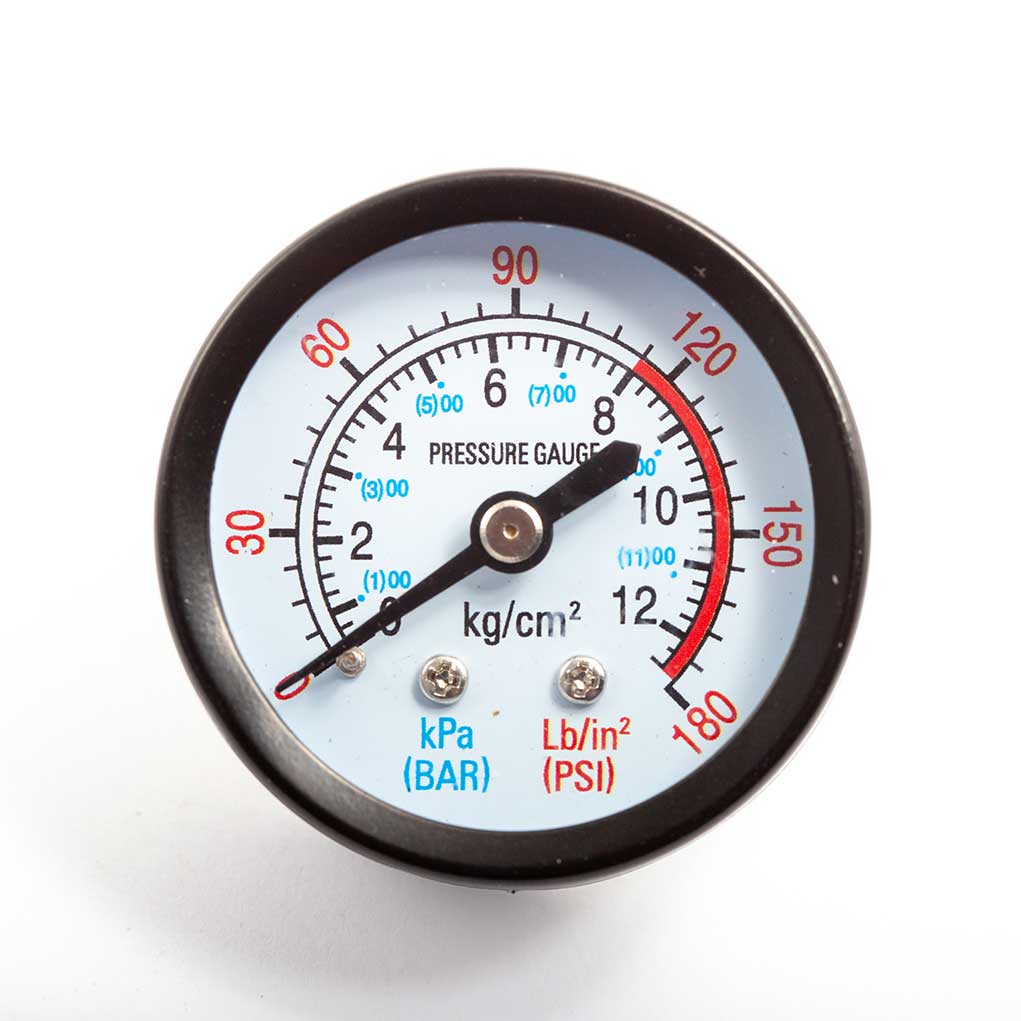
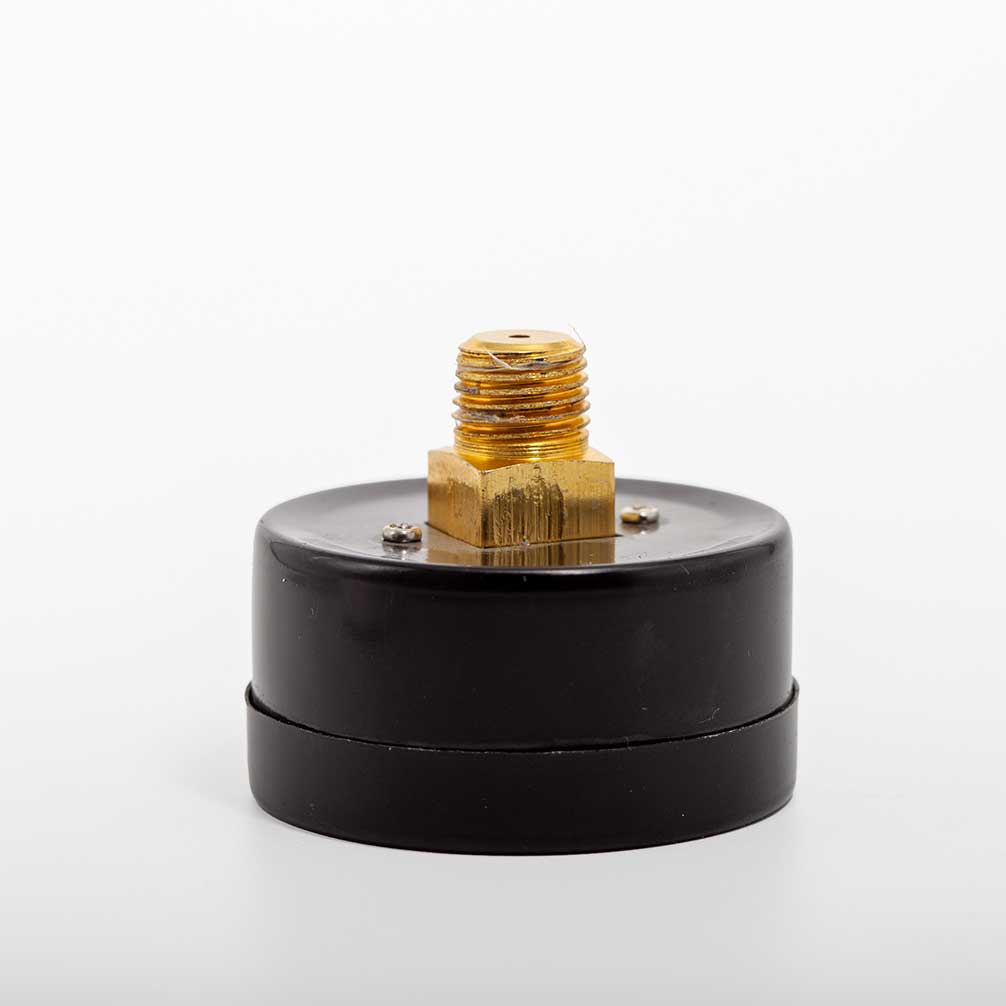
Axial connection (this model) means: when fitted to the pressure regulator’s threaded port, the gauge sits behind the main equipment and faces the operator. This is the standard for built-in gauges on FRL regulators — Festo LFR, SMC AW, Parker Watts, Norgren B07, and their equivalents.
💡 Quick check: if your old gauge has a port exiting straight back from the dial — you need the axial type. If the port exits downward — you need the radial type.
G 1/4″ vs M14×1.5 vs G 1/8″: Which Thread Is Which
| Thread | Standard | Typical application |
|---|---|---|
| G 1/4″ Male | BSP inch | FRL regulators, filters, pneumatic fittings, manifolds |
| G 1/8″ Male | BSP inch | Compact sensors, mini-regulators |
| M14×1.5 Male | Metric | Compressor pressure switches, spray guns |
| NPT 1/4″ Male | US standard | North American-made equipment |
G 1/4″ is the most universal thread in pneumatics. Most FRL air preparation units, pressure regulators, fine filters, manifolds, and pneumatic fittings use this standard. A G 1/4″ Male gauge threads directly into the regulator’s G 1/4″ Female port.
0–12 bar Scale: Why This Range Is Optimal
The rule for selecting gauge range: maximum system pressure should correspond to 60–70% of full scale. This is the zone of highest mechanism accuracy.
| System working pressure | Optimal gauge scale |
|---|---|
| Up to 4 bar | 0–6 bar |
| Up to 6 bar | 0–10 bar |
| Up to 8 bar | 0–12 bar ← this model |
| Up to 10 bar | 0–16 bar |
| Up to 12 bar | 0–16 bar or 0–20 bar |
A 0–12 bar gauge is ideal for systems with working pressure of 6–8 bar — the standard for most industrial compressors and pneumatic systems. The needle operates at 50–67% of scale — the maximum accuracy zone of the Bourdon tube.
Technical Specifications
| Parameter | Value |
|---|---|
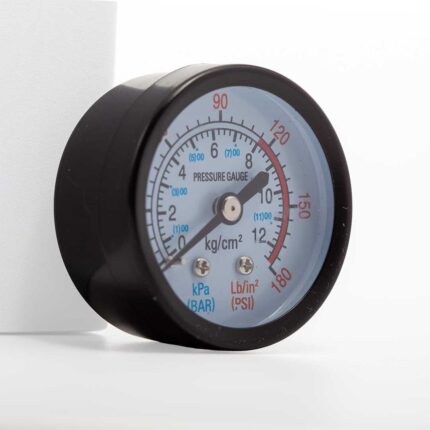
| Connection type | Axial (rear / central) |
| Thread | G 1/4″ Male (BSP) |
| Dial diameter | 50 mm |
| Scale | 0–12 bar |
| Scale divisions | 0.5 bar |
| Accuracy class | 2.5 |
| Type | Dry (no glycerine filling) |
| Body material | Plastic / ABS |
| Window material | Transparent plastic |
| Working temperature | −20 °C … +60 °C |
| Media | Compressed air, neutral gases |
| Compliance | GOST 2405, EN 837 |
Where the Axial G 1/4″ Gauge Is Installed
FRL pressure regulators (air preparation units) The gauge port on Festo, SMC, Parker, and Norgren regulators is always G 1/4″ Female with axial orientation. This gauge is the standard replacement for the built-in gauge on these units.
Control panels and switchboards The gauge mounts into a panel cut-out — the port passes through the panel wall and connects to the pneumatic line from behind; the dial is visible from the front. Axial connection enables flush panel mounting.
Air distribution manifolds Many manifolds provide a G 1/4″ port for section pressure monitoring. An axial gauge is more convenient here than a radial one — it does not protrude beyond the manifold face.
Instrument air pressure regulators The compact 50 mm body and axial connection are ideal for pressure regulators at paint spray, assembly, and pneumatic tool workstations.
50 mm Dial: When It’s Enough and When You Need More
| Diameter | Readability | When used |
|---|---|---|
| 40 mm | Up to 0.5 m | Compact built-in FRL units, mini-systems |
| 50 mm | Up to 1 m | FRL regulators, control panels, workstations |
| 63 mm | Up to 1.5 m | Filter-regulators, industrial workstations |
| 100 mm | Up to 3 m | Main switchboards, operator panels |
The 50 mm body is the compact standard for FRL regulators and built-in gauges. Most Festo, SMC, and Parker pressure regulators specify this size in their standard configuration.
Compatibility with Pressure Regulators and FRL Units
The G 1/4″ Male, Ø50 mm, axial gauge is the standard replacement for the built-in gauge on the following units:
- Festo — LFR-D-MINI, LFR-1/4-D-7-O-E, FR series regulators
- SMC — AW20, AW30, AW40, AC series units, AR series regulators
- Parker / Watts — 06F, 07F, B07 series regulators
- Norgren — B07, B11, Excelon Plus series units
- Camozzi — 6- and 9- series
- Most Chinese FRL units marked G 1/4″ for gauge port
⚠️ Check the body diameter. The G 1/4″ port is one standard, but the gauge body seat may be Ø40, Ø50, or Ø63 mm. Most standard FRL units use Ø50 mm. Measure the gauge seat diameter on your regulator before ordering.
Axial vs Radial: Summary
Axial (this model):
- Pressure regulator — gauge faces the operator, port enters the regulator port
- Control panel — flush panel mounting, dial visible from the front
- Manifold — does not protrude beyond the manifold face
Radial:
- 4-port pressure switch — gauge screws into the side port
- Receiver manifold — horizontal pipe, port below
- Tee in a vertical line — dial faces forward with bottom connection
Signs of Failure: When to Replace
- Needle does not return to zero after pressure release — Bourdon tube wear
- Fogged or cracked window — condensate inside, readings unreliable
- Needle sticking — fouling or corrosion of the mechanism
- Air leaking from the port — loss of seal integrity
- Deviation from reference gauge exceeding 5% — accuracy class 2.5 exceeded
⚠️ A faulty gauge means unreliable pressure control. Without an accurate gauge on a regulator it is impossible to set the correct working pressure. Replace immediately.
Expert Opinion
“The Ø50 mm axial gauge is the most common type for air preparation units. When a gauge fails on an FRL on an assembly line — this is exactly what you replace it with: G 1/4″, axial, Ø50, scale 0–10 or 0–12 bar depending on line pressure. One important point: when replacing the gauge on an FRL unit, always bleed the line to zero first — even a small residual pressure will eject the gauge with a bang when you unscrew it. Second point — PTFE tape. G 1/4″ BSP is a parallel thread; it does not self-seal by taper (unlike R and NPT). Three or four wraps of PTFE tape or a drop of anaerobic thread sealant — mandatory, otherwise it will weep at the thread.”
Vitaly Boluchevsky, Chief Engineer at Acvatron SRL, 15 years in the industry
FAQ
❓ Is this gauge compatible with the Festo LFR-1/4-D-7-O-E regulator? Yes, the Festo LFR-1/4-D-7-O-E has a G 1/4″ Female gauge port with a Ø50 mm seat — this gauge is a direct replacement. The 0–12 bar scale is appropriate for standard line pressures of 6–8 bar.
❓ Is PTFE tape or thread sealant needed when fitting? Yes, mandatory. G 1/4″ BSP is a parallel thread — it does not seal by taper interference (unlike R and NPT). Apply 3–4 wraps of PTFE tape or anaerobic thread sealant (Loctite 542 or equivalent).
❓ Why a 0–12 bar scale rather than 0–10 bar when working pressure is 8 bar? A 0–10 bar gauge at 8 bar working pressure puts the needle at 80% of scale — permissible but close to the upper limit. The 0–12 bar scale gives a working zone of 67% — the optimum balance of accuracy and pressure headroom. If pressure briefly spikes to 10–11 bar, the 0–12 bar gauge will not go off-scale.
❓ Can this gauge be used for gas or water? For neutral gases (nitrogen, argon) — yes. For water — subject to compatibility of the internal components with water (confirm with the manager). For aggressive gases or liquids, stainless steel gauges are required.
❓ Is a similar gauge available with a 0–10 bar or 0–16 bar scale? Yes, axial G 1/4″ Ø50 mm gauges with various scales (0–6, 0–10, 0–12, 0–16 bar) are available in the Acvatron SRL range. Check availability of the required scale: +373 22 503-580.








Reviews
Clear filtersThere are no reviews yet.