












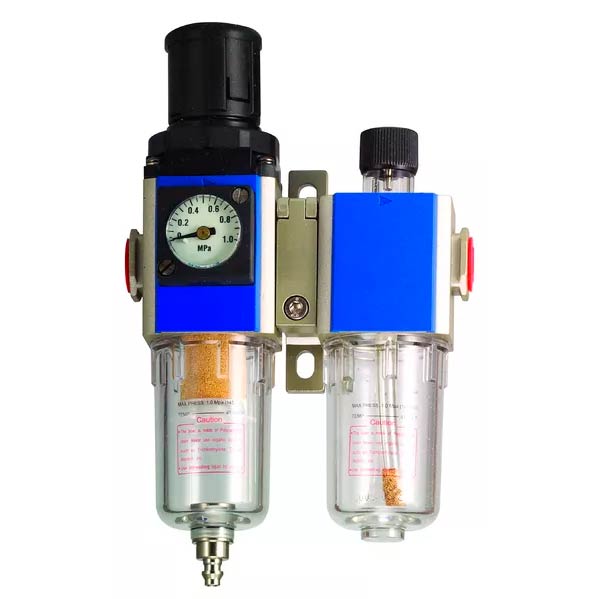
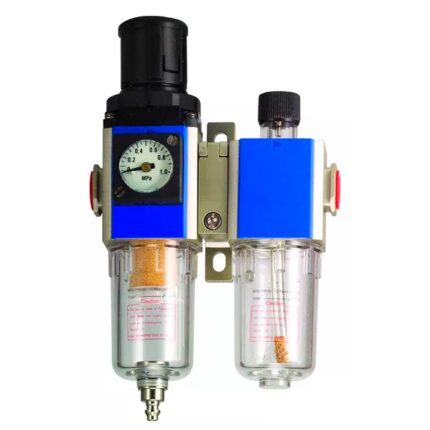
Compressed air passes through three consecutive stages:
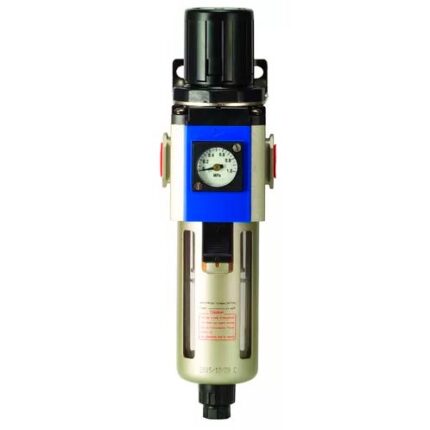
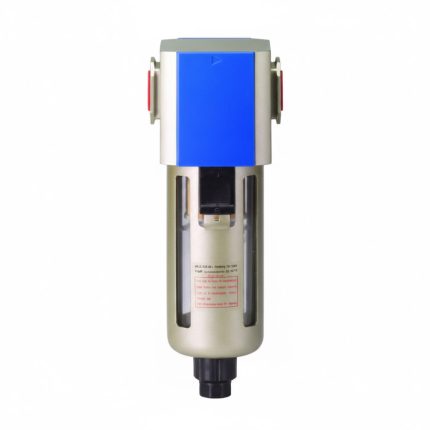
- Stage 1 — Filtration and moisture separation. SHPI’s patented spiral deflector spins the incoming airflow, centrifugally separating water droplets, oil mist, and solid particles. The 5-micron filter element captures remaining contaminants, and condensate collects in a 15 cm³ bowl that is drained manually.
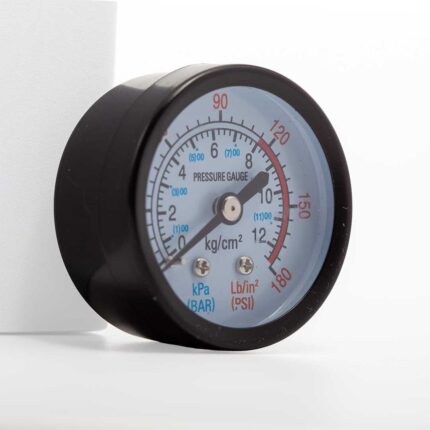
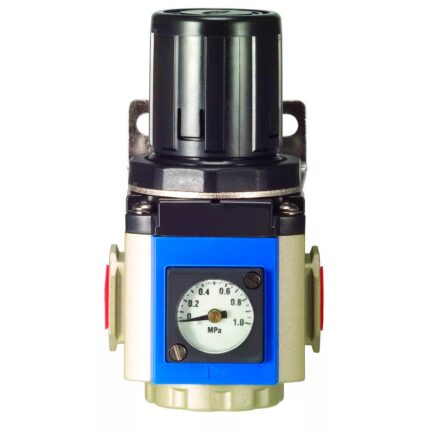
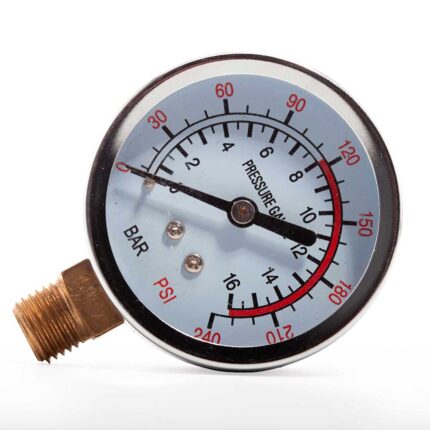
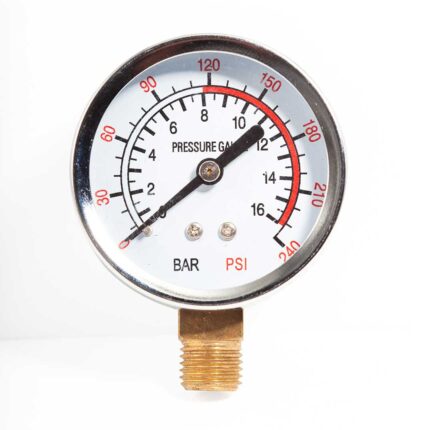
- Stage 2 — Pressure regulation. A diaphragm regulator with a self-locking mechanism holds the set outlet pressure steady regardless of upstream line fluctuations. The integrated square gauge provides constant visual monitoring.
- Stage 3 — Lubrication. The lubricator injects a fine oil mist into the airflow proportionally to flow rate, providing continuous lubrication of the internal mechanisms of the connected pneumatic tool without interrupting work.
This makes it an ideal single-station solution for one pneumatic tool or a small pneumatic setup.
Technical Specifications
| Parameter | Value |
|---|---|
| Function | Filter + pressure regulator + lubricator (3-in-1, FRL) |
| Working medium | Compressed air |
| Connection port | 1/4″ BSPP (G) |
| Pressure adjustment range | 0–8.5 bar (0–0.85 MPa) |
| Working pressure range | 1.5–9.0 bar (0.15–0.9 MPa) |
| Maximum working pressure | 10.0 bar (1.0 MPa) |
| Proof pressure | 15.0 bar (1.5 MPa) |
| Filtration grade | 5 microns (μm) |
| Drain type | Manual |
| Temperature range | 5°C … 60°C |
| Filter bowl volume | 15 cm³ |
| Oil reservoir volume (lubricator) | 15 cm³ |
| Recommended oil | ISO VG32 or equivalent |
| Gauge type | Integrated square, bar scale |
| Housing | Aluminum alloy |
| Filter element | Fiber, 5 μm |
| Bowl (filter/lubricator) | Polycarbonate (PC) + SPCC steel protective guard |
| Guide components | POM (polyoxymethylene) |
| Manufacturer | SHPI (Taiwan) |
Design Features
Model code breakdown — GFCS200-08-M-C3-W-G:
| Position | Meaning |
|---|---|
| G | Series G (SHPI industrial pneumatics) |
| F | Filter — filter/moisture separator |
| C | Combination — combined FRL module |
| S | Square gauge — integrated square pressure gauge |
| 200 | Size 200 (compact series) |
| 08 | Port size — 1/4″ |
| M | Drain type — Manual |
| C | Gauge — integrated square (Compact) |
| 3 | Gauge scale — bar |
| W | Filtration grade — 5 microns |
| G | Thread type — BSPP (G) |
Key advantages:
- Maximum compactness with full FRL functionality — size 200 with a 1/4″ port is the smallest in SHPI’s GFCS line, mounting directly at the workstation without extra space.
- All-in-one station solution — replaces a separate filter, regulator, and lubricator plus the connecting fittings between them, meaning fewer threaded joints and fewer potential leak points.
- Self-locking regulator — the adjustment screw’s clamping mechanism keeps the set pressure fixed under vibration or accidental contact, important for impact tools generating significant vibration.
- Proportional lubricator — doses oil automatically in proportion to air consumption; the transparent 15 cm³ reservoir lets you check the oil level visually without disassembly.
- Integrated square gauge with magnifying scale — comfortable reading even in tight spaces of a small workshop.
Installation Recommendations
- Respect the flow direction — the housing has an arrow marking inlet → outlet. Reversed installation breaks correct filtration and lubrication.
- Mount vertically, bowl facing down — vertical orientation is required for correct condensate separation and lubricator dosing; horizontal or inverted mounting disrupts both functions.
- Leave clearance below the unit — for removing the filter/oil bowl and accessing the manual drain valve.
- Use a wall bracket — reduces mechanical stress and vibration transmitted to the threaded connection, especially near impact tools.
- Seal the BSPP (G) thread correctly — this is a parallel thread sealed on a flat gasket, not a tapered thread; avoid excessive PTFE tape as used on tapered (NPT/BSPT) threads, which risks misaligning the gauge or cracking the housing.
- Set pressure under real load — adjust the regulator while the pneumatic tool is running (actual air consumption), not at rest — static and dynamic pressure differ significantly.
- Fill the lubricator to the max mark only — overfilling causes uncontrolled oil carryover into the line.
Analogues and Comparison
Close equivalents to SHPI GFCS200-08 (FRL 3-in-1, G1/4″, 5 micron, with gauge):
| Brand | Part number / Series |
|---|---|
| AirTAC | GAFC200-08 or GFC200-08 (FRL combination) |
| SMC | AC20-02 or AC2000-02 series (FRL) |
| Festo | FRC-1/4-D-MINI or MS6 series (FRL) |
| Camozzi | C2 series or MC202-02 (FRL combination G1/4) |
| Metal Work | FRL 200 / Beta series (combined unit G1/4) |
Note: all listed units are G1/4″ threaded, 5-micron, manual drain, 0–8.5 bar adjustment range. Before substituting, verify mounting dimensions, bowl volumes, and gauge type — these can differ slightly between brands.
GFCS200 vs GFCS300:
| Criterion | GFCS200-08-M-C3-W-G | GFCS300-15-M-C3-W-G |
|---|---|---|
| Connection port | 1/4″ | 1/2″ |
| Filter bowl volume | 15 cm³ | 40 cm³ |
| Oil reservoir volume | 15 cm³ | 40 cm³ |
| Typical air flow | up to ~800 l/min | up to ~1600 l/min |
| Recommended for | 1 tool / 1 workstation | multiple tools / main line |
| Mounting | Point-of-use (at the tool) | Point-of-use or main line |
Series 200 models — which one to choose:
| Criterion | GFS200 | GFRS200-08 | GFCS200-08 |
|---|---|---|---|
| 5-micron filtration | ✅ | ✅ | ✅ |
| Pressure regulator | ❌ | ✅ | ✅ |
| Lubricator | ❌ | ❌ | ✅ |
| Preparation stages | 1 | 2 | 3 |
| Suitable for spray guns | ✅ | ✅ | ❌ |
| Suitable for pneumatic tools | ✅ (with separate regulator) | ✅ | ✅ (optimal) |
Common Installation Mistakes
- Reversed flow direction (inlet/outlet swapped) — cancels the filtration and lubrication effect; always check the arrow on the housing.
- Horizontal or inverted mounting — the bowl no longer drains condensate correctly, and the lubricator can no longer meter oil proportionally to flow.
- Sealing the G1/4″ thread like a tapered thread — excessive PTFE tape or tapered-thread sealant can distort or crack the aluminum alloy body under over-tightening.
- Using automotive engine oil instead of ISO VG32 — engine oils contain detergent additives that destroy seals and clog the lubricator’s fine passages.
- Neglecting the manual drain — accumulated condensate can reach the air line and the pneumatic tool, causing internal corrosion.
- Setting pressure with no real airflow — pressure set at rest drops under load; always adjust with the tool running.
- Mounting near heat sources — exceeding the 5–60°C range affects seals and the polycarbonate bowls.
Application Areas
GFCS200-08-M-C3-W-G is the optimal choice for point-of-use connection of pneumatic tools that require lubrication:
- Auto repair shops — impact wrenches, pneumatic ratchets, grinders at a single workstation
- Tire service — pneumatic tools for tire mounting/demounting, balancing equipment
- Woodworking and furniture production — pneumatic staplers, nail guns, pneumatic sanders
- Small production workshops — pneumatic screwdrivers, rivet guns, assembly tools
- Construction and installation — pneumatic chipping hammers, installation guns, pneumatic hammers
- Repair workshops — universal point-of-use air preparation for any pneumatic tool with bearings and piston mechanisms
Important: GFCS200-08 is not intended for spray-painting equipment or airbrushes. Oil mist from the lubricator is incompatible with paint materials and causes coating defects. For painting equipment, use GFRS200-08 (filter + regulator, without lubricator).
Expert Opinion
Vitali Boluchevski, Lead Engineer, Acvatron SRL, 18 years of experience:
“GFCS200-08 is the right answer to the question of how to quickly and affordably set up complete point-of-use air preparation for a single tool. The 1/4″ port fits most hand-held pneumatic tools directly, with no adapters needed. The 15 cm³ oil reservoir is small, so with intensive use I recommend checking the oil level every 2–3 hours. Another mistake I regularly see in workshops here in Moldova is filling it with regular automotive engine oil — it contains detergent additives that destroy seals and clog the pneumatics’ fine channels. Use only clean ISO VG32 oil without additives. During our colder winter months, it’s also worth checking the drain bowl more often, since condensate can build up faster with sudden temperature swings.”
Compliance with International Standards
- ISO 5599 — pneumatic fluid power components and air preparation devices
- ISO 6953-1/2 — pneumatic pressure regulators: performance characteristics and test methods
- EN 983 — safety requirements for pneumatic systems in machinery
- ISO 8573-1 — compressed air purity classification (5 microns — solid particle class 3)
- ISO VG32 — recommended viscosity grade for lubricator oil
FAQ
How does GFCS200-08 differ from GFCS300-15? The main difference is size and flow capacity. GFCS200-08 has a 1/4″ port and flow up to ~800 l/min — a point-of-use solution for a single tool. GFCS300-15 has a 1/2″ port and twice the bowl volume (40 vs 15 cm³) — suitable for multiple tools or high air consumption. Functionality, construction, and materials are identical.
Can I use GFCS200-08 ahead of a spray gun? No. The lubricator injects oil mist into the air, which inevitably contaminates the paint and causes coating defects — craters, fish-eye, dulled finish. For spray-painting equipment, use GFRS200-08 (filter + regulator, no lubricator).
How do I correctly set the oil dosage on the lubricator? A standard starting point is 1 drop of oil per 10–15 m³ of air passed — visually, 1–2 drops per minute under moderate load. Too little and the tool overheats and wears; too much and oil ends up in the work area and soils the equipment. Fine-tune with the lubricator’s adjustment screw while the tool is running, watching the transparent sight glass.
What oil should be used and how often should it be topped up? Clean ISO VG32 pneumatic oil, free of detergent additives. Under intensive use, check the level in the transparent 15 cm³ reservoir every 2–3 hours of continuous operation.









Reviews
Clear filtersThere are no reviews yet.