











Condor MDR Pressure Switches for Compressors: MDR 1, MDR 2, MDR 3, MDR 4, MDR 2i — Full Review, Selection Guide, Adjustment

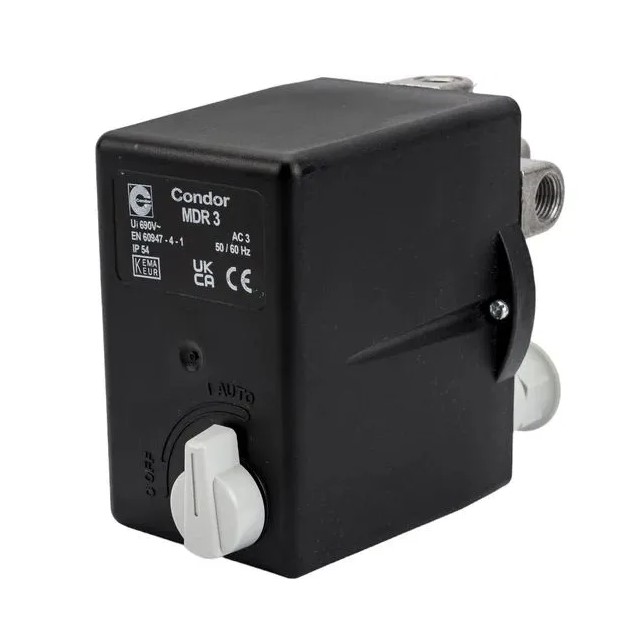
A pressure switch is a component nobody thinks about until the compressor stops starting — or stops stopping. Yet it is precisely the pressure switch that determines how long the motor will last, how stable the system pressure will be, and whether the windings will burn out at every pressurised start. Condor Werke (Germany, over 130 years in the industry) manufactures the MDR series — the most widely used pressure switches for piston and screw compressors in Europe. Here is a breakdown of every model: what sets them apart, how to select the right one, how to adjust it.
What a Pressure Switch Does and Why Your Compressor Needs One
A pressure switch is an electromechanical device that controls the compressor motor based on pressure in the receiver tank. The principle is straightforward: receiver pressure acts on the pressostat membrane or piston, compressing the spring. When pressure reaches the upper cut-out point (P_max), the spring relaxes to the switching point — contacts open, motor stops. When pressure falls to the lower cut-in point (P_min), the spring compresses again, contacts close — motor starts.
Adjustment is made with two screws: the large one (main spring) sets the cut-out pressure P_max; the small one (differential spring) sets the difference between P_max and P_min — the hysteresis, or pressure differential ΔP.
Three parameters fully determine which pressostat to choose:
- Maximum system working pressure (bar)
- Motor voltage and power (V, kW, A)
- Connection thread to the receiver (G 1/4″, G 3/8″ or G 1/2″)
The Condor MDR Series: Overview of the Range
Condor Werke produces several MDR variants, each targeting a specific equipment class and operating environment. All models share constructive continuity: the same adjustment principle, identical flange dimensions, compatible accessories.
MDR 1 — Single-phase pressure switch for compressors up to 11 bar
The MDR 1 is the base model of the series, designed for single-phase 220–250 V networks. Maximum switching pressure — 11 bar, maximum contact current — 16 A (covering motors up to 2.2–3 kW at 220 V). The unit is supplied as standard with pressure differential adjustment capability.
This is the most widely used pressure switch for domestic and semi-industrial piston compressors: Fiac, Abac, Fubag, Garage, Patriot, Remeza AirCast LB series, and equivalents. The vast majority of 220 V compressors rated up to 2.2 kW with receivers from 50 to 100 litres are factory-fitted with either the MDR 1 or its functional equivalent.
Available versions: standard housing with cover, version with On/Off switch, version with add-on operating hours counter kit (for motor service life tracking).
Connection thread: G 1/4″ (standard for compressors up to 3 kW) or G 3/8″.
MDR 2 — Single-phase pressure switch with unloader valve
The MDR 2 is a more advanced version for single-phase compressors; the key difference from the MDR 1 is the integrated unloader valve (Entlastungsventil, EW). The unloader valve activates at the moment the compressor stops: it bleeds pressure from the discharge line between the block and the check valve, eliminating load at the next start. Without an unloader valve, the motor must start against full line pressure from the first rotor revolution — this raises starting current 7–10 times above nominal and shortens winding life substantially.
MDR 2 parameters: 220–250 V, maximum pressure up to 11 bar (MDR 2/11) or up to 16 bar (MDR 2/16), contact current up to 16 A. Pressure differential adjustment — standard. Minimum differential step: ΔP ≥ 0.5 bar.
The MDR 2 is used on compressors where start-stop cycling is frequent and motor protection against repeated hot starts is critical. Typical makes: Fiac AB 100–200, Remeza СБ4 LB50/LB75, Abac B6000.
Optional add-on: operating hours counter, mountable in the cover in 4 positions at 90° intervals.
MDR 3 — Three-phase pressure switch with thermal overload relay
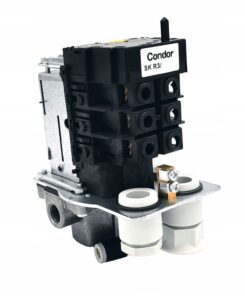
The MDR 3 is the first model in the series for three-phase 380–400 V networks. It is a three-pole switch with a maximum contact current of 20 A, covering motors up to 7.5–11 kW at 380 V. Maximum switching pressure — 16 bar.
The principal design feature of the MDR 3 is the ability to fit an integrated thermal overload relay (motor overcurrent protection). Available relay sizes: SKR 3/6.3 A, SKR 3/10 A, SKR 3/16 A, SKR 3/20 A. The thermal relay protects the motor under sustained overload: when current exceeds the set value, the bimetal element deflects and opens the control circuit, stopping the compressor until manually reset.
The MDR 3 is certified to KEMA KEUR, UL, and CSA standards — accepted on compressors supplied to North American markets and countries with strict component certification requirements.
Connection: G 1/4″, G 3/8″ or G 1/2″ depending on version. Unloader valve (EW or AEW) — optional.
Typical applications: Remeza СБ4/Ф-500 LT100 piston compressors, Remeza 4V-1.05/12.5, Abac Genesis, Fiac CX series.
MDR 4 and MDR 4 SD/SU — Three-phase high-pressure switch up to 16 bar
The MDR 4 builds on the MDR 3 with extended capabilities and switching pressure up to 16 bar. The MDR 4 SD version (Scale Display) features a transparent cover and an integrated scale, allowing the set pressure range to be read without removing the cover or using measurement equipment. This significantly simplifies scheduled settings checks in production environments.
The MDR 4 SU version uses a normally-open (NO) contact function instead of the standard normally-closed (NC). This is required for control circuit logic where switching is inverted relative to the standard arrangement.
The MDR 4 is used on industrial compressor stations operating at 12–16 bar, pneumatic spray-painting systems, and abrasive blasting installations.
MDR 2i — Electronic pressure switch with LCD display
The MDR 2i is a fundamentally different design: an electronic pressure switch with digital control. The key difference from mechanical MDR units: cut-in and cut-out pressures are set digitally — no springs, no adjustment screws. The 3-digit LCD display shows current pressure, set points, and operating status.
Additional functions of the MDR 2i unavailable in mechanical versions: built-in operating hours counter, alarm output for connection to signalling systems or PLCs, option for an integrated safety relief valve.
The MDR 2i is intended for applications requiring precise documentation of compressor operating regimes, integration into industrial automation systems, or remote monitoring.
MDR 8 — Compact pressure switch with fixed factory setting
The MDR 8 is a distinct class: a mechanical mini pressure switch with a normally-closed (NC) contact and a fixed factory-set pressure. No adjustment screws, no field-adjustable springs. Designed for series production of compressors where the cut-out pressure is standardised and requires no changes during service life.
Key advantages: very compact housing (minimal installation space requirements), low unit cost at series delivery volumes, no risk of accidental de-adjustment in service. Used primarily on low-power compressors with direct connection: oil-free mini-compressors, integrated compressor units.
MDR 21 — Pressure switch for the North American market
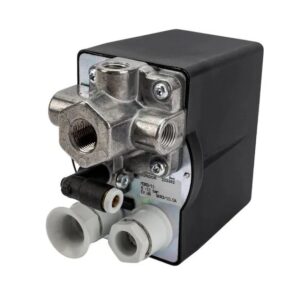
The MDR 21 is the MDR 2/MDR 3 adapted to UL and CSA standards, with pressure in PSI (175 PSI maximum) and voltage ≤ 250 V AC. The lateral cable entry provides a larger terminal compartment. Certification: KEMA KEUR, UL, CSA.
Condor MDR Series Comparison Table
| Model | Supply | Max. pressure | Max. current | ΔP adjustment | Unloader valve | Thermal relay | Features |
|---|---|---|---|---|---|---|---|
| MDR 1 | 220–250 V, 1ph | 11 bar | 16 A | Standard | No | No | Base model, counter option |
| MDR 2 | 220–250 V, 1ph | 11 / 16 bar | 16 A | Standard | Yes (EW/AEW) | No | Unloader valve as standard |
| MDR 3 | 380–400 V, 3ph | 16 bar | 20 A | Standard | Optional | Optional (SKR) | UL/CSA, thermal relay |
| MDR 4 SD | 380–400 V, 3ph | 16 bar | 20 A | Standard | Optional | Optional | Transparent cover with scale |
| MDR 4 SU | 380–400 V, 3ph | 16 bar | 20 A | Standard | Optional | Optional | NO contact function |
| MDR 2i | 220–250 V, 1ph | up to 16 bar | 16 A | Digital | Optional | No | LCD, counter, alarm output |
| MDR 8 | 220–250 V, 1ph | up to 11 bar | 16 A | Fixed | No | No | Mini housing, series production |
| MDR 21 | ≤ 250 V, 1ph | 175 PSI | 16 A | Standard | Optional | No | UL/CSA, lateral cable entry |
How to Adjust a Condor MDR Pressure Switch
Adjustment is carried out with the housing cover removed. The compressor must be de-energised before removing the cover.
Step 1 — Cut-out pressure (P_max). Turn the large adjustment screw (main spring): clockwise — cut-out pressure increases; counter-clockwise — decreases. Verify by running the compressor, waiting for it to stop, and checking the receiver pressure gauge.
Step 2 — Differential (ΔP). The small screw (differential spring) sets the gap between P_max and P_min. Clockwise — differential increases (compressor cuts in later); counter-clockwise — decreases (cuts in more frequently). Minimum permissible differential — 0.5 bar; recommended for most compressors — 2 bar (P_min = P_max − 2 bar).
Important: Condor publishes diagrams of permissible P_max / P_min value pairs for each model. If the chosen pair falls outside the shaded area of the diagram, that combination cannot physically be achieved on the given pressure switch. Example for MDR 1/11: with P_min = 4 bar, P_max can be set between 5.4 and 8 bar.
The Unloader Valve: Why It Matters More Than It Seems
The unloader valve (EW — Entlastungsventil) is not a convenience option — it is motor protection. When a compressor stops, compressed air remains in the discharge line between the compressor block and the receiver check valve. Without an unloader valve, the motor must overcome this pressure from the very first rotation. Starting current rises 5–10 times above nominal and is sustained not for fractions of a second but for several seconds — until the discharge line pressure bleeds down naturally.
The unloader valve automatically bleeds this pressure pocket at every stop. The next start is an unloaded start: normal starting current, minimal winding heat. On compressors with high cycling frequency (starts every 3–5 minutes), the difference in motor service life between MDR 1 (no valve) and MDR 2 (with valve) is a factor of 1.5 to 3.
How to Select the Right MDR Model for Your Compressor
The selection process takes three steps.
First — determine supply voltage and motor power. For single-phase 220 V compressors up to 3 kW — MDR 1 or MDR 2. For three-phase 380 V — MDR 3 or MDR 4.
Second — determine the compressor’s maximum working pressure. Up to 11 bar — MDR 1 or MDR 2/11. Up to 16 bar — MDR 2/16, MDR 3, MDR 4.
Third — assess cycling frequency and operating conditions. Compressor runs with frequent starts (more than 6–8 per hour) — choose MDR 2 with unloader valve. Three-phase motor without built-in thermal protection — MDR 3 with SKR thermal relay. Service life tracking required — MDR 2 or MDR 1 with operating hours counter.
Compatibility: Which Compressors Accept Condor MDR
The Condor MDR pressure switch is factory-fitted on compressors from leading manufacturers: Fiac (Italy), Abac (Italy), Remeza/AirCast (Belarus), Boge (Germany), Kaeser (Germany), Atlas Copco (Sweden/Belgium), as well as the majority of Asian OEM compressors (Fubag, Garage, Patriot, MZB, and equivalents) that use standard G 1/4″ or G 1/2″ mounting dimensions.
When replacing, confirm three parameters: flange thread size, pressure range, and motor voltage/current. Everything else is a matter of version — with or without unloader valve, with or without thermal relay.
Buy Condor MDR Pressure Switches in Moldova
Acvatron SRL supplies Condor MDR series pressure switches in Chisinau. In stock: pressure switches for single-phase (220 V) and three-phase (380 V) compressors, versions with and without unloader valve. Selection by your compressor model — free of charge. Documentation (invoice, certificate) — included.
Acvatron SRL — an engineering approach to every sale.