








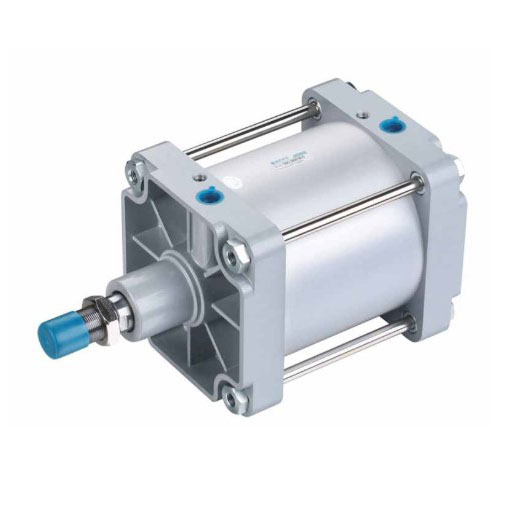

XCPC DNG-200×500-S Pneumatic Cylinder (ISO 15552), Magnetic Piston, Heavy-Duty Series
The XCPC DNG-200×500-S is a double-acting pneumatic cylinder with a 200 mm piston diameter and 500 mm stroke, designed to generate high linear force in industrial equipment. The cylinder belongs to the DNG series according to ISO 15552 and features a magnetic piston for use with non-contact position sensors. The series is designed for operating pressures up to 1.0 MPa (10 bar), with adjustable pneumatic cushioning and an operating speed range of 50–500 mm/s.
1. Purpose and Operating Principle
The XCPC DNG-200×500-S is a double-acting cylinder. The piston rod is extended and retracted by alternately supplying compressed air to the two working chambers.
The 200 mm piston diameter provides high pneumatic force, while the 500 mm stroke allows the cylinder to be used in mechanisms requiring a substantial linear movement of the working element.
The integrated piston magnet allows non-contact position sensors to be installed. This is suitable for automated mechanisms controlled by PLCs, pneumatic directional control valves and position monitoring systems.
Part Number Breakdown
| Designation | Meaning |
|---|---|
| DNG | Standard DNG-series cylinder according to ISO 15552 |
| 200 | Piston diameter — 200 mm |
| 500 | Piston stroke — 500 mm |
| S | Version with magnetic piston for position sensors |
2. Technical Specifications
| Parameter | Value |
|---|---|
| Model | XCPC DNG-200×500-S |
| Series | DNG |
| Standard | ISO 15552 |
| Type | Double-acting pneumatic cylinder |
| Piston diameter | 200 mm |
| Stroke | 500 mm |
| Working medium | Compressed air |
| Operating pressure | 0.1–1.0 MPa (1–10 bar) |
| Test pressure | 1.5 MPa (15 bar) |
| Operating temperature | −5…+60 °C |
| Operating speed | 50–500 mm/s |
| Cushioning | Adjustable pneumatic cushioning |
| Air connections | G3/4″ |
| Rod thread | M36×2 |
| Rod diameter | Ø40 mm |
| Magnetic piston | Yes |
| Lubrication | Not required; Turbine oil ISO VG32 may be used if required |
The main parameters of the DNG Ø200 series are confirmed by XCPC technical documentation.
Theoretical Force
The piston area for a 200 mm diameter piston is approximately 31,416 mm².
At 6 bar, the theoretical extension force is:
F ≈ 18,850 N ≈ 1,885 kgf.
At 10 bar:
F ≈ 31,416 N ≈ 3,204 kgf.
The retraction force is slightly lower because part of the piston area is occupied by the rod. At 6 bar, the theoretical retraction force is approximately 18,096 N ≈ 1,845 kgf.
These are theoretical values. Actual usable force depends on operating pressure, seal friction, speed, load and specific operating conditions.
⚠️ Information Requiring Verification
The publicly available XCPC documentation does not provide all construction dimensions of the DNG-200×500-S as a separate dimensional table specifically for the 500 mm stroke.
Before replacing an existing cylinder, the dimensional drawing of the exact configuration and the mounting arrangement should be checked.
3. Construction Features
| Component / Feature | Specification |
|---|---|
| DNG series | Standard pneumatic cylinders for industrial applications |
| 200 mm diameter | Large piston area and high force |
| 500 mm stroke | 500 mm rod travel |
| Double acting | Pneumatic actuation in both directions |
| Magnetic piston | Enables position monitoring with non-contact sensors |
| Adjustable cushioning | Adjustment of piston deceleration at the end of stroke |
| G3/4″ | Compressed-air connection |
| M36×2 | Rod thread |
| Ø40 mm | Rod diameter |
Main Design Features
Large piston diameter.
The 200 mm piston diameter provides high force without requiring excessively high operating pressure.
500 mm stroke.
The cylinder is suitable for mechanisms where the working element needs to travel approximately half a metre.
Adjustable pneumatic cushioning.
Cushioning reduces piston speed before the end position and helps reduce impact loads on the cylinder end caps.
Magnetic piston.
The integrated magnet allows non-contact position sensors to be used without mechanical limit switches.
ISO 15552 standard.
The DNG series belongs to the standardized industrial cylinder family according to ISO 15552, allowing the use of standard mounting solutions and compatible components.
4. Installation Recommendations
Air Connection
The cylinder ports use G3/4″ threads.
G3/4″ is a cylindrical BSPP thread. When a suitable fitting is used, sealing should be achieved according to the fitting design; PTFE tape should not automatically be applied to the cylindrical thread itself.
Rod Thread
The piston rod has an M36×2 thread.
When selecting a clevis, rod end, joint or other connection component, the thread diameter and pitch must match exactly.
Cushioning
For a cylinder with a 200 mm diameter and 500 mm stroke, correct cushioning adjustment is particularly important.
With a heavy mechanism and high operating speed, insufficient cushioning can result in significant impact loads at the end of the stroke.
Adjustment should be carried out after the cylinder has been installed, taking into account:
- load mass;
- operating speed;
- pressure;
- motion characteristics;
- required cycle time.
Air Preparation
Clean compressed air should be used for normal operation.
The pneumatic system should provide suitable filtration and remove water and condensate. Air quality directly affects the service life of seals and working surfaces.
Lubrication
XCPC specifies that the DNG series can operate without mandatory air lubrication. If lubrication is required, the manufacturer allows Turbine oil ISO VG32 to be used.
If continuous lubrication is introduced into the pneumatic system, the lubrication regime should be maintained. Uncontrolled switching between heavily lubricated air and completely dry operation is not recommended.
5. Alternatives and Comparison
For the DNG-200×500-S, it is more accurate to refer to ISO 15552 standard alternatives rather than claim direct interchangeability with a specific part number based only on identical diameter and stroke.
| Manufacturer | Series / Version | Diameter | Stroke | Comment |
|---|---|---|---|---|
| XCPC | DNG-200×500-S | 200 mm | 500 mm | Model described |
| Festo | DNG-200-…-PPV-A | 200 mm | up to 2000 mm | ISO 15552 series; exact configuration must be checked |
| Camozzi | Series 40K / 63 | 200 mm | 500 mm | Ø200×500 versions are available; mounting and rod details must be checked |
| SMC | CP96 | up to 100 mm in the referenced documentation | — | Ø200 mm is not specified in the referenced series |
Important: before replacing an XCPC cylinder with a cylinder from another manufacturer, check mounting dimensions, rod dimensions, threads, mounting accessories, ports, cushioning and sensor compatibility.
6. Common Mistakes
Using test pressure as operating pressure.
1.5 MPa is the test pressure, not the pressure intended for continuous operation. Maximum operating pressure is 1.0 MPa.
Incorrect mounting selection.
With this diameter and stroke, the loads on mounting components can be significant.
Applying side loads to the piston rod.
The cylinder is primarily designed to generate axial force. Side loads can accelerate guide and rod-seal wear.
Incorrect cushioning adjustment.
Insufficient cushioning can increase end-of-stroke impact, while excessive cushioning can reduce cycle performance.
Using contaminated compressed air.
Dust, water and condensate accelerate wear of internal components and seals.
Incorrect sensor installation.
The magnetic piston allows non-contact sensors to be used, but the sensor must be compatible and correctly mounted.
Mixing thread standards.
G3/4″ and M36×2 belong to different thread systems and cannot be substituted for each other.
Ignoring the load on the machine structure.
At 6 bar, the theoretical extension force is approximately 18.85 kN. Therefore, the frame, brackets, pins and connecting components must be adequately sized.
7. Applications
The XCPC DNG-200×500-S is designed for industrial equipment requiring high pneumatic force and a 500 mm working stroke.
Potential applications include:
- heavy-duty clamping mechanisms;
- movement of large components;
- pressing equipment;
- feeding mechanisms;
- automated production lines;
- actuation of dampers and valves;
- metalworking machinery;
- woodworking machinery;
- construction-material processing equipment;
- automated mechanisms with position monitoring.
For each specific application, the actual load, speed, cycle frequency, mounting arrangement and environmental conditions should be checked.
8. Expert Opinion
When selecting a large-bore pneumatic cylinder, the nominal force should not be the only consideration. For the DNG-200×500-S, the mass of the mechanism, side loads on the rod, operating speed and cushioning adjustment should also be considered.
“For 200 mm bore cylinders, I recommend checking the mechanics of the assembly first: alignment, mounting and the absence of side loads on the piston rod. Speed and end-of-stroke cushioning should then be adjusted. This approach allows the high force capability of the cylinder to be used without excessive loading of the guides and seals.”
Vitali Boluchevski, Lead Engineer, Acvatron SRL, 18 years of experience.
9. FAQ
What force does the XCPC DNG-200×500-S generate?
At 6 bar, the theoretical extension force is approximately 18.85 kN (1,885 kgf). At 10 bar, it is approximately 31.42 kN (3,204 kgf). Actual usable force depends on operating conditions.
What is the stroke of the DNG-200×500-S?
The piston stroke is 500 mm.
What is the operating pressure?
The DNG series has an operating pressure range of 0.1–1.0 MPa, or 1–10 bar. Test pressure is 1.5 MPa.
Does the cylinder have a magnetic piston?
Yes. The S suffix indicates a magnetic piston version designed for use with non-contact position sensors.
Does the cylinder require lubricated air?
The cylinder does not require mandatory lubricated air. If lubrication is required, XCPC specifies Turbine oil ISO VG32.
What is the piston rod thread?
For the 200 mm bore DNG cylinder, XCPC specifies an M36×2 rod thread and a 40 mm rod diameter.
Can it be replaced with a Festo, Camozzi or another manufacturer’s cylinder?
The series complies with ISO 15552, but identical bore and stroke do not guarantee complete mechanical interchangeability. Mounting dimensions, rod dimensions, threads, mounting accessories, ports and sensors must be checked.