










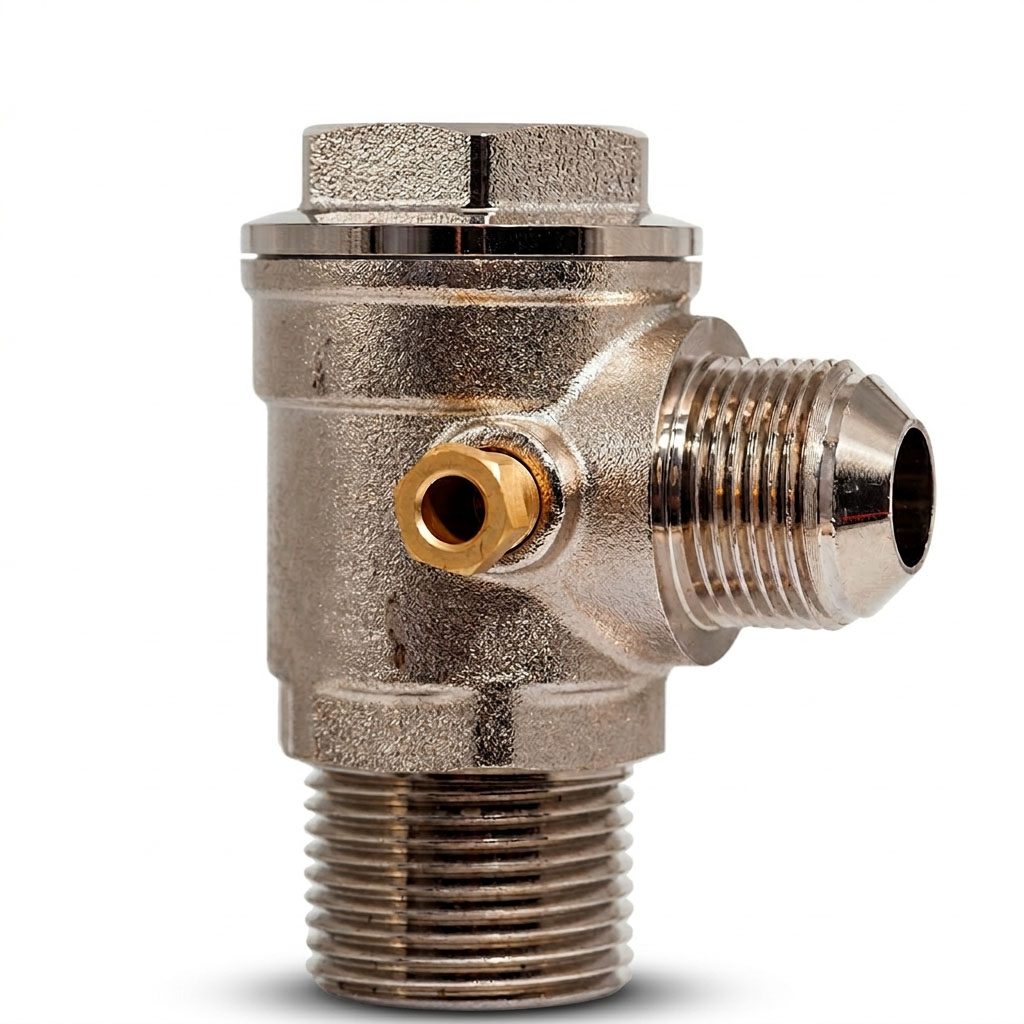
Compressor Check Valve 1″×3/4″ M/M
780,00 MDL
The 1″×3/4″ check valve is a critical component of a piston compressor’s pneumatic system, providing one-way delivery of compressed air from the piston element to the tank and preventing air from flowing back from the tank into the cylinders when the motor stops.
1. Purpose and Operating Principle
The valve is installed directly into the tank’s neck (1″ thread) and connects to the piston element’s discharge port (3/4″ thread). During compressor operation, air passes through the valve in one direction — into the tank; on shutdown, the spring-loaded flap closes off the return path, protecting the piston assembly from a pressure hit from air accumulated in the tank at the next start-up.
“M/M” in the designation stands for “male/male” — both connection ends of the valve have external (male) threads: the 1″ side (to the tank) and the 3/4″ side (from the piston element).
2. Technical Specifications
| Parameter | Value |
|---|---|
| Housing material | High-quality brass |
| Nominal pressure (Py) | 1.6 MPa (16 bar) |
| Connection size 1 | 1″ (to tank) |
| Connection size 2 | 3/4″ (from piston element) |
| Additional port | G1/8″ (for pressure switch unloader tube) |
| Temperature range | up to +180 °C |
| Thread type on both ends | External (“male/male”, M/M) |
| Applicability | Remeza AirCast LB-50, LB-75 piston elements |
| Standards | ISO 9001:2008, TS Declaration of Conformity (pressure equipment safety) |
| Maintenance schedule | Every 1200 operating hours or once a year |
3. Design Features
Designation Breakdown
| Designation element | Meaning |
|---|---|
| Check valve | Product type — one-way valve for pneumatic systems |
| 1″ | Connection thread on the tank side |
| 3/4″ | Connection thread on the piston element side |
| M/M | “Male/male” — external thread on both connection ends of the valve |
Design Solutions
- Brass housing — not prone to seizing of the internal spring and valve seat, which is especially important when operating with wet condensate in the air path
- Hexagonal housing head — allows servicing and cleaning the internal mechanism with a screwdriver/socket wrench without removing the entire assembly from the tank
- Additional G1/8″ port — specifically designed for the pressure switch’s unloader valve tube, eliminating the need for a separate tee fitting on the line
- The spring-loaded flap is rated for working pressure up to 16 bar — with a margin for most domestic and semi-industrial piston compressors (whose working pressure is typically 8–10 bar)
4. Installation Recommendations
- Before installation, fully release pressure from the tank and disconnect the compressor from power.
- To seal the 1″ and 3/4″ threaded connections, anaerobic sealants are recommended, resistant to vibration and the high temperature of discharged air — standard PTFE tape holds up less well in the constant vibration conditions of a piston element.
- Observe the flow direction during installation — the valve is one-way, and installing it backwards completely blocks air supply to the tank.
- Connect the pressure switch unloader tube to the additional G1/8″ port — this is the standard connection point, requiring no extra adapters.
- After installation, run the compressor and check the threaded connections on the valve housing with soap solution — a leak at this stage is most often due to insufficient tightening or improper sealant application rather than a defect in the valve itself.
5. Cross-References and Comparison
Confirmed Cross-Reference
| Manufacturer | Compressor Model | Part Number / Catalog Number | Configuration |
|---|---|---|---|
| Remeza | LB-75 | Part 4242133102, catalog number R35591 | Right-hand |
⚠️ The cross-reference is confirmed only for the Remeza LB-75 element in the right-hand configuration. Exact part numbers for the LB-50 and for the left-hand configuration have not been verified — send a photo of your compressor’s original valve and we’ll find the exact match.
Applicability by Element
Used with Remeza AirCast LB-50 and LB-75 piston elements, as well as in multi-motor tandem units on these elements (for example, СБ4/Ф-500.LB75Т), where several valves are installed on a single tank — one per piston element.
6. Common Mistakes
- Using PTFE tape instead of anaerobic sealant — under the vibration of a piston element, tape compresses over time and the connection starts leaking air.
- Installing the valve in reverse orientation — completely blocks air supply to the tank; the compressor runs but tank pressure doesn’t build.
- Replacing the entire assembly for a simple seat blockage — most of the time it’s enough to unscrew the hexagonal head, remove the valve, and clean the seat of carbon deposits, without replacing the whole valve.
- Ignoring the maintenance schedule — skipping scheduled service every 1200 operating hours or once a year leads to gradual seal wear and regular leaks through the pressure switch’s unloader valve.
- Confusing “the valve is leaking” with “the pressure switch is faulty” — both cases produce a similar symptom (hissing after shutdown), but are diagnosed and fixed differently (see FAQ).
7. Application
- Industrial and semi-industrial piston compressors on LB-50 and LB-75 elements
- Multi-motor tandem compressor units with several piston elements on a single tank
- Trunk pneumatic lines — as an additional equipment protection element against air backflow
8. Expert Opinion
“The main symptom of a fault in this assembly is constant hissing from under the pressure switch after the compressor stops. This means the check valve is ‘leaking’ due to seal wear or carbon particles getting under the seat. Per the schedule, check valve maintenance should be performed every 1200 operating hours or once a year. Don’t rush to replace the whole assembly: it’s usually enough to unscrew the hexagonal head, remove the valve, and clean the seat of debris. If the hissing doesn’t stop even after cleaning — check whether the source is actually the pressure switch’s own unloader valve rather than the check valve: the symptoms are similar, but the causes and repairs differ.”
Vitali Boluchevski, Lead Engineer, Acvatron SRL, 18 years of experience
9. FAQ
❓ Why does the compressor hum and fail to start when there’s air in the tank? The likely cause is sticking or leaking of the check valve. Air from the tank pushes against the pistons, preventing the motor from reaching speed. A faulty pressure switch unloader valve can also be the cause — check both components.
❓ Can PTFE tape be used when installing the valve into the tank? For sealing, specialized anaerobic sealants are recommended, resistant to vibration and the high temperature of discharged air — they hold the connection more reliably than PTFE tape under the constant vibration of a piston element.
❓ How can I test the valve without disassembling it? Stop the compressor and wait for pressure to release through the pressure switch. If air continues escaping from the unloader valve (the hissing doesn’t stop), the check valve needs cleaning or replacement. You can also check the connection with soap solution: persistent bubbling indicates a leak through the valve or the threaded connection.
❓ How often does the check valve need servicing? The schedule is every 1200 operating hours of the compressor or once a year, whichever comes first.
❓ Does this valve fit any piston compressor with a 1″×3/4″ thread? The valve is designed for Remeza AirCast LB-50 and LB-75 elements. For other brands with the same thread, dimensional compatibility is usually maintained, but the exact match (including whether a right- or left-hand version is needed) is best confirmed with the manager by sending a photo of the original valve.