











Technical Specifications
| Parameter | Value |
|---|---|
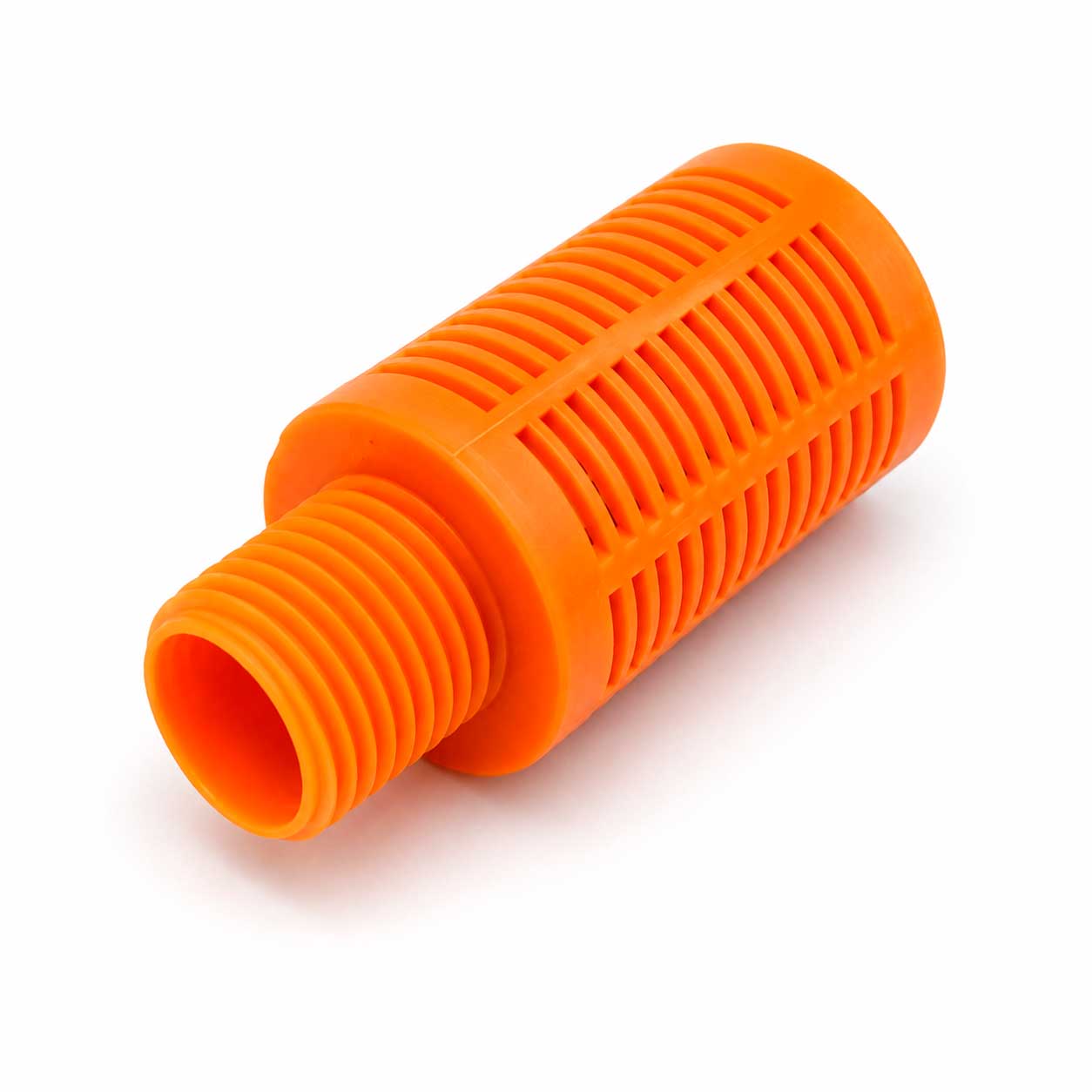
| Purpose | Breather (vent) valve for compressor |
| Thread type | R 1/4″ (external taper, ISO 7-1 / BSPT) |
| Thread diameter, mm | 12.7 |
| Thread pitch, mm | 1.25 |
| Overall length, mm | 44.0 |
| Threaded section height, mm | 10.0 |
| Body material | Plastic (polyamide) |
| Color | Yellow |
| Filter element material | Polymer mesh / foam insert |
| Operating temperature, °C | −10…+90 |
| Max. crankcase overpressure, bar | up to 1.0 |
| Thread sealing | PTFE tape or taper self-seal (no gasket) |
| Compatibility | Piston compressors with an R 1/4″ port |
| Weight, g | ~8 |
💡 Expert tip: the plastic R 1/4″ breather is rated up to +90 °C. On powerful two-stage compressors with long duty cycles, crankcase cover temperature can exceed this limit — in such cases a metal equivalent with a brass body is recommended instead.
Design Features
The body is molded from impact-resistant yellow plastic — the marking color used by most household compressor manufacturers for quick visual identification of the breather among other threaded plugs. The tapered R 1/4″ thread (unlike a cylindrical G thread) provides self-sealing on tightening without an extra gasket, which is convenient for frequent replacement. Inside the body is a simple labyrinth with a filter insert that captures coarse dust and prevents oil mist discharge. The compact 44 mm length and 10 mm thread height allow installation in tight spaces — under a belt guard or inside a compressor frame recess.
Installation Recommendations
- Stop the compressor and wait for the crankcase to cool (below +40 °C).
- Unscrew the old plug or worn breather with a suitably sized wrench.
- Clean the port thread of old sealant, carbon deposits, and dirt.
- Wrap the new breather’s thread with 2–3 turns of PTFE tape in the tightening direction — the tapered R 1/4″ thread needs sealing to guarantee tightness under vibration.
- Screw the breather in by hand until snug, then tighten an additional 1/4–1/2 turn with a wrench, without excessive force — the plastic body cracks easily if overtightened.
- Start the compressor and check the mounting area for oil leaks after 10–15 minutes of operation.
Brand Equivalents
| Brand | Part/series | Thread type | Key parameter | Note |
|---|---|---|---|---|
| SMC | AF breather series | R 1/4″ | Length 40–45 mm | Full thread compatibility, metal body — higher heat resistance |
| AIGNEP | breather valve series | R 1/4″ | Plastic/brass | Direct equivalent by mounting size |
| Festo | vent plugs | G 1/8″–1/4″ | Requires verification | Often cylindrical thread — check the profile before replacing |
| Camozzi | small-compressor breather series | R 1/4″ | Length 42–48 mm | Compatible, height differs by up to 4 mm |
| Metal Work | breather valve | R 1/4″ | Plastic | Budget equivalent, identical geometry |
⚠️ Substitution note: before installing an equivalent from another brand, always verify (1) thread type — tapered R vs. cylindrical G, which are not interchangeable without an adapter; (2) overall length — insufficient clearance under a guard may cause the breather to touch the belt cover; (3) body material heat resistance — plastic breathers are limited to +90…+100 °C.
Common Installation Mistakes
- Fitting a blind plug instead of a breather — raises crankcase pressure and forces oil out through the seals within the first hour of operation.
- Skipping sealing tape on the tapered thread — compressor vibration gradually loosens the joint, causing an oil leak along the thread.
- Overtightening the plastic body — cracks the thread base, which doesn’t show immediately but appears after several heating-cooling cycles.
- Installing a cylindrical-thread breather into a tapered port — the thread doesn’t fully seat, leaving a gap and a leak.
- Ignoring a clogged filter — a blocked breather creates the same pressure as a blind plug, with the same result: oil forced out through the seals.
Practical Use Cases
- Small domestic compressors (up to 50 L tank, 1.5–2.2 kW) — routine breather replacement during scheduled maintenance every 300–500 operating hours.
- Auto service and tire shops — higher dust levels require more frequent replacement, every 2–3 months.
- Woodworking and furniture workshops — wood dust clogs the filter quickly; additional shielding or more frequent blow-out is recommended.
- Compressors used for spray painting — if solvent vapor reaches the breather area, verify plastic compatibility with aggressive vapors.
Expert Opinion
Vitali Boluchevski, Acvatron SRL, compressor equipment engineer
“Under Moldovan conditions — with summer heat above +35 °C and heavy dust at many sites — a plastic R 1/4″ breather typically lasts 6–8 months with regular compressor use. The most common mistake I see from customers: screwing the breather in without PTFE tape, relying on the tapered thread’s seal alone. On a new breather this works, but after 2–3 months of vibration the joint starts to leak. My advice: always use 2–3 wraps of tape, even on a tapered thread, and once a season check the breather by blowing through it — if you feel strong resistance, replace it; it’s inexpensive and takes five minutes.”
FAQ
Will this breather fit a screw (rotary) compressor? No. Screw compressors use a check-valve breather rated for 4–8 bar in a sealed oil circuit. This model is intended only for piston compressors and receiver tanks with atmospheric crankcase pressure.
How do I tell if my port thread is tapered (R) or cylindrical (G)? A tapered R thread narrows toward the end and screws in by hand, sealing without a gasket, until noticeable resistance is felt. A cylindrical G thread has a constant diameter along its length and requires a washer or O-ring. If unsure, send us a close-up photo of the port thread.
Can this breather be used on a compressor intended for drinking water or food production? The standard plastic breather is not certified for contact with drinking water. For food and medical applications, check with our team for certified equivalents in food-grade plastic or stainless steel.
What torque should the breather be tightened to? For the plastic body — hand-tight until snug, plus 1/4–1/2 turn with a wrench. No exact torque is specified by the manufacturer due to the self-sealing tapered thread; the key is not to exceed the resistance you feel, to avoid cracking the body.








Reviews
Clear filtersThere are no reviews yet.