






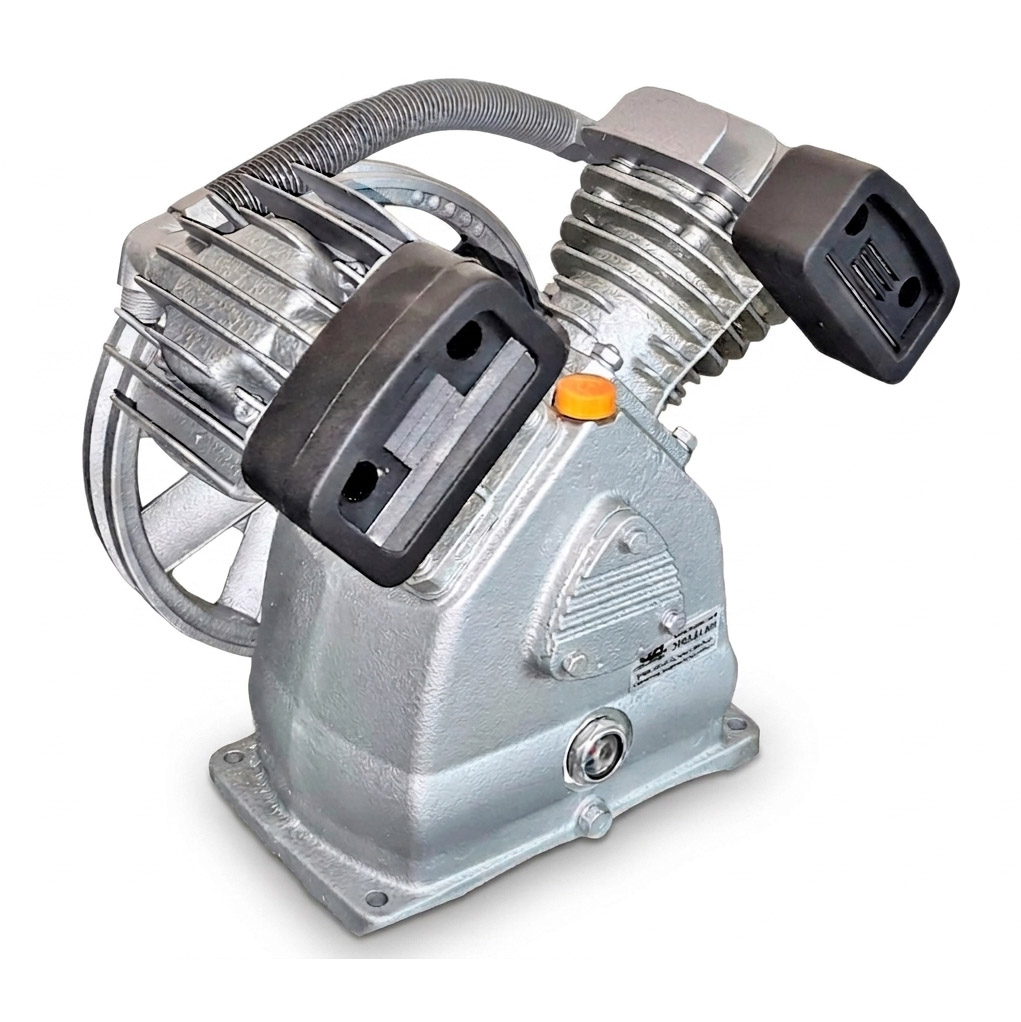
LB30 Technical Specifications
| Parameter | Value |
| Number of cylinders | 2 (V-configuration) |
| Recommended motor power | 2.2 kW |
| Input capacity (theoretical) | 420 l/min |
| Output capacity (effective) | 340 l/min |
| Maximum working pressure | 10 bar |
| Crankshaft speed | 1,100 rpm |
| Cylinder bore | 65 mm |
| Block material | Cast iron (cylinders and crankcase) |
| Lubrication type | Oil (splash lubrication) |
| Cooling | Air, via flywheel fan |
| Block weight | 18 kg |
| Compatibility | Aircast (Remeza) compressors, units with a matching mounting pattern |
Advantages and Design Features (USPs)
- Stable performance under continuous load. Unlike lightweight aluminum blocks, the LB30’s cast-iron construction holds cylinder geometry through long duty cycles — the unit doesn’t drift out of shape from heat, which matters for continuous-duty use on production lines.
- High compression efficiency at low piston speed. The reduced crankshaft speed (1,100 rpm) lowers friction-zone temperature and extends piston ring life — the block delivers 340 l/min output without forcing the operating regime.
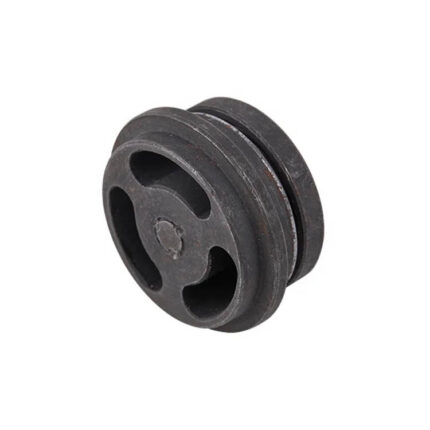
- Effective heat dissipation. A specially shaped flywheel drives airflow across the cylinder fins, preventing valve-plate overheating during long tank-fill cycles.
- Serviceability and parts availability. The unit uses the standard Aircast-line mounting pattern — the valve plate, rings, and connecting-rod bearings are sold separately, lowering total cost of ownership over a 5–7 year horizon.
- The 340 l/min / 10 bar range covers most typical workshop tasks — from impact wrenches to LVLP paint stations — without needing a separate compressor for every operation.
Application Areas
- Auto service and tire shops — impact wrenches, blow guns, tire inflation.
- Body repair and painting — LVLP spray guns and light HVLP guns, paired with a receiver of 100 l or more.
- Woodworking and installation work — pneumatic staplers, nailers, small pneumatic cylinders.
- Small-scale production and assembly lines — intermittent operations that don’t require the compressor to run at 100% continuous load.
Expert Opinion: Vitali Bolucevschi
“When helping customers choose the LB30 block, I always point out the difference between 420 l/min at the input and 340 l/min at the output — the second figure is what’s actually available to your tool. Paired with a 2.2 kW motor, this unit shows one of the best energy-efficiency ratios in its class. The equipment is ISO 9001 certified. My advice: fit a 100-liter receiver — it smooths out pulsations and extends the interval between services.”
Frequently Asked Questions
Why is the output capacity (340 l/min) lower than the input capacity (420 l/min)?
This is a normal physical process: some air is lost to heat, the clearance volume in the compression chamber, and valve resistance. 340 l/min is the real flow rate to use as a reference when selecting tools.
Is the LB30 enough for painting a car?
Yes, this volume is sufficient for LVLP spray guns. For HVLP guns, which use more air, a larger receiver is recommended to cover peak demand.
Can output be increased by raising the motor speed?
No. Exceeding the factory-rated 1,100 rpm causes overheating, accelerated valve-plate wear, and voids the warranty — the factory setting already balances service life and output.