











Why a Condensate Drain Is Needed and What Happens Without One
Compressed air always contains water vapour. During compression and cooling, moisture condenses — in the receiver, filters, and pipework. If condensate is not removed regularly:
- The receiver corrodes from the inside — water + oxygen = rust that flakes off and contaminates tools and products
- Filters lose effectiveness — a filter bowl full of condensate allows moisture to pass further into the system
- Dryers become overloaded — excess condensate shortens refrigerant and adsorbent service life
- Pneumatic cylinders and valves fail — water washes away lubricant and causes rod corrosion
- Painting, welding, laser cutting — even a small amount of moisture in the air degrades quality
A condensate drain is the automatic solution: it expels condensate on a schedule with no operator involvement.
Why the Solenoid Timer Type Is Better Than a Float Drain
Float-type condensate drains are the most common but least reliable type:
| Parameter | Float type | Solenoid timer type (this model) |
|---|---|---|
| Operating principle | Mechanical float | Programmable timer relay |
| Sensitivity to contamination | High — particles block the valve | Low — built-in strainer protects the valve |
| Failure in open position | Common — condensate flows continuously | None — NC valve stays closed on power loss |
| Failure in closed position | Common — particles trap the float | Rare — timer forces the valve open |
| Manual drain | Separate operation | Built-in ball valve |
| Drain interval adjustment | Not possible | Programmable (open duration and frequency) |
| Service life | 2–5 years with contaminated air | 5–10 years under normal conditions |
Conclusion: the solenoid timer drain is more reliable, adjustable to the actual condensate formation rate, and independent of air quality.
Three-in-One Design: What’s Inside the Housing
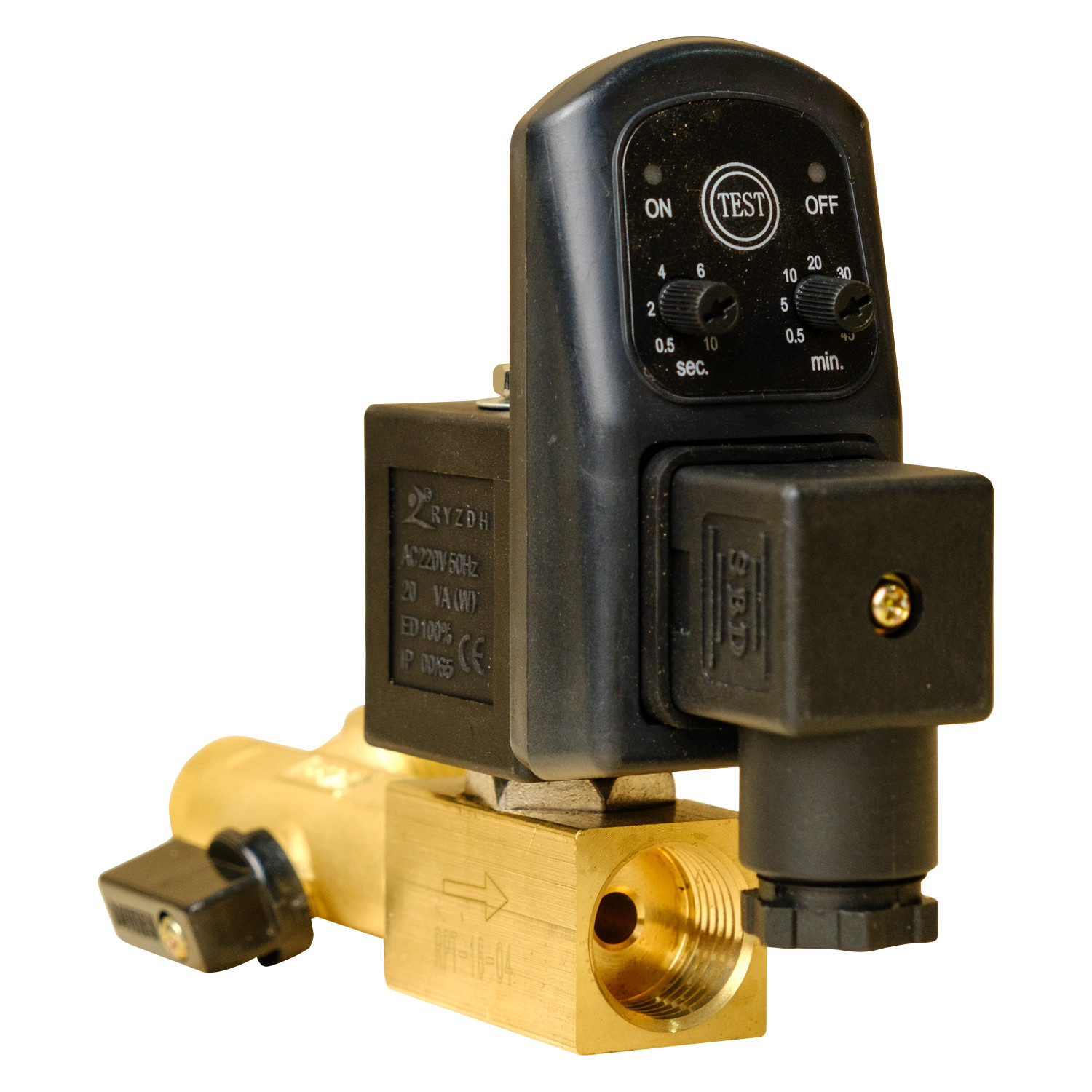
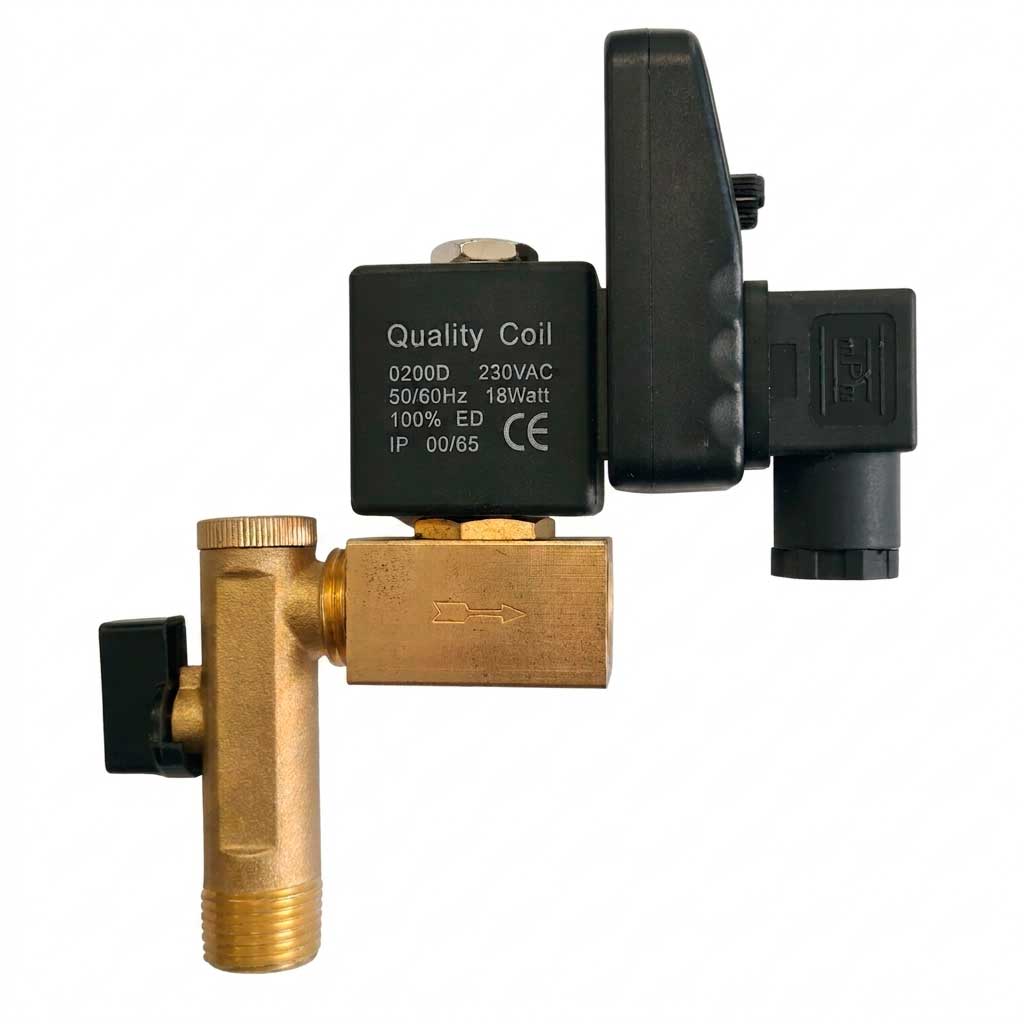
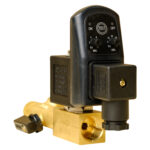
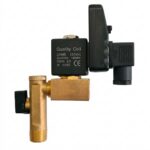
1. 2/2 NC Direct-Acting Solenoid Valve Normally Closed (NC) means: with no power, the valve is closed — condensate does not drain. When 220V is applied to the coil, the valve opens for the timer-set duration and condensate is expelled. Direct action ensures reliable operation regardless of differential pressure.
2. Built-In Mechanical Strainer Protects the solenoid valve seat from solid particles (scale, rust, debris from the receiver). This is the key difference from basic solenoid valves — the built-in strainer prevents the primary cause of failure: seat fouling.
3. Manual Ball Valve Allows manual condensate drain without energising the coil — for maintenance, testing, or emergency drain when the power supply is off.
Programmable Timer Control
The unit includes a programmable timer with two independent settings:
- Interval between drains (pause) — how frequently the valve opens. Range: from a few minutes to several hours. Adjusted to match condensate formation rate: more condensate — shorter interval.
- Valve open time (drain duration) — how long the valve stays open. Typically 1–10 seconds. Long enough to expel accumulated condensate, but not so long as to waste compressed air pressure.
💡 Setting guide: start with a 30-minute pause and a 3-second drain duration. Check after a few days — if condensate is not accumulating, increase the pause; if the valve is expelling only air with no condensate, reduce the drain duration.
Technical Specifications
| Parameter | Value |
|---|---|
| Type | Timer-controlled solenoid condensate drain |
| Coil voltage | AC 220V, 50/60 Hz |
| Valve type | 2/2 NC (normally closed), direct acting |
| Working pressure | up to 16 bar |
| Inlet connection | G 1/2″ Male |
| Outlet connection | G 1/2″ Female — for drain hose |
| Housing material | Aluminium |
| Seal material | FPM (fluorocarbon rubber, Viton) |
| Built-in strainer | Yes |
| Manual valve | Yes (ball valve) |
| Control | Programmable timer relay |
| Working medium | Compressed air, condensate |
| Protection class | IP65 |
Where to Install the Condensate Drain
The condensate drain is mounted at the lowest point of the vessel or line — where condensate collects under gravity:
Compressor receiver The primary condensate accumulation point. Fitted to the lower drain port of the receiver. Drain interval — every 30–120 minutes depending on compressor load.
Main line filters Coarse and fine filters have a lower bowl for condensate and oil collection. The drain replaces the manual drain cock. Interval — every 15–60 minutes.
Refrigerant dryer At the dryer outlet, air temperature rises and some moisture re-condenses — the drain automatically removes this condensate.
Low points in the distribution line At bends and low points in the pipework, condensate accumulates and flows toward consumers. Installing a drain at each low point prevents this.
Cyclone separators and moisture separators The lower port of a cyclone is the optimal mounting location.
Recommended Installation Layout
Compressor → Receiver → [drain] → Dryer → Filter → [drain] → Consumer
                ↓                             ↓
          (lowest point)               (lowest point)
The drain hose from the G 1/2″ Female outlet port is directed to a collection sump or a condensate treatment system.
⚠️ Important: condensate from a compressed air system contains oil — it must not be discharged directly to drain without an oil-water separator. Use a collection vessel or a condensate treatment system.
5 Reasons to Choose a Solenoid Drain Over a Float Drain
1. Works with contaminated condensate Float valves are blocked by solid particles from the receiver. The built-in strainer in this model protects the valve seat from fouling.
2. No air loss on failure An NC valve remains closed on power loss or component failure. A float valve frequently sticks open on failure — the compressor loses pressure.
3. Adjustable to any operating pattern Compressor output, air temperature, and ambient humidity all affect condensate volume. The timer allows precise interval adjustment to match actual site conditions.
4. Manual drain without depressurising The built-in ball valve allows manual condensate drain at any time — for inspection or maintenance without stopping the system.
5. FPM seals for aggressive condensates Compressor condensate contains oil, acids, and mechanical particles. FPM (Viton) is the most chemically resistant seal material available, outperforming NBR and EPDM in demanding conditions.
Expert Opinion
“On most compressors up to 15 kW that we service, the condensate drain is the first thing overlooked at installation and the first thing that causes problems a year later. The typical scenario: the float valve on the filter has stuck — the owner doesn’t know, the filter bowl is full of condensate, water is going into the line, then rust in the cylinders and ruined paintwork. The solenoid timer drain solves this systematically: even if the filter is overloaded — the timer will open the valve strictly on schedule. The one thing to set correctly is the drain duration: too long and you’ll be pushing air through along with the condensate, losing system pressure. 2–5 seconds is the optimum for most receivers up to 500 litres.”
Vitaly Boluchevsky, Chief Engineer at Acvatron SRL, 15 years in the industry
FAQ
❓ What is the difference between a normally closed (NC) and normally open (NO) valve? An NC valve is closed with no power and opens when voltage is applied. An NO valve works in reverse. For a condensate drain you need the NC type: in a de-energised state (fault, power cut) the valve stays closed and does not vent system pressure.
❓ How is the drain hose connected to the G 1/2″ outlet port? The G 1/2″ Female outlet port (internal thread) is designed for connecting a drain hose or tube. Use a G 1/2″ Male nipple with a hose barb of the required diameter. Route the drain hose to a collection sump or a dedicated vessel for oil-containing condensate.
❓ Does the compressor need to be shut down to install the condensate drain? Yes. Before fitting, the compressor must be stopped and pressure bled from the receiver and filter to zero. Working under pressure when replacing a condensate drain is dangerous. After installation, check all connections for leaks under pressure using soapy water.
❓ How often does the solenoid condensate drain need servicing? Every 6–12 months, clean the built-in strainer of accumulated particles. Remove the filter element and flush it with clean solvent or compressed air. Check the valve seat for leaks: if the valve seeps in the closed position — replace the seals or the complete valve.
❓ Can this drain be used in systems handling oil or aggressive liquids? Yes. FPM (Viton) seals are compatible with oils, fuels, weak acids, and aggressive condensates — which is precisely why FPM is specified for industrial pneumatic systems where condensate contains compressor oil.









Reviews
Clear filtersThere are no reviews yet.