



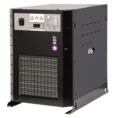




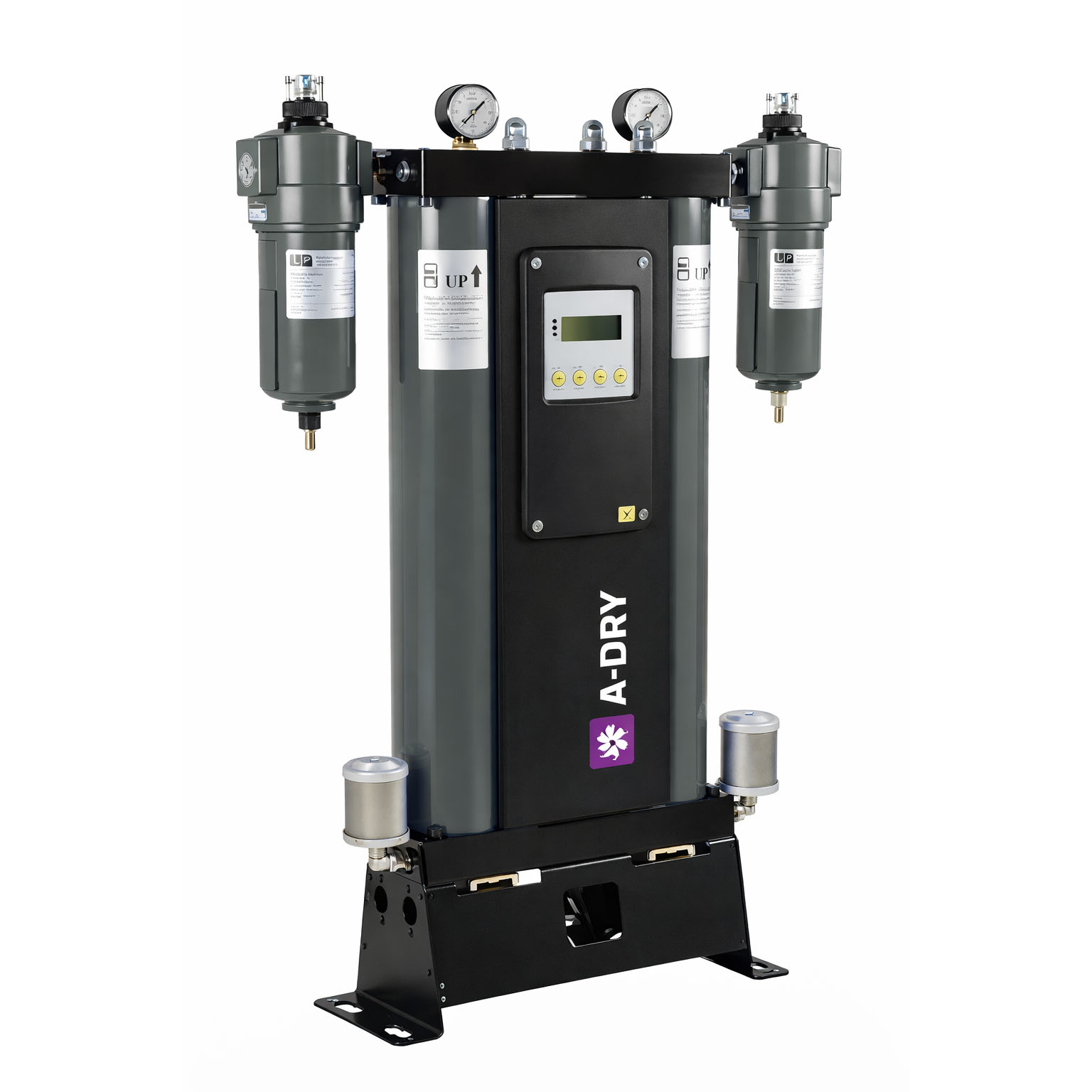

A-DRY 60 Technical Specifications
| Parameter | Value |
|---|---|
| Nominal inlet flow | 60 Nm³/h |
| Nominal outlet flow* | 47.4 Nm³/h |
| Working pressure | 4–16 bar |
| Inlet air temperature | +1.5…+50 °C |
| Pressure dew point (PDP) | −40 °C (optionally −70 °C) |
| Connection (inlet/outlet) | G 3/4″ |
| Protection class | IP 65 |
| Power consumption | < 35 W |
| Dimensions (H × W × D) | 972 × 370 × 148 mm |
| Unit weight | 45.0 kg |
*Outlet flow is calculated allowing for average regeneration losses of 17.3%.
💡 Important: when set to a −70 °C dew point, a correction factor of CD = 0.7 applies for calculating actual throughput. At other working pressures, use the COP correction factors (from 0.63 at 4 bar to 2.13 at 16 bar).
How Adsorption Drying Works: The Principle in Brief
Unlike a refrigerant dryer, which cools the air to condense moisture out of it, the A-DRY 60 adsorption dryer passes air through a bed of desiccant material that physically binds water molecules onto its surface.
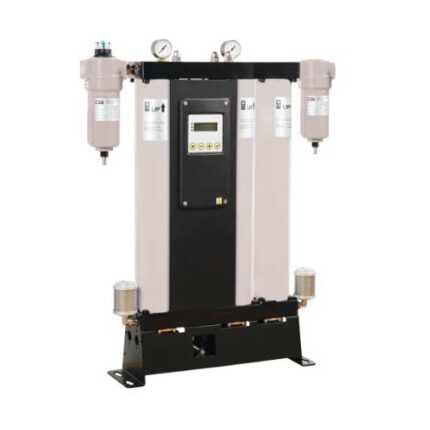
The unit operates on a two-tower scheme: while one tower is drying the working air flow (adsorption phase), the second is regenerating — purged with a portion of the already-dried air to remove accumulated moisture (regeneration phase). The towers switch cyclically, providing a continuous supply of dry air with no interruption to the process.
5 Design Advantages of the A-DRY 60
1. Two-Layer Adsorbent Bed
The towers use a combination of materials: a primary layer of high-efficiency molecular sieve and a protective bottom layer of water-resistant silica gel. This prevents degradation of the primary desiccant from droplet moisture ingress and ensures deep, stable drying over the entire service life of the bed material.
2. 4 Independent Valve System
Four independent solenoid valves control the adsorption and regeneration cycles, rather than a traditional multi-port valve. This arrangement is more reliable, provides precise phase switching, and significantly simplifies diagnostics during maintenance — each valve can be checked and replaced individually without dismantling the whole assembly.
3. Spring-Loaded Desiccant Retention
Each tower is fitted with an internal spring that continuously compresses the adsorbent bed. This eliminates granule-to-granule friction and so-called “channelling” — the formation of through-channels in the desiccant bed that allow air to pass without being dried. The design prevents dust formation and extends the bed material’s service life.
4. Optimised 10-Minute Working Cycle
The cycle time distribution — 5 minutes adsorption, 4 minutes regeneration, 1 minute repressurisation — reduces valve switching to 12 times per hour. This lowers mechanical wear on the valves and improves overall system stability compared to dryers with more frequent cycles.
5. Standby Mode
Receiving a signal from the compressor via a dry contact, the controller halts the regeneration cycle during periods of no air consumption, fully eliminating the associated compressed air losses. This makes the A-DRY 60 one of the most economical models in its class for facilities with variable operating schedules.
Expert opinion: “The A-DRY 60 stands out in the market specifically because of its Standby mode. In facilities with intermittent schedules — two-shift operation, weekends, seasonal demand — this feature saves a meaningful volume of compressed air that would otherwise be wasted on regeneration while the compressor is idle.”
Vitaly Boluchevsky, Chief Engineer at Acvatron SRL
Simplified Servicing
The removable tower design allows the desiccant to be replaced within minutes — simply undo two side screws to fully remove a tower for servicing. This reduces equipment downtime during scheduled maintenance and lowers the workload for the service team.
Maintenance schedule:
- Annually — replace filter elements and silencers
- Every 4 years — full service kit including desiccant replacement
A-DRY Range: Model Selection by Capacity
| Model | Connection | Inlet flow (Nm³/h) | Outlet flow* (Nm³/h) | Dimensions A×B×C (mm) | Weight (kg) |
|---|---|---|---|---|---|
| A-DRY 06 | G 3/8″ | 6 | 4.7 | 339×280×100 | 10.5 |
| A-DRY 12 | G 3/8″ | 12 | 9.5 | 573×280×100 | 13.5 |
| A-DRY 24 | G 3/8″ | 24 | 19.0 | 1041×280×100 | 19.0 |
| A-DRY 36 | G 3/8″ | 36 | 28.4 | 1509×280×100 | 27.5 |
| A-DRY 60 | G 3/4″ | 60 | 47.4 | 972×370×148 | 45.0 |
| A-DRY 75 | G 3/4″ | 75 | 59.3 | 1167×370×148 | 53.0 |
| A-DRY 105 | G 3/4″ | 105 (117) | 83 | 1567×370×148 | 70.0 |
| A-DRY 150 | G 1″ | 150 | 118.5 | 1345×440×198 | 170.5 |
| A-DRY 200 | G 1″ | 200 | 158 | 1538×440×198 | 182.2 |
| A-DRY 250 | G 1 1/2″ | 250 | 196 | 799×740×405 | 410.5 |
| A-DRY 300 | G 1 1/2″ | 300 | 235 | 899×740×405 | 427.7 |
| A-DRY 400 | G 1 1/2″ | 400 | 313 | 1094×740×405 | 461.9 |
| A-DRY 600 | G 1 1/2″ | 600 | 470 | 1484×740×405 | 530.0 |
*Specifications are given at 7 bar working pressure, 35 °C inlet temperature, and a −40 °C dew point. Outlet flow is calculated allowing for average regeneration losses of 17.3%.
💡 Not sure which model you need? Your compressor’s output capacity should equal or exceed the dryer’s inlet flow. Send your compressor’s nameplate data to an Acvatron SRL engineer and we’ll identify the exact model from the A-DRY range.
Applications
Food and Pharmaceutical Industry Prevents microbial growth in aseptic processes; meets ISO 8573-1 classes 1–3.
Electronics and Precision Engineering Protects sensitive components from oxidation and corrosion during assembly and testing.
Chemical Industry Drying process air and inert gases for production lines.
Paint and Coating Production Ensures flawless coating quality with no defects caused by moisture in the spray air.
Compliance with International Standards
Omega Air equipment is certified to leading global regulations:
- ISO 8573-1 — compressed air purity standard
- PED 2014/68/EU / EN 13445 — European directives for pressure equipment
- ISO 9001:2015 — certified quality management system
- GOST-R / TR TS — confirmed compliance with EAEU technical regulations
FAQ
❓ How often does the service kit need to be replaced on the A-DRY 60? Standard annual maintenance includes replacing the filter elements and silencers. A full service kit with desiccant replacement is recommended once every four years.
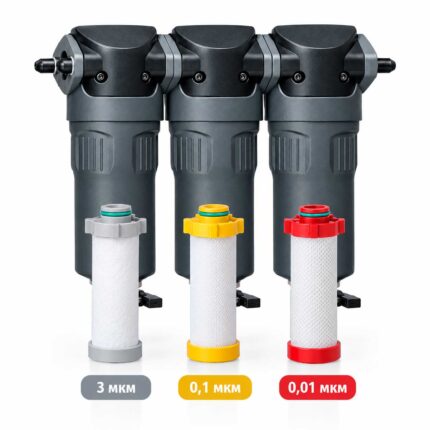
❓ What level of pre-filtration is required before the dryer? To protect the adsorbent from oil and contaminants, a super-fine filter (0.01 µm) must be installed on the inlet. If the dryer is supplied without a built-in filter, the inlet air must meet ISO 8573-1 class 1.
❓ Can the dew point be set to −70 °C? Yes, the controller supports −25 °C, −40 °C, and −70 °C settings. When set to −70 °C, a correction factor of CD = 0.7 must be applied to correctly calculate the throughput capacity.
❓ What is the difference between the A-DRY 60 and a refrigerant dryer? A refrigerant dryer cools the air and achieves a dew point of around +3 °C — sufficient for most general industrial applications. The A-DRY 60 is an adsorption type, reaching −40 °C (optionally −70 °C). The choice depends on your requirements: if you need freeze protection outdoors, particularly clean air for food/pharmaceutical production, or compliance with ISO 8573-1 classes 1–3, you need an adsorption dryer specifically.
❓ Can the A-DRY 60 be used for breathing air? The standard A-DRY 60 model is designed for technical compressed air. For breathing air to EN 12021, Omega Air offers a dedicated version — the A-DRY 60 BM. Check with an Acvatron SRL manager for the version required for your application.
Why Acvatron SRL
Genuine Omega Air equipment with certificates Acvatron SRL supplies Omega Air (Slovenia) adsorption dryers with a full certification package: ISO 9001, PED 2014/68/EU, GOST-R/TR TS.
Model selection based on your compressor parameters Provide your compressor’s output and pressure — an Acvatron SRL engineer will identify the exact model from the A-DRY 06–600 range, including breathing-air versions.
Complete air treatment solution In addition to dryers, Acvatron SRL supplies fine filters, receivers, and pressure regulators — for building a complete compressed air treatment system tailored to your process requirements.
Service and maintenance Acvatron SRL carries out installation, commissioning, and scheduled servicing of A-DRY dryers, including desiccant replacement per the maintenance schedule.
Documents for legal entities All items are supplied with full accompanying documentation. For companies — VAT invoice and contract.
Problems You May Have Already Faced
- Condensate in the pneumatic line — a refrigerant dryer only reduces the dew point to around +3…+5 °C, so when outdoor or workshop temperatures drop, water condenses directly inside pipes and equipment.
- Lines freezing in winter — on open sites or in unheated workshops, moist air turns to ice inside pipework, blocking pneumatic tools and valves.
- Process rejects caused by moisture — in coating, pharmaceuticals, and electronics, even a small amount of moisture in the air can spoil a production batch or damage sensitive components.
- Internal corrosion of the pneumatic system — condensate destroys valves, cylinders, and piping over years, and the damage is only discovered when a failure occurs.
- A refrigerant dryer cannot meet the technical specification — ISO 8573-1 classes 1–3 or the EN 12021 breathing air standard are physically unachievable with refrigerant drying.
If your process requires a dew point below −20 °C, adsorption drying is the only solution. The A-DRY 60 covers this requirement for flows up to 60 Nm³/h.









Reviews
Clear filtersThere are no reviews yet.