










Screw vs Scroll Compressor: What’s the Difference and Which to Choose

When choosing a compressor for a production facility, auto service centre, laboratory, or other site, a common question arises between two air compression technologies — rotary screw and scroll. Both technologies deliver reliable performance, but they’re built for different air demand levels and operating conditions. The difference in design directly affects output capacity, noise level, maintenance requirements, and overall cost of ownership.
How a scroll compressor works
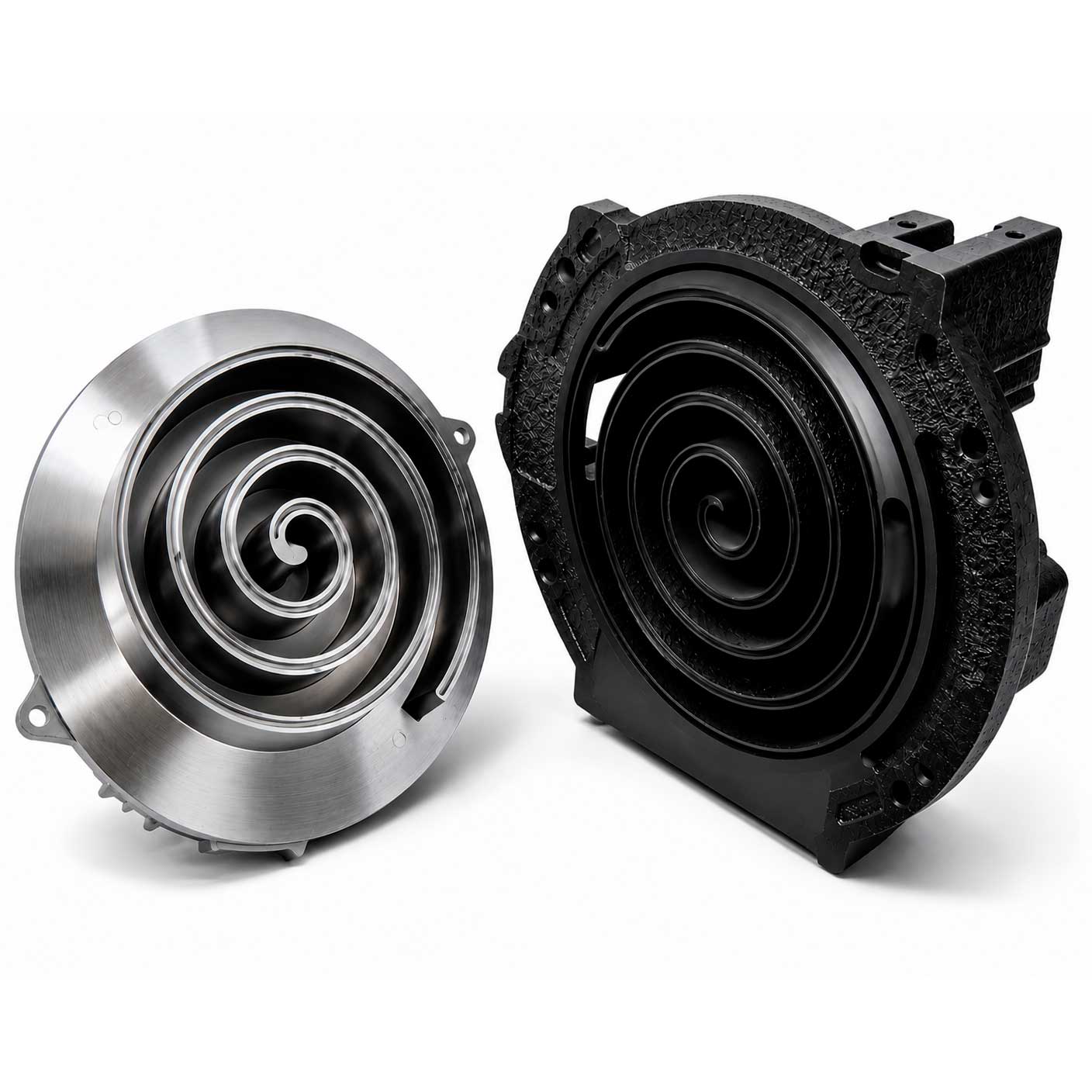
A scroll compressor compresses air using two spiral-shaped scroll elements: one stays fixed, while the other orbits around it. This motion traps air in enclosed pockets between the scrolls, which gradually shrink in volume as they move toward the centre, creating compression. Air enters through the outer suction area and exits through the central channel already at working pressure.
Thanks to few moving parts and tight internal sealing, scroll compressors are compact, reliable, and quiet. Most units produce oil-free air, which reduces the risk of oil entering the pneumatic system and lowers maintenance needs.
Typical characteristics:
- output typically between 2 and 15 CFM (cubic feet per minute);
- working pressure usually 90–120 psi (roughly 6–8 bar);
- quiet operation — around 70–75 dB;
- oil-free design with minimal oil carryover;
- compact footprint, minimal installation space required.
Limitations:
- not suited to high air demand or large industrial processes;
- fixed output reduces energy efficiency at partial load;
- less durable in harsh operating conditions compared to screw compressors;
- not designed for continuous round-the-clock operation.
How a rotary screw compressor works
A rotary screw compressor compresses air using two interlocking rotors — one male, one female. As they rotate, air enters through the suction port and gets trapped between the rotors and the housing. As rotation continues, the air volume decreases, raising pressure until the air exits through the discharge port.
This design provides steady airflow, good efficiency, and less heat build-up compared to piston compressors. Most rotary screw compressors use oil injection for lubrication, cooling, and sealing of the screw pair, though oil-free models also exist for applications where clean compressed air is essential.
Key advantages:
- high output — often 10–500+ CFM;
- reliable for continuous 24/7 operation;
- suited to industrial tasks with high air demand;
- variable speed drive (VSD) models improve energy efficiency.
Limitations:
- higher cost compared to compact compressors;
- oil-injected models require regular oil and filter maintenance;
- more complex servicing compared to scroll units.
Screw vs scroll compressor comparison
| Parameter | Scroll | Screw |
|---|---|---|
| Output | 2–15 CFM | 10–500+ CFM |
| Working pressure | 90–120 psi (~6–8 bar) | varies by model, wide range |
| Noise level | ~70–75 dB | ~80–85 dB |
| Duty cycle | intermittent, moderate load | continuous, 24/7 operation |
| Air type | mostly oil-free | oil-injected or oil-free |
| Maintenance | minimal | regular oil and filter changes (for oil-injected models) |
| Cost | lower upfront cost, limited output | higher cost, better efficiency at high demand |
How to choose the right compressor for your needs
Choose a scroll compressor if:
- clean air with no oil-contamination risk matters most (medical, dental, laboratory settings);
- quiet operation near staff or customers is required;
- air consumption is moderate and intermittent (2–15 CFM);
- continuous round-the-clock operation isn’t required.
Choose a screw compressor if:
- the site runs 24/7 with high, steady air demand;
- multiple consumers need to be supplied from one centralised system;
- energy efficiency under variable load matters (relevant for variable-speed-drive models);
- the production process involves intensive industrial use.
In some cases, a hybrid setup combining both technologies can offer the best balance of efficiency, flexibility, and reliability where air demand fluctuates.
Expert opinion
“In Moldova, the choice usually leans toward screw compressors — they suit petrol stations, auto service centres, and manufacturing facilities, and provide stable air supply under intensive use. I recommend scroll compressors where air purity and low noise are critical — for example, in dental offices or small laboratories. When selecting equipment, it’s always important to look at the site’s actual air consumption profile rather than just the nameplate output — that helps avoid both overspending and undersized capacity,” — Vitali Boluchevski, lead engineer at Acvatron SRL.
FAQ
Which compressor is cheaper to maintain — screw or scroll? Scroll compressors generally require less maintenance thanks to their oil-free design and fewer moving parts. Oil-injected screw models need regular oil and filter changes.
Can a scroll compressor be used on a production line with constant load? Scroll compressors aren’t designed for continuous round-the-clock operation under high load — a screw compressor is better suited to that kind of duty.
Which compressor is quieter? Scroll compressors run quieter — around 70–75 dB, compared to 80–85 dB for screw models.
Do oil-free screw compressors exist? Yes, oil-free screw compressors are made for applications that need clean air at a higher output than a scroll compressor can provide.
What’s more practical for a petrol station or auto service centre in Moldova — screw or scroll? For petrol stations, auto service centres, and industrial sites with intensive round-the-clock use, a screw compressor is usually the more practical choice in terms of output-to-reliability ratio.