










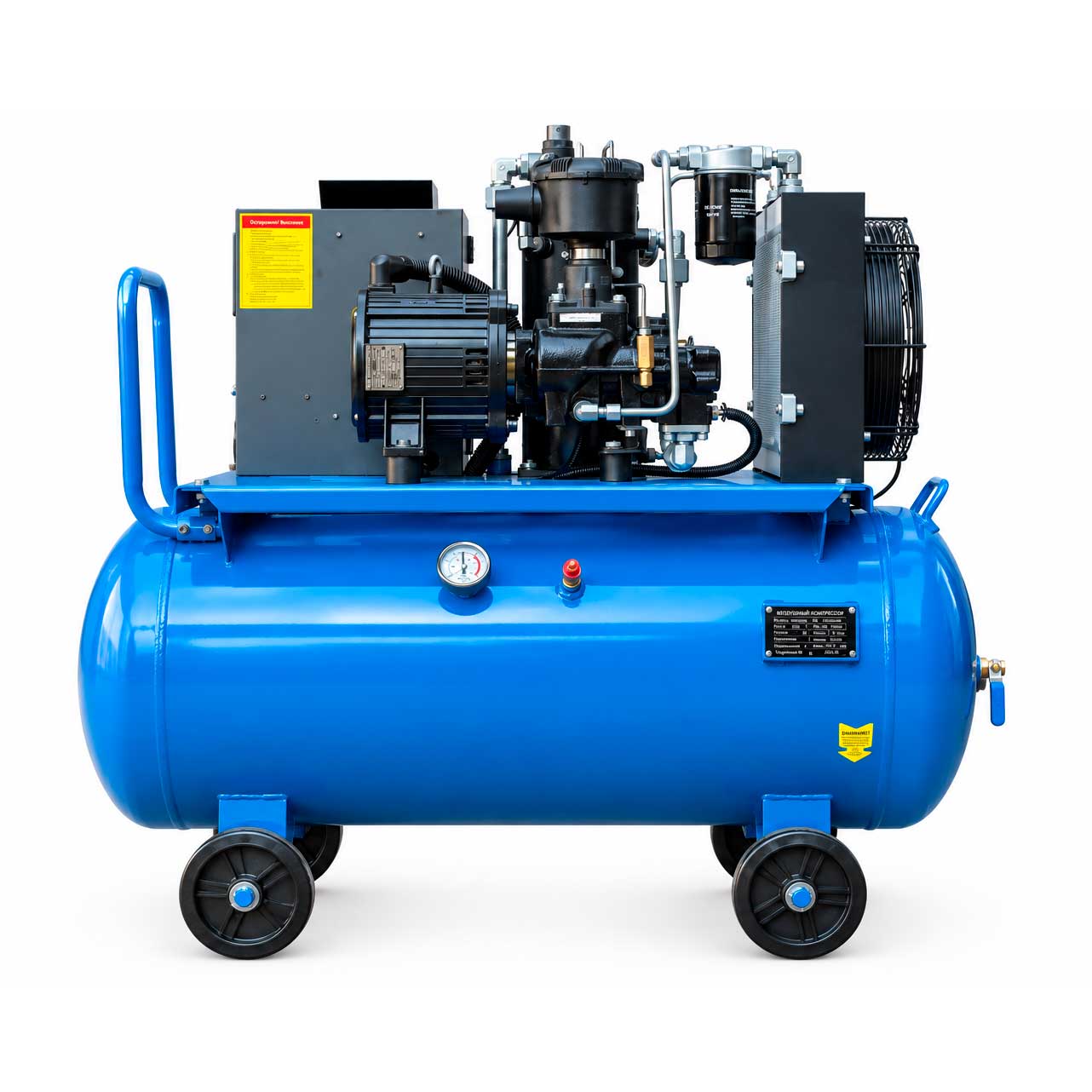
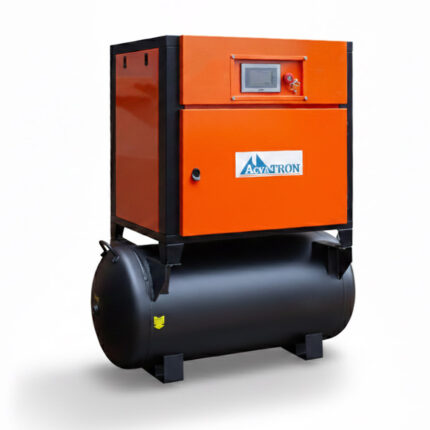
Screw Compressor ASC-10-10-200A, 7.5 kW (direct drive, permanent magnet motor, with frequency converter)
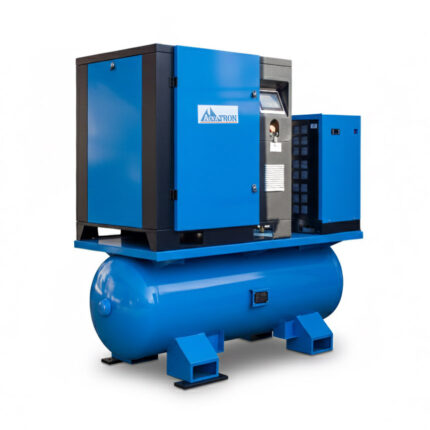
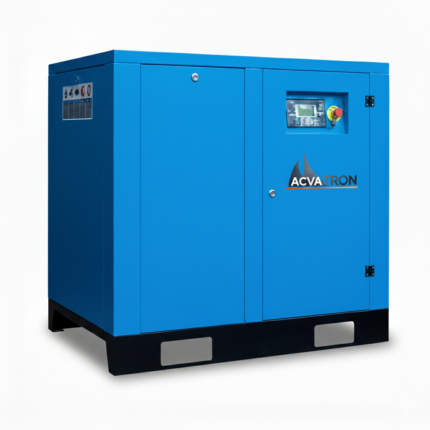
The ASC-10-10-200A is an open-type screw compressor station with direct drive: the screw element rotor is mounted directly on the electric motor shaft, with no belt transmission and no gearbox. The motor is a synchronous permanent magnet (PM/IE5-class) motor, which reduces excitation losses compared to an asynchronous motor and delivers high efficiency across a wide speed range.
1. Purpose and Operating Principle
The unit is equipped with a frequency converter (VFD): the speed of the screw pair is smoothly adjusted to match current air demand, so the compressor does not run in a full-power “start/stop” cycle but adapts to the load instead — this reduces peak starting currents and smooths out network pressure. Compressed air passes through the air-oil separator into the built-in 200 l receiver, from where it is delivered to the pneumatic network via the outlet fitting.
The combination of direct drive + PM motor + inverter is a design suited to consumers with a variable load profile (not round-the-clock operation at maximum), where energy savings at partial loads and minimal noise/vibration compared to a belt-driven scheme matter.
2. Technical Specifications
| Parameter | Value |
|---|---|
| Model | ASC-10-10-200A |
| Compressor type | Screw, open type, oil-injected |
| Drive type | Direct (beltless) |
| Motor | Synchronous, permanent magnet (PM) |
| Frequency converter (VFD) | Included |
| Motor power | 7.5 kW |
| Working pressure | 10 bar |
| Free air delivery | 950 l/min (≈0.95 m³/min) |
| Receiver volume | 200 l |
| Screw element | BAOSI |
| Outlet fitting | 1/2″, female thread |
| Noise level | 68 dB(A) |
3. Design Features
Model code breakdown:
| Fragment | Meaning |
|---|---|
| ASC | Air Screw Compressor — series/type |
| 10 | Motor power in HP (≈7.5 kW ≈ 10 HP) |
| 10 | Working pressure, bar |
| 200 | Receiver volume, l |
| A | Open-type design |
Design solutions:
- The screw element rotor is mounted directly on the motor shaft — eliminating the belt assembly entirely (no belt slippage, no scheduled belt tensioning or replacement).
- Permanent magnet motor — higher efficiency at partial loads compared to an asynchronous motor of the same power rating.
- Built-in frequency converter — soft start and output regulation matched to actual air demand, instead of a “full load/idle” cycle.
- Built-in 200 l receiver — dampens pressure pulsations and reduces compressor cycling frequency.
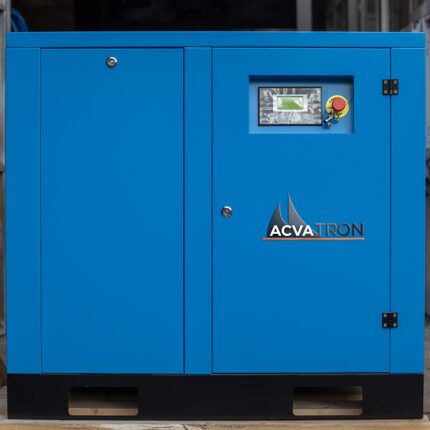
- Open layout (no soundproof enclosure) — easier access to service components, but a higher noise level than cabin-enclosed units (see “Application” section).
4. Installation Recommendations
- Install on a flat, level base with clearance around the perimeter (at least 0.6–0.8 m) for free air circulation and servicing — this is an open-type unit, cooled directly from the room.
- Provide a dedicated power line with protection sized for the starting current of the PM motor with the frequency converter (starting currents are lower than a direct-on-line start of an equivalent asynchronous motor, but the line should still be sized from datasheet values, including the supply voltage, which needs to be confirmed with the supplier).
- Connect to the pneumatic network via the 1/2″ outlet fitting thread (female):
- If the fitting is BSPP (G, parallel) — sealed with a flat gasket; no PTFE tape required.
- If BSPT (R, tapered) — a self-sealing connection; PTFE tape or equivalent sealant is required.
- The room must have supply-and-exhaust ventilation: an open-layout compressor releases heat directly into the room, and at 7.5 kW this is a significant thermal load for a small space.
- Fit the 200 l receiver with an automatic or manual condensate drain and check the safety valve periodically.
- The frequency converter is sensitive to power quality — where mains voltage is unstable, a stabilizer or UPS for the control board is recommended.
- If the network will supply pneumatic tools that require lubrication (impact wrenches, impact grinders), install a separate line lubricator downstream of the receiver — the compressor’s separator is not designed to provide metered tool lubrication.
5. Alternatives and Comparison
| Brand / Model | Power | Free air delivery | Drive | Frequency converter | Comment |
|---|---|---|---|---|---|
| ASC-10-10-200A (this model) | 7.5 kW | 950 l/min | Direct, PM | Yes | Screw element: BAOSI |
| MZB-10A (direct drive, China) | 7.5 kW | 800–1100 l/min (by pressure) | Direct | Yes | Screw element: BAOSI |
| Remeza 7.5 kW range (typical line) | 7.5 kW | ⚠️ check current catalogue | Belt/direct (by version) | On request | Verify the current model line before quoting |
| Aircast (comparable class) | 7.5 kW | 1100 l/min | Varies | On request | Verify the current model line before quoting |
Comparison with neighbouring line models: ⚠️ the ASC line-up (sizes below/above the 200A in receiver volume/power) is not confirmed — if neighbouring models exist, add the comparison once the line-up is confirmed with the supplier.
6. Common Mistakes
- Installing the unit in a cramped, unventilated room — overheating of the PM motor and converter electronics, triggering thermal protection.
- Ignoring the receiver’s condensate drain — moisture buildup, corrosion inside the receiver, and water entering the pneumatic network.
- Feeding compressed air directly to a pneumatic tool requiring lubrication without a separate lubricator — accelerated tool wear.
- Applying PTFE tape to the cylindrical (BSPP) thread of the outlet fitting “just in case” — this thread type must be sealed with a flat gasket; extra tape can disrupt the fit and cause misalignment.
- Connecting to an unstabilized power supply with significant voltage sags — incorrect frequency converter operation, up to emergency shutdowns.
- Skipping scheduled maintenance of the separator and filters on a unit with frequently changing load (the converter causes more frequent regulation cycles) — accelerated element fouling.
7. Application
This unit is designed for sites with a variable compressed air consumption profile: small production shops, auto service centers, woodworking, food and packaging lines — anywhere air demand fluctuates during a shift rather than staying constantly at maximum. The frequency converter and PM motor make this model more energy-efficient specifically under uneven load, rather than round-the-clock operation at 100% capacity (for that scenario, a non-regulated unit of higher nominal power is usually more efficient).
The open (non-cabin) layout calls for installation in a separate technical room or compressor room rather than in a shop floor next to workstations — the 68 dB(A) noise level is lower than most comparable units in this class, but a dedicated technical room is still advisable if the unit runs continuously near personnel.
8. Expert Opinion
“Direct drive and a permanent magnet motor are what genuinely cut maintenance and electricity costs on compressors with a variable load. No belt means no scheduled belt replacement and no slippage losses, and the converter lets the unit ‘breathe’ according to actual air demand instead of constantly running at full power for nothing,” notes Vitali Boluchevski, Lead Engineer, Acvatron SRL, 18 years of experience.
9. FAQ
Does the receiver’s condensate need to be drained manually every day? If an automatic condensate drain is installed — no, but periodic manual checks of the valve are recommended to confirm it’s working correctly.
Can this unit be connected to a pneumatic tool that requires lubrication, without a lubricator? No — the compressor’s built-in separator does not replace metered lubrication; such a tool needs a separate line lubricator installed downstream of the receiver.
How is direct drive with a PM motor better than a classic belt-driven design? There’s no belt wear or slippage, and efficiency at partial loads is higher thanks to the synchronous motor and the converter’s smooth speed regulation.
Is this model suitable for continuous operation at maximum load? A unit with a frequency converter performs best under a variable consumption profile; for constant operation at 100% load, the inverter’s economic benefit is smaller — this scenario is worth discussing with the sales manager when selecting a unit.
What is this model’s working pressure? 10 bar.










Reviews
Clear filtersThere are no reviews yet.