








Nardi Pacific M 16 High-Pressure Compressor — 160 L/min, up to 420 bar, 63 dB
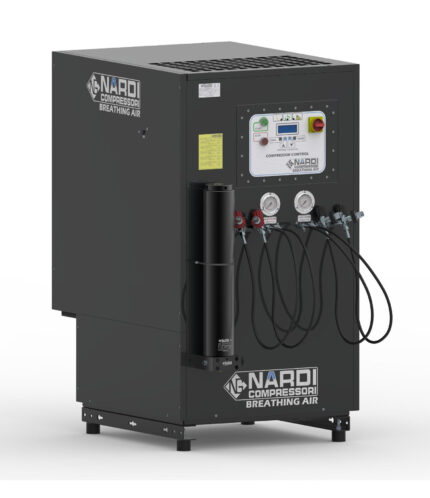
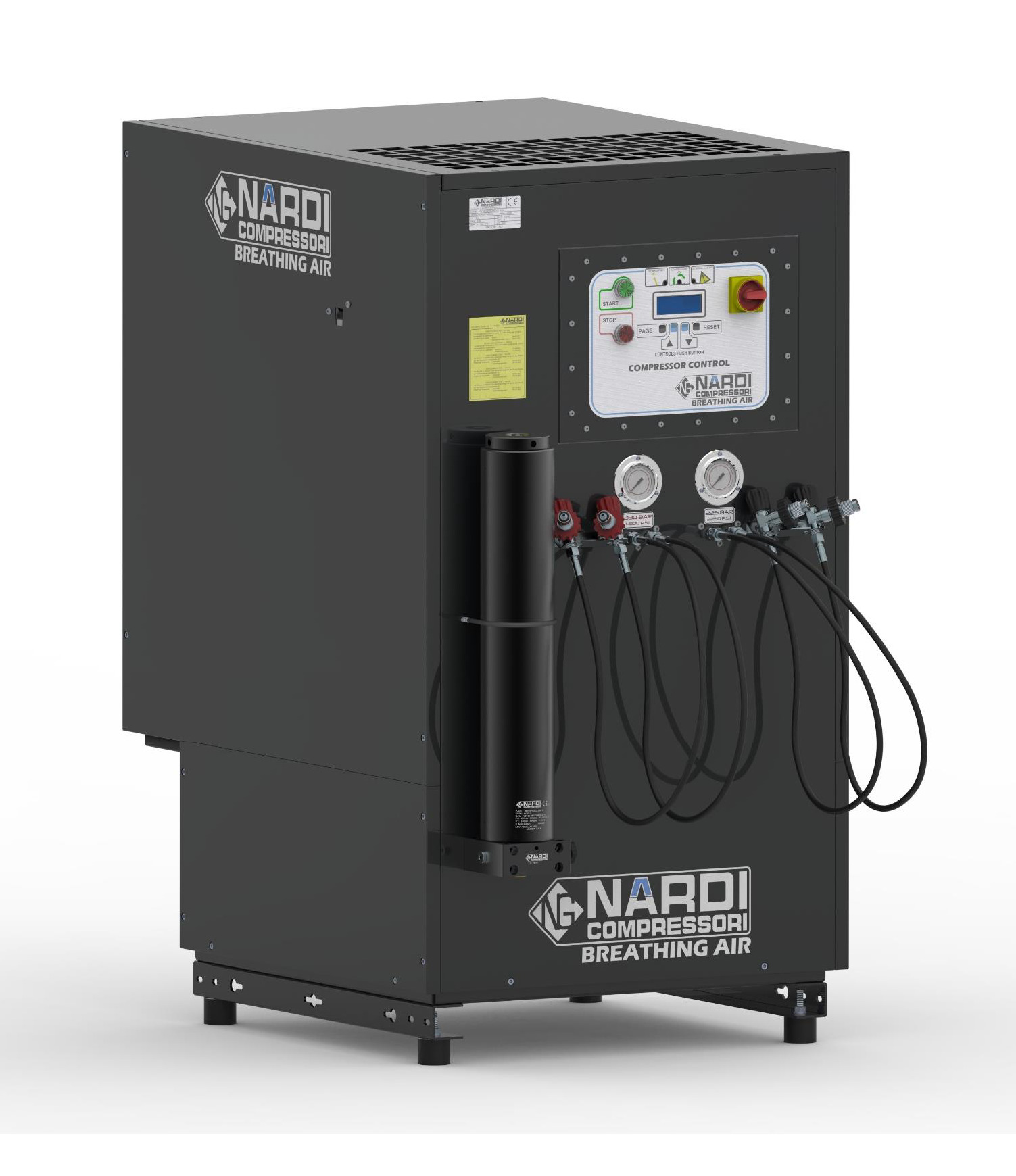
Nardi Pacific M 16 is a stationary three-stage reciprocating high-pressure compressor in a sound-absorbing enclosure. It is designed to fill cylinders with breathing air (diving, breathing apparatus) after the air has been purified in the filter unit.
How it works. Ambient air passes through the intake filter, is compressed in three successive stages of the compressor block and cooled in stainless-steel inter-stage coils. Condensate (water and oil) is separated between the stages and at the outlet, after which the air passes through the PAC filtration system and reaches the cylinder via the fill hose. Drive: 3.0 kW (4 HP) three-phase electric motor, 1350 rpm.
1. Purpose and operating principle
Pacific M 16 is the entry model of the Pacific M line: a fit where a quiet stationary station is needed and filling speed matters, but does not justify a 4–7.5 kW motor.
2. Technical specifications
| Parameter | Value |
|---|---|
| Manufacturer / series | Nardi Compressori (Italy), Pacific M |
| Flow rate | 160 L/min (9.6 m³/h) |
| Working pressure (versions) | 225 / 330 / 420 bar |
| Number of stages | 3 |
| Drive | three-phase electric motor |
| Motor power | 3.0 kW (4.0 HP) |
| Rotation speed | 1350 rpm |
| Noise level | 63 dB |
| Weight | 264 kg |
| Dimensions (L × W × H) | 75 × 108 × 134 cm |
| Lubrication | forced, oil pump; magnetic separator in the oil circuit |
| Cooling | fan, stainless-steel inter-stage coils |
| Filtration | PAC system (separator + adsorption cartridge) |
3. Design features
Model code explained
| Element | Meaning |
|---|---|
| Pacific | series of stationary Nardi compressors in a sound-absorbing enclosure |
| M | series version designation ⚠️ to be confirmed with the manufacturer |
| 16 | flow-rate index: in the Pacific M line, 16 / 23 / 27 / 30 / 35 correspond roughly to 160 / 230 / 270 / 300 / 350 L/min |
Design solutions (per the manufacturer)
- Sound-absorbing enclosure with acoustic panels and optimized ventilation — declared noise level 63 dB.
- Forced lubrication by an oil pump: oil reaches all friction points regardless of operating mode, which matters when filling several cylinders in a row.
- Magnetic separator in the oil — traps fine metal particles, reducing abrasive wear of bearings and the crankshaft.
- Wing-shaped fan blades — good airflow at moderate speed.
- Stainless-steel inter-stage coils — heat dissipation and resistance to condensate corrosion.
- Roller bearings (the manufacturer states European production).
- Anti-vibration mounts under the unit.
- Electronic control panel (per the manufacturer for the series: temperature, oil level, current, pressure) ⚠️ functions in the base version to be confirmed.
4. Installation recommendations
- Intake air determines air quality. Take air from a clean zone: away from vehicle and generator exhaust, boiler rooms, smoking areas and sources of oil or solvent vapors. Carbon monoxide (CO) and oil vapor are not fully removed by the PAC filter, so the compressor must not be installed where the air may be contaminated.
- Room ventilation. The enclosure relies on a constant flow of cooling air. Do not place the unit against walls, in niches or in closed rooms without ventilation; minimum clearances — per the datasheet ⚠️ (to be confirmed with the manufacturer). During long runs the room temperature must stay within the permitted range (⚠️ per the datasheet).
- Base. At 264 kg, a level, solid floor is required. No special foundation is needed, but the unit must stand level on its standard anti-vibration mounts.
- Electrical connection. 3.0 kW three-phase motor: dedicated line with a circuit breaker matched to the motor’s rated current (⚠️ value — per the nameplate). After the first start, always check the direction of rotation against the arrow on the enclosure/fan — with reverse rotation, cooling and oil supply will not work properly.
- First start. Before starting, check the oil level and confirm the PAC cartridge is installed; the first operating hours — per the run-in recommendations in the datasheet.
- High-pressure connections. High-pressure connections seal with an O-ring or a cone/edge seat, not with PTFE tape or sealant. The thread type and sealing of the fill fitting (DIN / INT, G or other) depend on the version — ⚠️ confirm per configuration. Do not use fittings rated for lower pressure on the 330/420 bar line.
- Condensate. Provide a container for condensate; do not drain it onto the floor. Condensate contains oil.
- Choosing the pressure version. The unit’s working pressure must match the cylinders being filled: a 200 bar cylinder is filled on the 225 bar version, a 300 bar cylinder on the 330 bar version, and so on. Do not buy the 420 bar version “just in case” if your cylinders are 300 bar — it is an unnecessary cost.
5. Equivalents and comparison
Equivalents from other manufacturers
Exact “one-to-one” equivalents for 160 L/min at 3.0 kW in a silenced stationary design are few, so compare by class. The closest real reference points, per Coltri datasheets:
| Model | Flow rate | Power | Pressure | Noise |
|---|---|---|---|---|
| Nardi Pacific M 16 | 160 L/min | 3.0 kW | 225 / 330 / 420 bar | 63 dB |
| Coltri MCH 8 Standard (open design) | 125 L/min | 3 kW | 330 bar | 79 dB |
| Coltri MCH 11 Smart (open design) | 195 L/min | 4 kW | 330 bar | 79 dB |
| Coltri Mark III Silent TPS, 235 ET | 235 L/min | 4 kW | up to 330 bar | 72 dB |
⚠️ Coltri datasheets measure flow rate while filling a 10 L cylinder from 0 to 200 bar (tolerance ±5%, +20 °C). Nardi’s test method is not given in open data, so L/min comparison is indicative only. Before replacing, check pressure, power supply, dimensions and filtration type. We do not give part numbers of other manufacturers (Bauer, etc.) without verification against their datasheets.
Comparison with neighboring models in the Pacific M line
| Model | Flow rate | Power | Noise | Dimensions (cm) |
|---|---|---|---|---|
| Pacific M 16 | 160 L/min / 9.6 m³/h | 3.0 kW / 4.0 HP | 63 dB | 75 × 108 × 134 |
| Pacific M 23 | 230 L/min / 13.8 m³/h | 4.0 kW / 5.5 HP | 66 dB | 75 × 108 × 134 |
| Pacific M 27 | 270 L/min / 16.2 m³/h | 5.5 kW / 7.5 HP | 70 dB | 75 × 108 × 134 |
| Pacific M 30 | 300 L/min / 18.0 m³/h | 5.5 kW / 7.5 HP | 68 dB | 75 × 108 × 134 |
| Pacific M 35 | 350 L/min / 21.0 m³/h | 7.5 kW / 10 HP | 72 dB | 75 × 108 × 134 |
All models in the line share the same footprint, so moving up to a higher-capacity model does not require a different installation space. M 16 is the quietest and least power-hungry.
Pacific M 16 or Atlantic? Atlantic is a portable series (about 40–42 kg, open frame, 60–100 L/min, up to 330 bar, 76–79 dB in the electric version): suited to field work and small volumes. Pacific M is a stationary station for regular filling: forced lubrication, sound insulation, up to 420 bar, PAC filtration.
6. Common mistakes
- Placing the compressor near the exhaust of a vehicle, generator or boiler room: CO gets into the cylinder, and the adsorption cartridge is not guaranteed to retain it.
- Replacing the PAC cartridge “by appearance” rather than by running hours: once the adsorbent is saturated, moisture and oil mist pass into the cylinder, and this cannot be seen by eye.
- Starting up without checking the direction of rotation after connecting the three phases.
- Running in a closed room without ventilation: even with low noise, the enclosure needs a constant flow of cooling air, otherwise overheating and protection trips follow.
- Choosing pressure “just in case”: a 420 bar compressor is not needed if all cylinders are 200–300 bar.
- Filling cylinders with an expired inspection date — not a unit issue, but the responsibility lies with the filling-station operator.
- Ignoring condensate drainage and the oil level at the start of each shift.
7. Applications
- Dive centers and diving schools — filling cylinders in urban areas and resorts where low noise matters.
- Emergency services and gas-and-smoke protection units — filling breathing apparatus cylinders (air quality to be confirmed by analysis ⚠️ — e.g. with the optional ACS analyzer or in a laboratory).
- Sports clubs (paintball, PCP air-gun shooting) — filling small and medium cylinders.
- Laboratories and specialized medical applications — high-pressure air supply for equipment.
8. Expert opinion
“Pacific M 16 is the choice for those who need a stationary station but cannot accept the noise of open compressors. What I would look at first when buying: exactly which pressure you need and where the air will be drawn from. These two things matter more than the 30–40 L/min difference between models. The service life of such machines comes down to maintenance discipline: changing oil and the filtration cartridge on time, and draining condensate.”
— Vitali Boluchevski, Lead Engineer, Acvatron SRL, 18 years of experience
9. FAQ
1. What filtration system does the Pacific M 16 have? The unit is equipped with the PAC filtration system: a separator and an adsorption cartridge that remove condensate, oil mist and odors from the air. ⚠️ The exact version (PAC1 or other) and cartridge life are confirmed at the time of order.
2. How long does it take to fill a cylinder? As a guide: a 10 L cylinder to 200 bar holds about 2000 L of free air, so at 160 L/min that is at least 12–13 minutes. Actual time is longer because flow rate drops as cylinder pressure rises. Exact figures depend on the manufacturer’s test method ⚠️.
3. Is a special foundation required? No. The unit weighs 264 kg and stands on anti-vibration mounts; a level, solid floor rated for this load is enough. Leave free space around it for enclosure ventilation.
4. Can the Pacific M 16 fill 300 bar and 420 bar cylinders? Yes, but only in the matching version: the series is built for 225, 330 and 420 bar. The version is chosen when ordering, so tell the manager the type and pressure of your cylinders.
5. Is separate equipment needed to monitor air quality? The PAC filter purifies the air but does not replace monitoring. For services and dive centers working to the breathing-air quality standard (EN 12021), periodic air analysis is recommended; an optional ACS in-line analyzer is available for the series ⚠️ (availability for M 16 to be confirmed).