










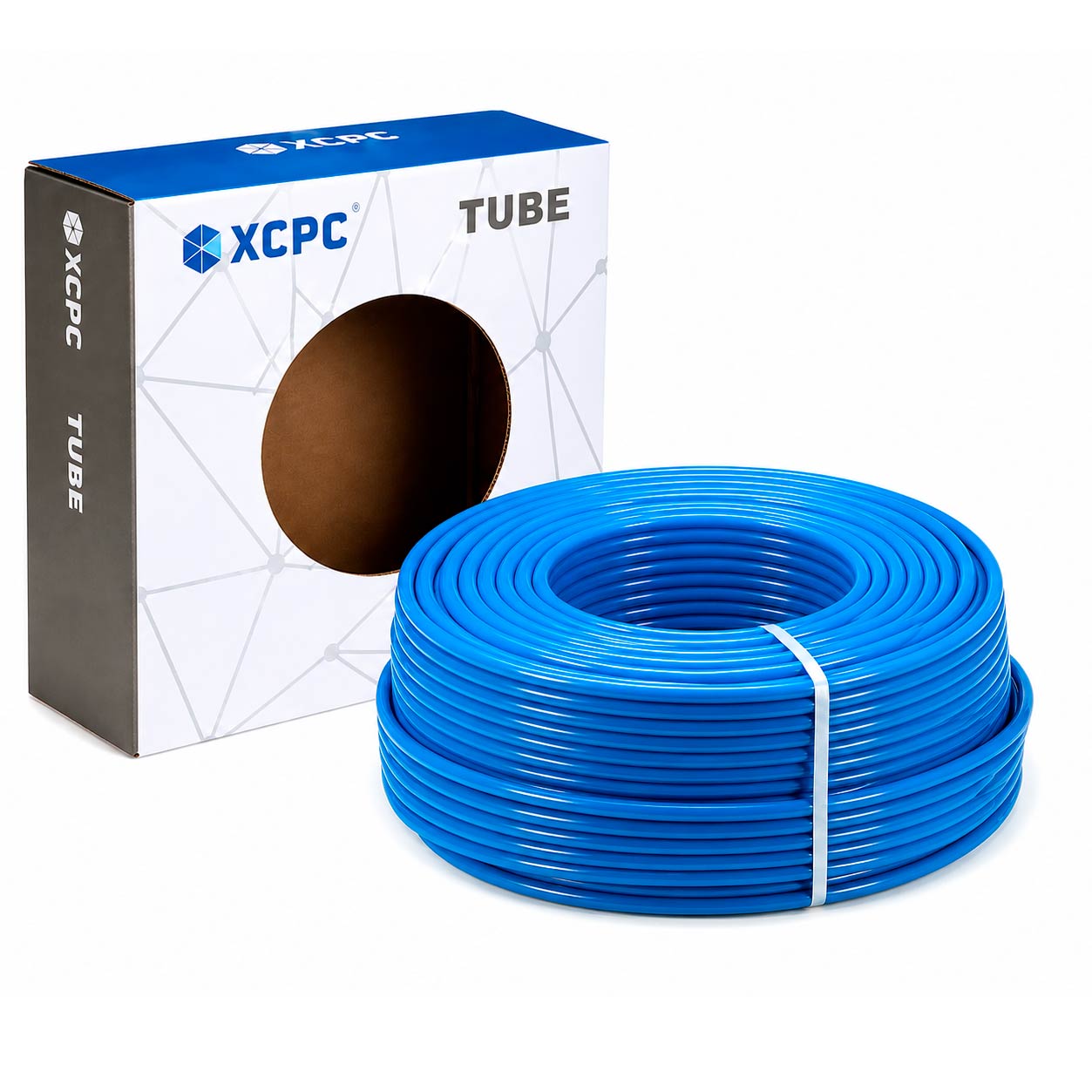

XCPC PU-8X5-BU Pneumatic Polyurethane Tube (Ø8×5 mm, Blue)
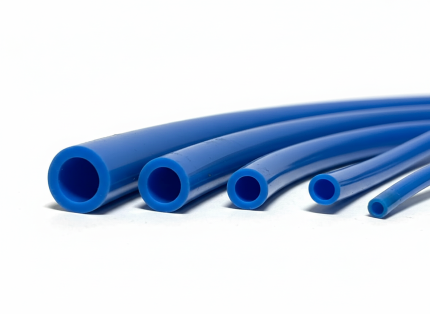
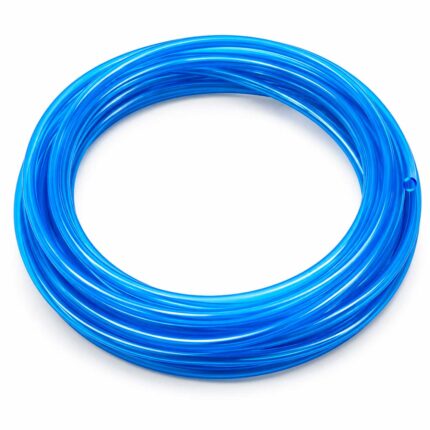
The XCPC PU-8X5-BU is a calibrated, flexible blue thermoplastic polyurethane (PU) pneumatic tube with an 8 mm outer diameter, 5 mm inner diameter, and 1.5 mm wall thickness. It is designed to distribute compressed air in industrial pneumatic systems — connecting pneumatic cylinders, valves, robotic grippers, FRL air preparation units, and air tools at working pressures up to 10 bar (1.0 MPa) at +20 °C.
Технический справочник по пневматическим трубкам
Сравнение материалов: PU · PA · PE · PTFE/PFA/FEP · PVC · Силикон | Давление в барах, температура в °C
| Материал | Раб. давление (+23°C, Ø6) | Температура | Гибкость | FDA | Топливо / масла | Кислоты | Щёлочи | UV-стойкость | Гидролиз | Цена |
|---|---|---|---|---|---|---|---|---|---|---|
| PU — Полиуретан | до 16 бар | −40 … +60 °C | Спец. марки | Средняя | Слабая | Средняя | Слабая | Слабая | Средняя | |
| PA12 — Полиамид | до 25 бар | −40 … +100 °C | Да (PA12) | Высокая | Средняя | Средняя | Хорошая | Хорошая | Средняя | |
| PE / LDPE | до 10 бар | −30 … +60 °C | Да (пищ. марки) | Слабая | Высокая | Высокая | Средняя | Отличная | Низкая | |
| PTFE / PFA / FEP | до 20 бар | −60 … +260 °C | FDA + USP VI | Универсальная | Все (кроме F₂) | Универсальная | Отличная | Отличная | Очень высокая | |
| PVC — ПВХ | до 12 бар | −10 … +60 °C | Спец. марки | Слабая | Средняя | Высокая | Слабая | Хорошая | Низкая | |
| Силикон (VMQ) | до 10 бар | −60 … +180 °C | FDA + USP VI | Слабая | Средняя | Средняя | Отличная | Отличная | Высокая |
Полиуретан (PU / PUR)
Максимальная гибкость · Отличная истираностойкость · Большой выбор цветов · Лёгкий вес · Малый радиус изгиба · Хорошее соотношение цена / качество
Гидролиз при влажности · Слабая UV-стойкость · Ограниченная химстойкость · Не для горячих сред (>60°C) · Набухание в сильных растворителях
Полиамид / Нейлон (PA6 · PA11 · PA12)
Высокое рабочее давление · Хорошая UV-стойкость · Устойчивость к топливам и маслам · FDA-совместимость PA12 · Широкий тем. диапазон
PA6 сильно впитывает влагу · Менее гибкий, чем PU · Требует точного монтажа фитингов · Чувствителен к конц. кислотам
Полиэтилен (PE / LDPE / HDPE)
Самая низкая цена · Химическая инертность к воде / кислотам / щелочам · Очень лёгкий · FDA-совместимость
Низкая тем. стойкость · Набухает в углеводородах · Невысокое давление (LDPE) · LDPE ползёт при нагрузке · UV-деградация без стабилизаторов
Тефлон: PTFE · PFA · FEP
Максимальная хим. инертность · Рабочие темп. до +260°C · Антиадгезионные свойства · FDA + USP Class VI · Нулевое влагопоглощение
Наивысшая стоимость · PTFE не сваривается · Жёсткий (ограниченная гибкость) · Очень тяжёлый · Нельзя применять с расплавами щелочных металлов
ПВХ — Поливинилхлорид
Низкая цена · Высокая прозрачность · Хорошая стойкость к щелочам и разб. кислотам · Широкая доступность
Хрупкость на морозе · UV-деградация · Не совместим с углеводородами · HCl при горении · Пластификаторы мигрируют со временем
Силикон (VMQ / MVQ)
FDA + USP Class VI · Автоклавируется · Широчайший тем. диапазон · UV/озон-стойкость · Биологически инертен · Гибкость сохраняется на морозе
Не совместим с углеводородами · Высокая стоимость · Низкая прочность на разрыв · Газопроницаем · Слабая стойкость к конц. кислотам
1. Purpose and Operating Principle
Thanks to precision outer-diameter calibration (Ø8 mm), the tube seals cleanly inside Ø8 mm push-in collet fittings: the fitting’s internal O-ring seals against the outer wall while the collet claws lock the tube against blow-out under pressure. The heavier 1.5 mm wall (compared with the European 1.25 mm standard) adds extra kink resistance, pressure-pulsation tolerance, and abrasion resistance, enabling tight routing down to a 20 mm minimum bend radius on moving axes and cable drag chains.
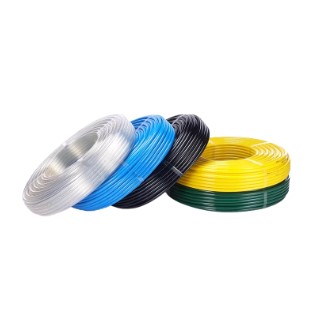
Its blue (BU / Blue) finish follows standard industrial color coding for primary compressed-air supply lines, making troubleshooting and maintenance faster in multi-line pneumatic panels.
2. Technical Specifications
| Parameter | Value |
|---|---|
| Manufacturer | XCPC Pneumatic |
| Part Number (Model) | PU-8X5-BU |
| Material | Thermoplastic Polyurethane (PU) |
| Outer Diameter (O.D.) | 8 mm |
| Inner Diameter (I.D.) | 5 mm |
| Wall Thickness | 1.50 mm |
| Color | Blue (BU) |
| Working Medium | Compressed air (industrial water permitted — see note below) |
| Max. Working Pressure (at +20 °C) | 10 bar (1.0 MPa) |
| Min. Burst Pressure (at +20 °C) | 30 bar (3.0 MPa) |
| Min. Bend Radius (at +20 °C) | 20 mm |
| Operating Temperature Range | −20 °C … +80 °C (with pressure derating above +20 °C) |
| Standard Roll Length | 100 m (sold by the meter from 1 m) |
| Price at acvatron.md | 24.00 MDL / m |
⚠️ Unconfirmed / to-be-verified parameters (not detailed in the public XCPC datasheet for
PU-8X5-BU):
- Polyurethane base chemistry (ether-based vs. ester-based): XCPC’s general PU datasheet does not specify ether vs. ester formulation for this SKU. For continuous exposure to high humidity, hot water, or water mist, confirm hydrolysis resistance with Acvatron SRL.
- Shore hardness & exact O.D. tolerance: XCPC catalogs list 95A or 98A Shore hardness depending on revision; exact O.D. tolerance (typically ±0.10 mm) and vacuum rating should be verified per batch.
- Food-contact (FDA / EU 1935/2004) & silicone-free (LABS-free) certification: not declared — choose dedicated certified tubing for direct food contact or paint-shop applications.
- Temperature pressure derating: the 10 bar rating applies at +20 °C; at +60 °C allowable working pressure drops roughly by half (~5 bar). Verify the exact derating factor for elevated-temperature zones.
3. Design Features
Model Code Breakdown: PU-8X5-BU
| Code Element | Meaning | Explanation |
|---|---|---|
| PU | Material | Polyurethane — flexible pneumatic tubing |
| 8 | Outer Diameter (O.D.) | 8 mm (fits Ø8 mm metric push-in fittings) |
| 5 | Inner Diameter (I.D.) | 5 mm (wall thickness (8 − 5) / 2 = 1.5 mm) |
| BU | Color | Blue — standard pneumatic air-line color code |
Key Engineering Solutions
- Reinforced 1.5 mm Wall: provides a 3:1 burst safety factor (30 bar burst vs. 10 bar working) and superior kink resistance on tight bends and reciprocating assemblies.
- High Elasticity & Shape Memory: stays supple down to −20 °C and rebounds rapidly after repeated flexing cycles.
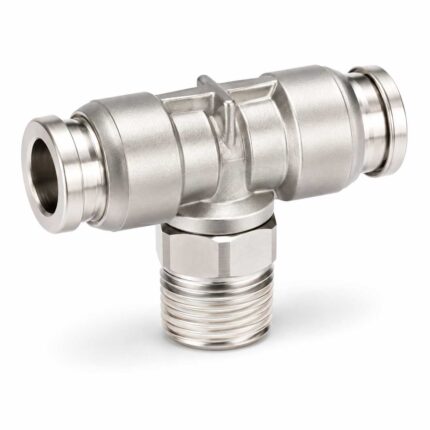
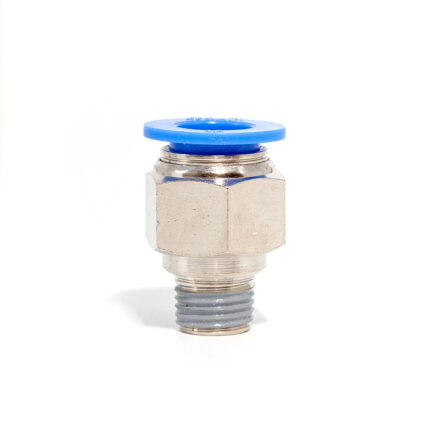
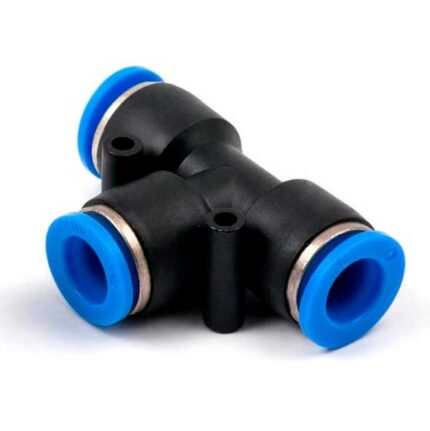
- Calibrated Outer Surface: uniform Ø8 mm outer geometry ensures leak-free sealing in XCPC push-in fittings (
XPC,XPL,XPB,XPE) and standard metric fittings from other brands. - Oil & Abrasion Resistance: resists compressor oil mist, industrial lubricants, and wear against machine frames and drag chains.
- Smooth Ø5 mm Bore: minimizes pressure drop on medium-length feeder runs to Ø32–63 mm pneumatic cylinders.
4. Installation Guidelines
- Cut Square at 90°: always cut the tubing with a dedicated pneumatic tube cutter. Angled cuts, oval flattening from pliers/scissors, or burrs will compromise the internal O-ring seal inside push-in fittings.
- Seat Fully in Ø8 mm Push-In Fittings: push the tube past the initial O-ring resistance until it bottoms out firmly (typically 17–20 mm depending on the fitting), then gently tug back to confirm the collet teeth are engaged.
- Match the Fitting Type:
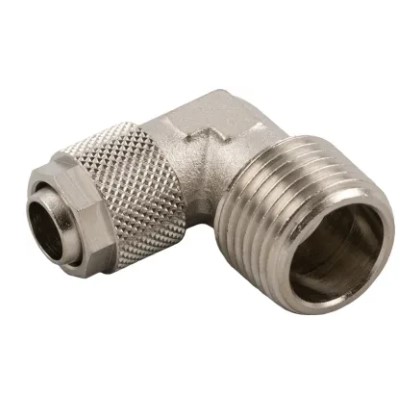
- Ø8 mm Push-In Fittings: seal on the 8 mm O.D. —
PU-8X5-BUfits all standard Ø8 mm metric push-in connectors. - Barb Fittings & Compression Nut Nipples: depend on the 5.0 mm I.D. — verify barb size before assembly.
- When threading the fittings themselves into pneumatic equipment, respect thread type: BSPP (G, parallel) seals with a flat gasket and no PTFE tape; BSPT (R, tapered) seals with PTFE tape; metric parallel (e.g., M5) seals via a captive O-ring at the base without PTFE tape.
- Ø8 mm Push-In Fittings: seal on the 8 mm O.D. —
- Respect Minimum Bend Radius: never bend tighter than 20 mm (keep 35–40 mm on moving drag-chain runs), and leave at least 30–40 mm of straight tubing immediately exiting the fitting so side loads do not unseat the O-ring.
- Allow Slack for Motion & Expansion: provide slight slack on long or moving runs to accommodate minor dimensional changes under pressure and temperature swings.
- Re-Installation Practice: depress the release collar fully before pulling the tube out. If the tube end shows deep collet bite marks, trim off 20–25 mm before re-inserting.
5. Equivalents and Comparison
Cross-Reference Table (Blue Ø8 mm O.D. Polyurethane Tubing)
| Brand | Verified Part Number | Dimensions (OD × ID) | Wall | Max Pressure | Temperature | Compatibility with PU-8X5-BU |
|---|---|---|---|---|---|---|
| XCPC | PU-8X5-BU | 8 × 5.0 mm | 1.50 mm | 10 bar (+20 °C) | −20…+80 °C | Reference model |
| SMC | TU0805BU (not TU0805B, which is black!) |
8 × 5.0 mm | 1.50 mm | 8 bar (+20 °C) | −20…+60 °C | Direct equivalent (both OD & ID) |
| AirTAC | US98A080050100MBU |
8 × 5.0 mm | 1.50 mm | 10 bar | −20…+70 °C | Direct equivalent (100 m roll, 98A) |
| Festo | PUN-H-8x1,25-BL |
8 × 5.7 mm | 1.25 mm | up to 10 bar | −35…+60 °C | Push-in Ø8 mm equivalent (different ID!) |
| Camozzi | TPU 8/5.5 (blue) |
8 × 5.5 mm | 1.25 mm | up to 10–12 bar | −40…+74 °C | Push-in Ø8 mm equivalent (different ID!) |
| Parker Legris | 1025U08 (blue) |
8 × 5.5 mm | 1.25 mm | up to 12 bar | −20…+70 °C | Push-in Ø8 mm equivalent (different ID!) |
| AIGNEP | TBPU00855AZ |
8 × 5.5 mm | 1.25 mm | up to 10 bar | −20…+60 °C | Push-in Ø8 mm equivalent (different ID!) |
| Metal Work | 90111142 |
8 × 5.5 mm | 1.25 mm | up to 10 bar | −20…+60 °C | Push-in Ø8 mm equivalent (different ID!) |
Important before substituting: all listed tubes share an 8 mm O.D. and are interchangeable in Ø8 mm push-in collet fittings. However, for 5.0 mm I.D. hose barbs or compression nipples, only true
8 × 5.0 mmtubes (SMC TU0805BU,AirTAC US98A080050100MBU) are direct drop-in replacements. Always check pressure derating at operating temperature and chemical compatibility.
Comparison With Adjacent XCPC PU Sizes & Tubing Materials
| Model / Material | Dimensions (OD × ID) | Wall | Min. Bend Radius | Typical Use |
|---|---|---|---|---|
| XCPC PU-6X4-BU | 6 × 4.0 mm | 1.00 mm | ~15 mm | Compact cylinders Ø16–32 mm, pilot signals |
| XCPC PU-8X5-BU | 8 × 5.0 mm | 1.50 mm | 20 mm | Universal standard: Ø32–63 mm cylinders, air tools, moving axes |
| XCPC PU-10X6.5-BU | 10 × 6.5 mm | 1.75 mm | ~25–30 mm | Ø63–100 mm cylinders, valve manifold headers |
| XCPC PU-12X8-BU | 12 × 8.0 mm | 2.00 mm | ~35–40 mm | Branch mains and high-consumption air tools |
| Polyamide / Nylon (PA12 / XCPC NY 8×6) | 8 × 6.0 mm | 1.00 mm | ~40–50 mm | Static runs, higher pressures (15–20+ bar), chemical resistance; kinks easily on tight bends |
| Polyethylene (PE 8×6) | 8 × 6.0 mm | 1.00 mm | ~45–60 mm | Budget low-pressure fixed lines; stiffer with lower flex fatigue life |
6. Common Mistakes
- Cutting with regular scissors, wire cutters, or a dull blade. Pinched oval ends and slanted cuts fail to seat behind the fitting’s O-ring, leaking air immediately or after brief vibration.
- Partial insertion into push-in fittings (stopping at the O-ring). Stopping at the first resistance leaves the tube 5–8 mm short of the stop, risking blow-out at 8–10 bar.
- Sharp bends directly at the fitting exit. Side-loading cocks the tube inside the collet and pinches one side of the O-ring, causing chronic leaks. Keep 30–40 mm straight before curving.
- Running 10 bar at +50…+70 °C ambient or air temperature. The 10 bar rating holds at +20 °C; at +60 °C allowable working pressure drops to roughly 5 bar — exceeding it causes ballooning and burst failures.
- Using standard PU with hot water, steam, or harsh solvents. Standard (especially ester-based) PU hydrolyzes over time in hot wet service and swells in ketones, acids, and aromatic solvents — specify PA12 or PTFE instead.
- Swapping 8×5 mm tubing for 8×5.7 mm (Festo) or 8×5.5 mm (Camozzi) on a 5 mm hose barb. Oversized I.D. tubing slips loosely onto a 5 mm barb and blows off under pressure.
7. Applications
- Industrial Automation & Assembly Lines: feeding Ø32–63 mm pneumatic cylinders, rotary actuators, grippers, and valve islands.
- Robotics, Manipulators & Drag Chains: continuous-flex routing where rigid nylon cracks or kinks.
- Packaging, Woodworking & Non-Contact Food Machinery: tight-radius routing inside control cabinets and frames.
- Workstations & Auto Workshops: flexible supply lines from FRL units to pneumatic tools and blow guns.
- Color-Coded Pneumatic Piping: blue (
BU) designates primary compressed-air lines.
When not suitable: fixed high-pressure lines (>10 bar), continuously hot environments (>+60 °C), direct food contact (without FDA approval), or aggressive chemicals (acids, alkalis, acetone).
8. Expert Opinion
Vitali Boluchevski, Lead Engineer, Acvatron SRL, 18 years of experience: “XCPC PU-8X5-BU is the workhorse tubing size for shop-floor automation. Its 1.5 mm wall gives a noticeable margin in durability and kink resistance over thinner 1.25 mm tubing — it comfortably holds a 20 mm bend radius and survives moving carriages without creasing. When cross-referencing other brands, remember two things: inside Ø8 mm push-in fittings it interchanges directly with Festo, Camozzi, and SMC, but if your machine uses 5 mm I.D. barbs, stick strictly to 8×5 mm tubing. And always cut it square at 90° with a proper tube cutter — 80% of collet fitting leaks come from slanted cuts.”
9. FAQ
1. Can I run XCPC PU-8X5-BU at 10 bar and +60 °C? No. The 10 bar max working pressure is rated at +20 °C. As temperature rises, polyurethane softens; at +60 °C limit working pressure to roughly 5 bar (~0.5 derating factor).
2. Is this tube compatible with Festo, Camozzi, SMC, or AIGNEP Ø8 mm push-in fittings? Yes. All standard Ø8 mm metric push-in fittings seal on the 8 mm outer diameter. Just cut square at 90° and push fully home.
3. How does PU-8X5-BU polyurethane compare to PA12 8×6 mm nylon tubing? Polyurethane is far more flexible (20 mm minimum bend radius vs. 40–50 mm for nylon) and resists kinking on moving axes. PA12 nylon is stiffer but handles higher pressures and harsher chemicals on fixed runs.
4. How do I prevent air leaks at push-in collet fittings? Use a dedicated tube cutter for a clean 90° cut, push the tube all the way to the stop with a light tug check, and keep 30–40 mm straight before bending. Trim 20–25 mm off scored ends before re-using the tube.











Reviews
Clear filtersThere are no reviews yet.