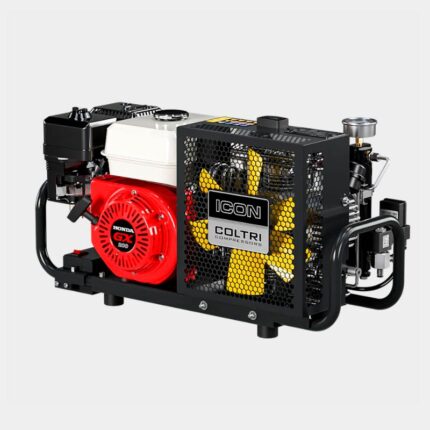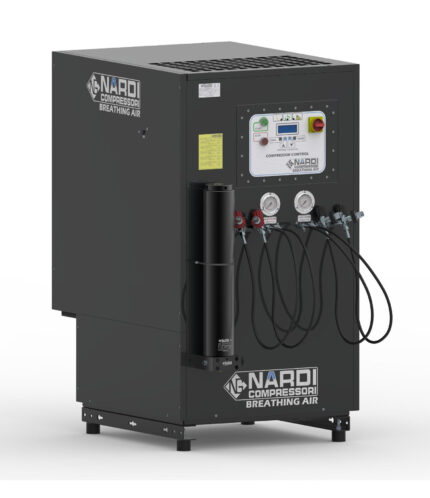









Nardi Pacific EG 23 — Petrol High-Pressure Breathing Air Compressor, 230 L/min, up to 330 bar
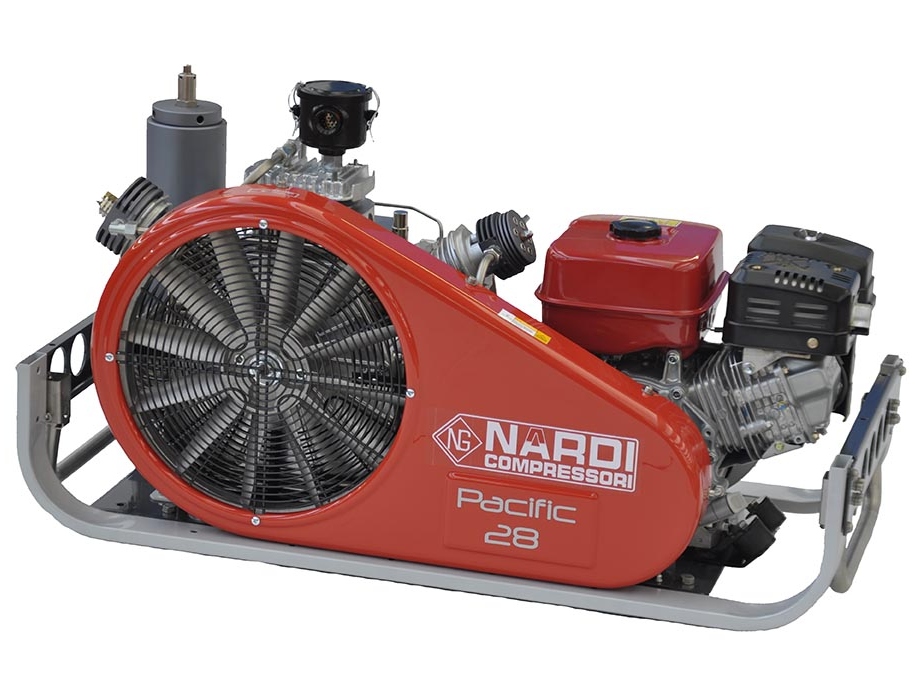
The Nardi Pacific EG 23 is a portable high-pressure piston compressor with a 9.0 hp (6.7 kW) petrol engine, designed to produce breathing air and fill cylinders where there is no mains power. Output 230 L/min (13.8 m³/h), working pressure 225 or 330 bar, three compression stages, PAC1 filtration system as standard. A 10 L cylinder is filled to 200 bar in 8 minutes 46 seconds.
1. Purpose and Operating Principle
The Pacific EG 23 draws in ambient air, compresses it in a three-stage piston block (three pistons) to 225 or 330 bar and purifies it at the outlet through a system of separators and the PAC1 final filter. The result is breathing air used to fill scuba, rescue and other cylinders.
It is driven by a petrol engine, so the compressor does not depend on mains power or generators. The unit is built for work in the field: remote sites, vessels, emergency zones and field dive bases. The shaft turns at 1,350 rpm — a moderate speed for a compressor in this class, which reduces wear on the block.
2. Technical Specifications
| Parameter | Value |
|---|---|
| Model | Nardi Pacific EG 23 |
| Output | 230 L/min / 13.8 m³/h |
| Working pressure | 225 / 330 bar (3,250 / 4,800 PSI) |
| Number of stages | 3 (three pistons) |
| Drive | Petrol engine |
| Engine power | 9.0 hp / 6.7 kW |
| Shaft speed | 1,350 rpm |
| Fill time 10 L / 200 bar | 8 min 46 s |
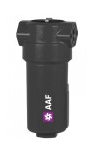
| Filtration system | PAC1 (two separators on the block + final filter on the frame) |
| Noise level | 86 dB |
| Weight | 108 kg |
| Dimensions (L × W × H) | 111 × 53 × 65 cm |
| Frame | Aluminium, epoxy powder coating, stainless steel parts |
| Oil (per Nardi manual for the Pacific 23 block) | Nardi Synthetic 150, ≈ 3.5 L |
| Ambient temperature (per manual) | +5 … +45 °C |
| Altitude (per manual) | up to 2,000 m |
| Air quality standard | EN 12021 (breathing air) |
| Manufacturer | Nardi Compressori S.r.l., Italy |
⚠️ To be confirmed (not assumed):
- Weight. The table states 108 kg / 249 lbs, but 249 lbs is ≈ 113 kg. An older edition of the Nardi sheet for the EG 23 lists 113 kg. Confirm the current weight with the manufacturer.
- Noise level. 86 dB is from the Nardi sheet (ed. 2020); measurement conditions (distance, load) are not stated; the older edition gave 79 dB.
- Engine: make and model, fuel tank capacity, start type (recoil/electric), fuel consumption — not found in public data.
- Oil and temperature limits are taken from the Nardi manual for the Pacific 23 block (E23/EG23); check against the manual supplied with the machine.
- Certification. The page lists ISO 9001 (TÜV SÜD) and UNI EN 12021:2014; the Nardi manual mentions UNI EN 12021:2000. Ask the manager for the valid documents.
- Price and availability are not shown on the page.
3. Design Features
Pacific EG 23 model code decoder
| Position | Meaning |
|---|---|
| Pacific | Nardi range of portable breathing air compressors |
| EG | Petrol-engine version (E — electric motor) |
| 23 | Nominal output 230 L/min |
Design solutions:
- Light-alloy block with good heat dissipation; the cylinders are left unpainted so heat escapes unhindered. This matters for a petrol-driven unit working in hot conditions.
- Cylinder-piston group: wear-resistant cast iron piston rings and engineering polymers reduce friction and keep compression stable over hundreds of operating hours.
- Forced lubrication by an oil pump; the oil passes through a filter and a magnet that traps metal particles.
- Aluminium frame with epoxy powder coating and stainless steel fasteners — corrosion protection, including in marine environments.
- PAC1 filtration: two separators on the block and a final filter on the frame.
- Options: transport kit (trolley kit — two wheels and a handle), hour meter, “Eco Friendly” condensate collection tank, Air Control System (humidity, CO and CO₂ monitoring).
4. Installation and Operating Recommendations
- Engine exhaust contains carbon monoxide. Set the compressor up only outdoors or in a well-ventilated place. The block’s air intake must be upwind of the exhaust: CO drawn into the intake air ends up in the cylinder.
- Level, stable surface. The block and engine are force-lubricated, but a steep tilt disrupts the oil supply. Permissible tilt per the Nardi manual is up to 5°.
- Drain condensate manually. The EG version has no electronic pressure control and no automatic condensate drain (these are available only on the electric Pacific E).
- Hour meter. The standard configuration has no electronic service panel, so oil and PAC1 filter cartridge changes are tracked by operating hours. Fit a meter and keep a log.
- Oil — only what the manufacturer recommends for the block (Nardi Synthetic 150 per the manual). Do not mix different oils.
- Choose the pressure to match the cylinder. Use the 330 bar mode only for cylinders rated for that pressure; for 200/232 bar cylinders set 225 bar.
- Monitor air quality — for regular filling of breathing cylinders plan periodic air testing or fit the Air Control System.
5. Equivalents and Comparison
Cross-references to other brands: verified exact part numbers of equivalents (Coltri, Bauer, etc.) for this class are not confirmed, so we do not list them. Our manager selects an equivalent by output, pressure and drive.
Comparison with neighbouring models in the Pacific range:
| Model | Drive | Output | Power | Fill time 10 L / 200 bar | Stages | Rpm | Noise | Weight |
|---|---|---|---|---|---|---|---|---|
| Pacific EG 23 | Petrol | 230 L/min | 9.0 hp / 6.7 kW | 8 min 46 s | 3 | 1,350 | 86 dB | 108 kg |
| Pacific EG 27 | Petrol | 270 L/min | 9.0 hp / 6.7 kW | 7 min 26 s | 3 | 1,550 | 88 dB | 118 kg |
| Pacific EG 30 | Petrol | 300 L/min | 14.0 hp / 10.0 kW | 6 min 44 s | 3 | 1,450 | 88 dB | 118 kg |
| Pacific EG 35 | Petrol | 350 L/min | 14.0 hp / 10.0 kW | 5 min 47 s | 4 | 1,550 | 88 dB | 123 kg |
| Pacific E 23 | Electric 3-phase, 5.5 hp / 4 kW | 230 L/min | — | 8 min 46 s | 3 | 1,350 | 77 dB | 108 kg |
Pacific E 23 data is from the Nardi sheet (ed. 2020). If mains power is available and the compressor will stay in one place, the Pacific E 23 gives the same output, runs quieter and offers electronic pressure control. Choose the EG 23 when there is no electricity.
6. Common Mistakes
- Starting it in an enclosed room or next to the air intake. Carbon monoxide from the exhaust ends up in the breathing air — this is a safety issue, not a wear issue.
- Expecting an automatic condensate drain. The EG does not have one: condensate must be drained manually.
- Ignoring operating hours. With no electronic panel, nothing will remind you to change the PAC1 filters and the oil.
- Filling a 200 bar cylinder with the 330 bar setting. Pressure must be set to match the cylinder.
- Storing it with fuel and without servicing after the season — carburettor and filter contamination.
- Operating above +45 °C without taking the manual’s limits into account.
7. Applications
- Professional and commercial diving: breathing air for dive teams at remote locations.
- Search and rescue and emergency zones: mobile compressed air supply.
- Vessels and yachts without powerful generators: autonomous cylinder filling at sea.
- Tactical and special units: autonomous charging station.
- Sports events: cylinders for paintball, outdoor dive safaris.
8. Expert Opinion
“The Pacific EG 23 is a field machine and has to be run like one. Rule one — outdoors only, with the air intake upwind of the exhaust. Rule two — the EG has no automatic condensate drain and no electronic panel, so I always advise fitting an hour meter straight away and keeping a log of oil and filter changes. And if mains power is available, look at the Pacific E 23: the same 230 L/min, but noticeably quieter.”
Vitali Boluchevski, Lead Engineer, Acvatron SRL, 18 years of experience
9. FAQ
What filtration system does the Pacific EG 23 use? PAC1 is fitted as standard: two separators on the block and a final filter on the frame. It purifies the air to a level that meets the EN 12021 standard for breathing air.
Can the compressor be fitted with wheels for easy moving? Yes, an optional transport kit (trolley kit) is available: two wheels and a handle for moving it over hard surfaces.
How do I keep track of filter changes without an electronic panel? Fit the optional hour meter and keep a log: it shows the operating time of the engine and the filter cartridges. For real-time air purity monitoring you can add the Air Control System (humidity, CO, CO₂).
What is the difference between 225 bar and 330 bar? They are two working modes of the compressor: 225 bar for 200/232 bar cylinders, 330 bar only for cylinders rated for that pressure. Choose the mode according to the cylinder marking.
How does the EG 23 differ from the electric Pacific E 23? The output and block are the same (230 L/min), but the EG runs on a 9 hp petrol engine without mains power. The electric version is quieter (77 dB versus 86 dB) and has an electronic pressure control system with automatic condensate drain.