











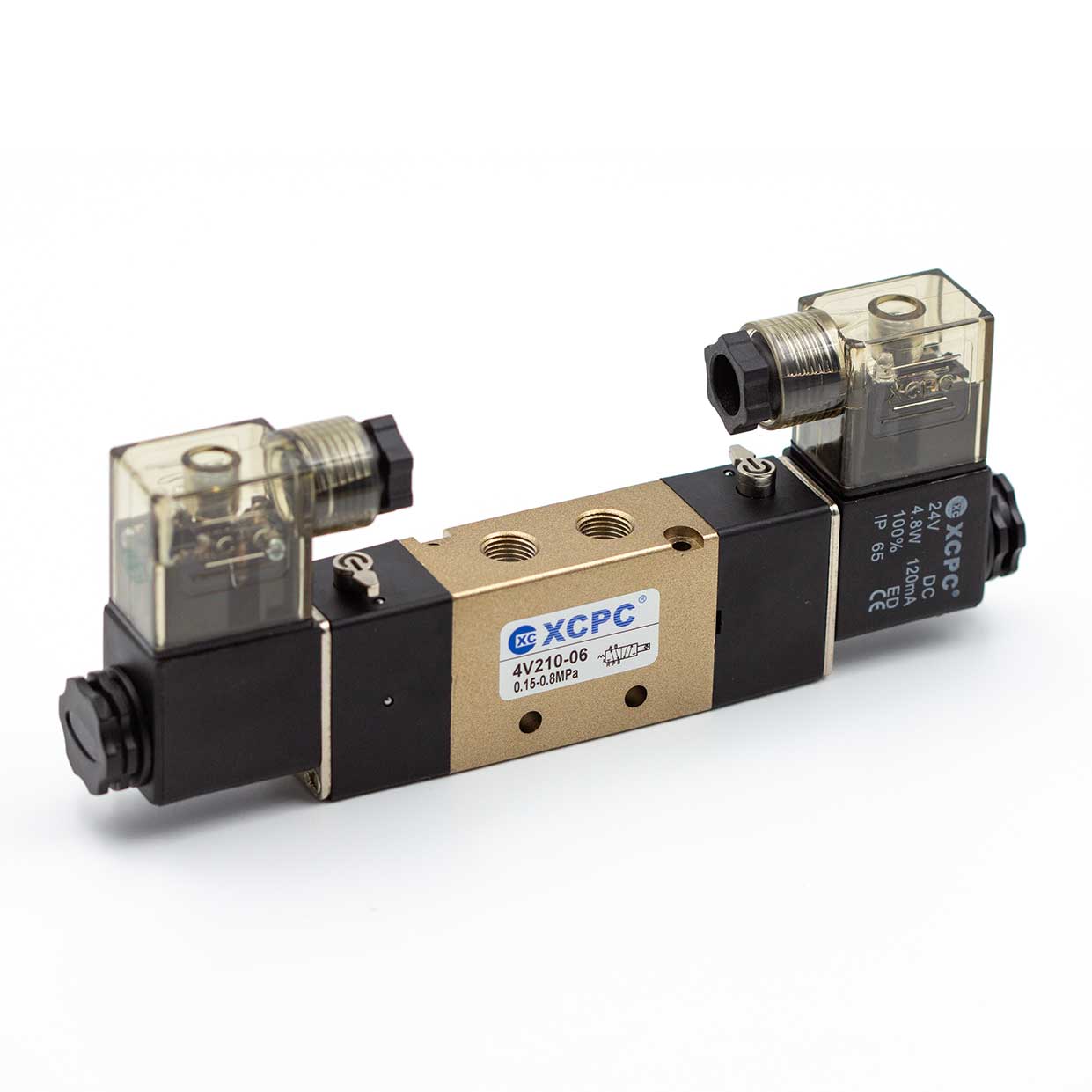
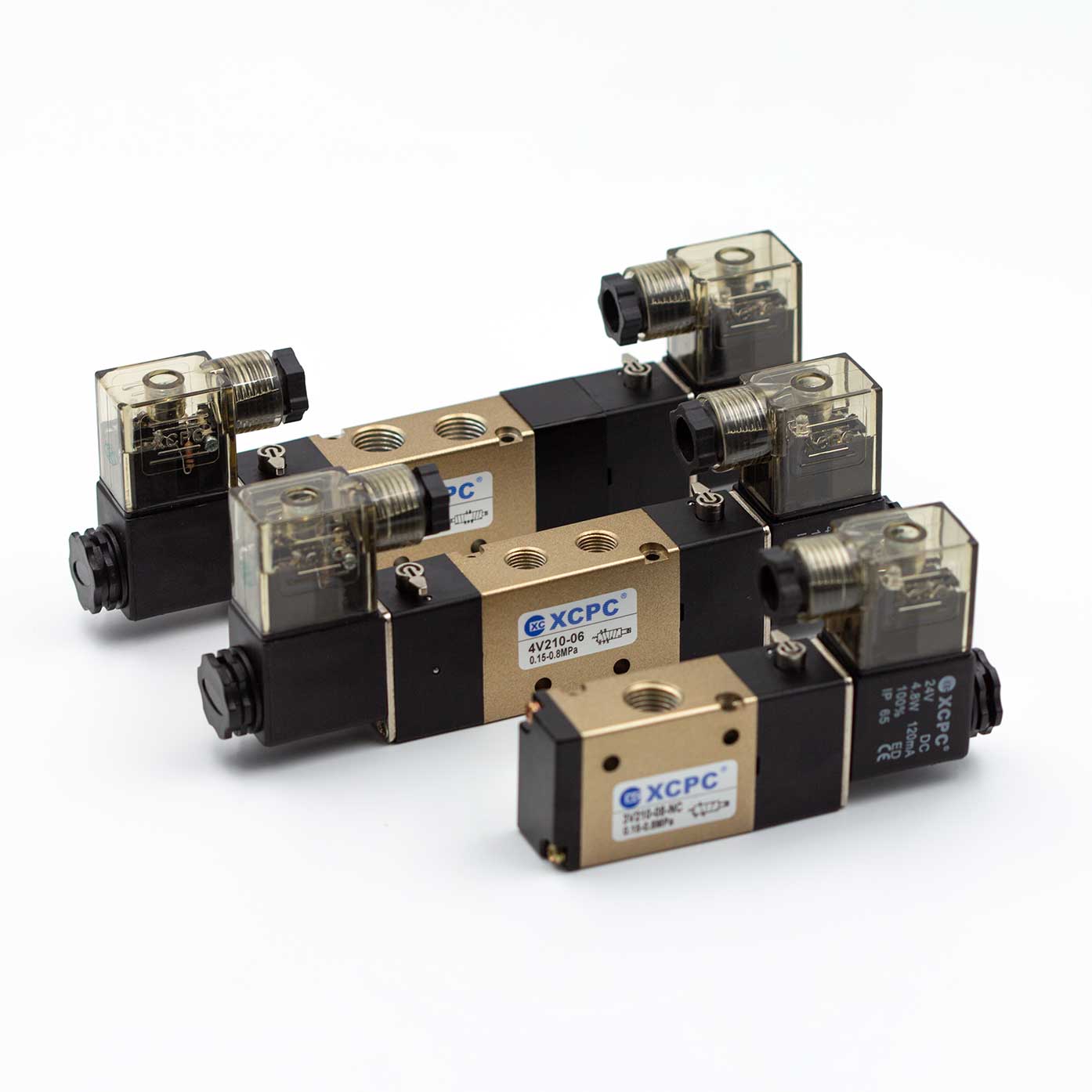
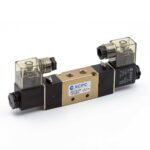
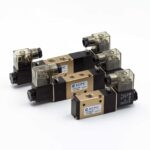
Operating principle:
- With the coil de-energized, the return spring holds the spool in its initial position: supply port P is connected to one of the working ports (say, B), while the other working port (A) is vented to atmosphere through its own exhaust channel.
- When voltage is applied to the solenoid (DC 24V), the spool shifts to the second position: port P switches over to port A, while port B is now vented to atmosphere — the cylinder rod moves in the opposite direction.
- When voltage is removed, the spring returns the spool to its initial position in roughly 0.05 seconds.
- Control is internally piloted: the valve uses pressure from the main working line itself to actuate, so no separate pilot air line is needed. This simplifies installation, but means that below a minimum pressure threshold (roughly 0.15 MPa), reliable spool switching is not guaranteed.
- The housing includes a manual override (a push-button or lever) — useful during installation, commissioning, and troubleshooting of the pneumatic circuit without needing an electrical signal.
Technical Specifications
| Parameter | Value |
|---|---|
| Valve type | 5/2 (5 ports / 2 positions) |
| Control type | Single solenoid (monostable), internal pilot |
| Connection thread (P, A, B, R, S) | G 1/8″ |
| Flow coefficient | Cv ≈ 0.78 |
| Working medium | Compressed air (filtration to 40 μm required) |
| Working pressure | 0.15–0.9 MPa (1.5–9 bar) |
| Maximum pressure | 1.2 MPa |
| Temperature range | +5°C … +50°C |
| Supply voltage | DC 24V (±10% tolerance) |
| Power consumption | 2.5 W |
| Protection and insulation class | IP65, Class F |
| Max. cycle frequency / response time | 5 cycles/sec / 0.05 sec |
| Lubrication | Not required (dry air); if switching to lubricated air, maintain lubrication continuously |
| Manual override | Yes |
| Manifold-mountable | Yes, on a common base plate |
| Series | XCPC, 200 series |
⚠️ Exact weight and dimensions for the original XCPC listing are not published uniformly across open sources — different resellers show close but not identical values (roughly around 200 g). For project documentation, we recommend requesting the exact datasheet from an Acvatron sales manager.
Design Features
Decoding the designation 4V210-06-DC24V:
| Element | Meaning |
|---|---|
| 4V | XCPC’s five-way (5-port) solenoid valve series, for double-acting cylinders |
| 210 | Size within the 200 series lineup, single solenoid, 2 positions |
| 06 | Nominal bore / connection thread — G 1/8″ |
| DC24V | Coil supply voltage — 24V DC |
Key design solutions:
- Sliding spool mechanism — provides good sealing and a fast, crisp response to the control signal.
- Special internal passage machining — reduces friction and the pressure needed to actuate, extending valve life and allowing operation without lubricated air.
- Internal pilot — no separate pilot air line is needed, simplifying tubing compared to externally piloted valves.
- Manual override on the housing — lets you manually check actuator operation during commissioning without waiting for an electrical signal from the controller.
- Manifold base plate compatibility — multiple 4V210-06 valves can be assembled into a single manifold block on a shared plate to save space in the control cabinet.
Installation Recommendations
- Account for the minimum working pressure (0.15 MPa) — because of internal piloting, reliable spool switching below this threshold isn’t guaranteed; for operation at reduced pressure, consider an externally piloted version.
- Install silencers on both exhaust channels (R and S) — the G 1/8″ thread accepts standard silencers of the matching size; this protects the spool from external dust and reduces noise on every switching cycle.
- Meet the air purity requirement — filtration to 40 μm.
- If the system already runs on lubricated air (via a lubricator in the FRL unit), keep feeding this valve lubricated air continuously — intermittent lubrication (sometimes present, sometimes not) wears seals faster than a stable supply of dry air throughout.
- Check coil voltage and current type when ordering — this model is DC 24V ±10%; XCPC also produces DC 12V versions, as well as AC 110/220V, for the same housing series — DC and AC coils are not interchangeable.
- Use the manual override during commissioning — this lets you verify correct pneumatic line connections to the cylinder before applying a control signal from the controller.
- When assembling into a manifold, check that A/B port connections aren’t crossed between adjacent valves — a common cause of “mixed-up” rod travel direction on multi-cylinder machines.
Analogues and Comparison
Functional equivalents to the 4V210-06 (5/2, G1/8″, solenoid-operated) from other manufacturers:
| Brand | Model / series |
|---|---|
| AirTAC | 4V210-06 (direct functional and dimensional equivalent, by designation) |
| SMC | VFS2000 series (5/2, similar port size) |
| Festo | VUVS / CPE series (5/2, G1/8″) |
| Camozzi | 4-6V series, G1/8″ size |
Before substituting an equivalent from another brand, verify the flow coefficient (Cv), response time, and protection class — even with similar port markings, these parameters can differ.
4V210-06 vs 4V210-08 vs 3V210-08 — don’t mix them up when ordering:
| Criterion | 3V210-08 (3/2) | 4V210-06 (5/2) | 4V210-08 (5/2) |
|---|---|---|---|
| Number of ports / positions | 3 ports / 2 positions | 5 ports / 2 positions | 5 ports / 2 positions |
| Connection thread | G 1/4″ | G 1/8″ | G 1/4″ |
| Type of actuator controlled | Single-acting cylinder | Double-acting cylinder | Double-acting cylinder |
| Flow coefficient Cv | 0.89 | 0.78 | higher than the 06 version (larger port) |
| Typical application | Pilot signals, simple pushers | Compact actuators, low flow | Actuators with higher air flow demand |
Common Ordering and Installation Mistakes
- Ordering the 06 version (G1/8″) for an actuator that needs higher airflow — at high cylinder stroke speed or large piston diameter, the smaller port can limit travel speed; in that case, consider the 4V210-08 with a G1/4″ port instead.
- Confusing 3V210 and 4V210 when ordering — 3V controls a single-acting cylinder (3 ports), 4V controls a double-acting cylinder (5 ports); these are different connection schemes, not interchangeable without redesigning the pneumatic circuit.
- No silencers on exhaust ports R and S — accelerates spool contamination by dust and raises noise levels on the shop floor.
- Operating below the minimum pressure threshold without accounting for internal piloting — leads to unstable or incomplete spool switching, especially noticeable at idle or where there are leaks in the line.
- Intermittently switching between lubricated and dry air — wears seals faster than a stable supply of dry air from the start.
- Incorrect A/B port labeling when assembling into a manifold — causes reversed rod travel direction on some cylinders of a multi-unit machine.
Application Areas
The 4V210-06 model is used wherever compact control of double-acting cylinders with relatively low air demand is needed:
- Assembly and packaging machinery — actuators for clamps, pushers, rotary modules
- Machine tools with pneumatic clamping fixtures
- Small-scale automation and robotics — compact pneumatic actuators in tight spaces
- Machine building and instrument engineering — positioning assemblies where a compact control block matters
Expert Opinion
Vitali Boluchevski, Lead Engineer, Acvatron SRL, 18 years of experience:
“The 4V210-06 is essentially the ‘little sibling’ of the 4V210-08 valve in the same series: the same control logic for a double-acting cylinder, but in a compact G1/8″-port execution for lower-airflow tasks. In practice, some customers order the 06 version simply because it’s cheaper, without checking the actual flow their cylinder needs — then complain about sluggish or ‘lazy’ rod movement. Before ordering this model, I always recommend checking the cylinder’s bore diameter and stroke speed against the flow a 1/8″ port can actually deliver. One thing I always point out separately is the built-in manual override — it’s a genuinely useful feature during commissioning, and it’s worth using rather than skipping straight to applying a signal from the controller.”
FAQ
What is the difference between the 4V210-06 and the 3V210-08? These are different circuits. The 4V210-06 is a five-port valve (5/2) for controlling a double-acting cylinder (powered travel in both directions). The 3V210-08 is a three-port valve (3/2) for a single-acting cylinder with spring return. They also have different connection threads (G1/8″ on the 06 version versus G1/4″ on the 08 version).
Can I use the 4V210-06 in place of the 4V210-08? Functionally, yes — both models control a double-acting cylinder using the same logic. But the 06 version has a smaller port (G1/8″) and a lower flow coefficient (Cv ≈ 0.78), suited to smaller-bore cylinders with moderate stroke speed. For larger actuators or high-speed requirements, the 08 version with its G1/4″ port is the better fit.
Does this model need a separate pilot air line? No, the valve uses internal piloting — it uses pressure from the working line itself to switch the spool. However, below roughly 0.15 MPa, reliable actuation isn’t guaranteed; for very low-pressure operation, an externally piloted version is needed.
What is the manual override on the housing for? It lets you manually switch the spool (via a button or lever) without applying an electrical signal — useful for the first startup of a pneumatic circuit, troubleshooting faults, and verifying that hoses are correctly connected to the cylinder.
What other coil voltage options are available for this series? Besides DC 24V (this model), DC 12V versions are available, as well as AC 110V and 220V (50/60 Hz), for the same 4V200 housing lineup. The allowed voltage deviation is ±10% of nominal.









Reviews
Clear filtersThere are no reviews yet.