












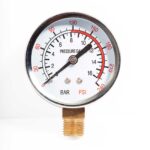
How M14×1.5 Differs from Standard G 1/4″ and G 1/8″ Pressure Gauges
M14×1.5 is a metric thread, unlike the BSP inch threads G 1/4″ and G 1/8″ used in most industrial pneumatic systems. M14×1.5 gauges are installed at specific connection points:
| Thread type | Standard | Typical application |
|---|---|---|
| M14×1.5 Male | Metric | Compressor pressure switches, spray guns, paint cups |
| G 1/4″ Male | BSP inch | Pneumatic lines, filters, pressure regulators |
| G 1/8″ Male | BSP inch | Small-fitting gauges, sensors |
| NPT 1/4″ Male | US standard | North American-made equipment |
The M14×1.5 gauge is a direct fit at the following connection points:
- Free port on a 220V pressure switch with M14 thread (models without a built-in gauge)
- Receiver manifold with M14 port
- M14 T-adapter in the compressor line
Bottom Radial Connection: What It Means and Why It Matters
Pressure gauges are made with two connection orientations:
| Type | Port location | When used |
|---|---|---|
| Bottom radial | Below, perpendicular to the dial axis | Panel mounting, pressure switch, manifold |
| Rear axial | Behind, along the dial axis | In-line pipe mounting in the flow direction |
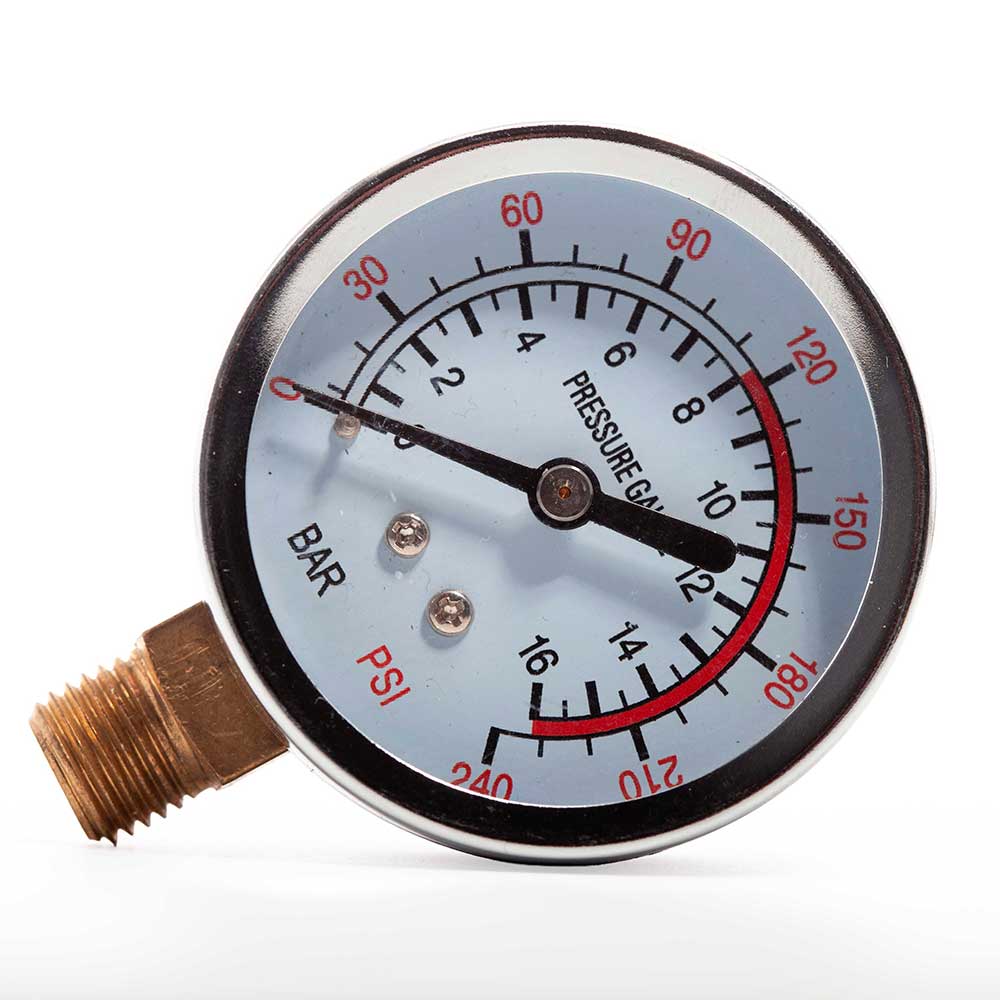
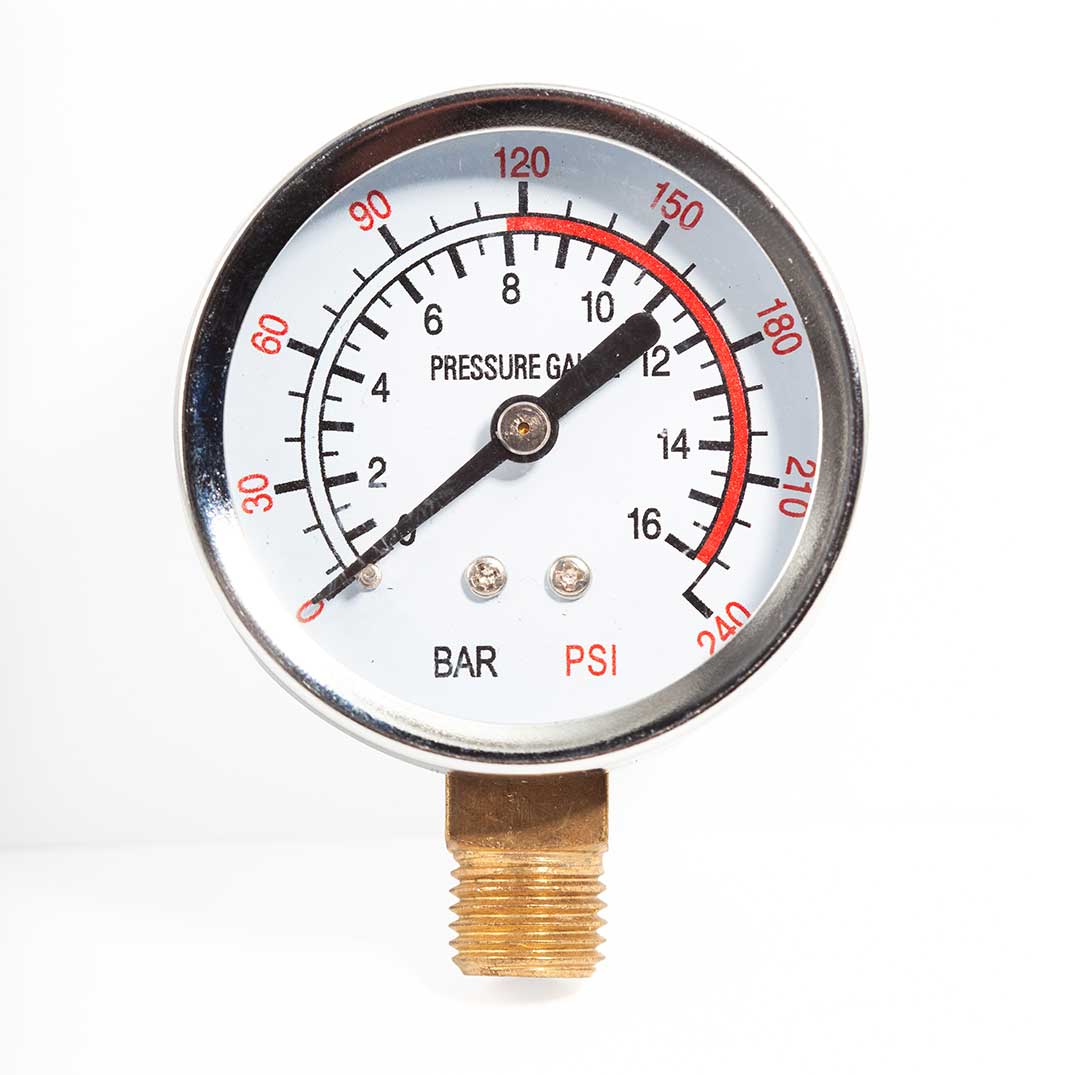
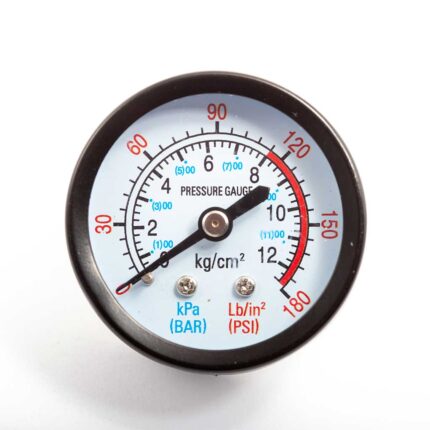
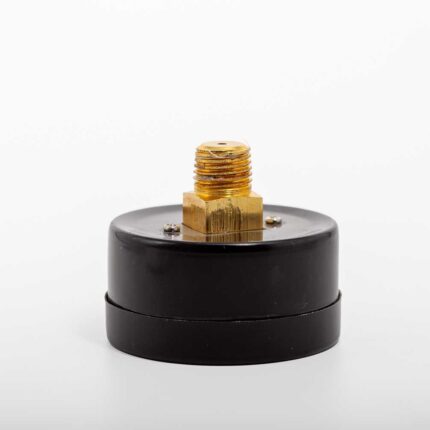
Bottom radial connection (this model) means the port exits from the bottom of the body at 90° to the dial face. This suits vertical mounting on a pressure switch or a horizontal receiver manifold — the gauge faces forward and the dial is easy to read.
Technical Specifications
| Parameter | Value |
|---|---|
| Connection type | Bottom radial |
| Thread | M14×1.5 Male (metric) |
| Dial diameter | 60 mm |
| Scale | 0–16 bar |
| Scale divisions | 0.5 bar |
| Accuracy class | 2.5 (GOST 2405) |
| Type | Dry (no glycerine filling) |
| Body material | Plastic / metal |
| Window material | Transparent plastic |
| Working temperature | −20 °C … +60 °C |
| Media | Compressed air, neutral gases |
Where the M14×1.5 Gauge Is Installed
Compressor pressure switch Most pressure switches (pressostats) with 4 ports have one free M14 port for a gauge. This gauge screws directly into that port without an adapter.
Receiver manifold On some compressors the receiver manifold has an M14 port for a gauge. The gauge shows current receiver pressure.
T-adapter in the line If no free port is available — an M14 tee fitting is used at the required point in the distribution line.
Spray guns and paint equipment A number of professional spray guns and paint booths use M14×1.5 thread for connecting an air or paint pressure gauge.
How to Choose a Pressure Gauge: 4 Parameters
1. Connection thread M14×1.5 — for pressure switches and manifolds with metric M14 thread. For G 1/4″ — choose a gauge with the corresponding thread. An M14→G 1/4″ adapter exists but the extra joint is an extra potential leak point.
2. Dial diameter 60 mm — the standard for bench and compressor gauges. Readable at 1–2 m. For control panels — 100 mm. For compact systems — 40 mm.
3. Full-scale range Should be 1.5–2× higher than the maximum system working pressure. For a 10 bar compressor — a 0–16 bar gauge is ideal (working pressure sits at 60–70% of scale). Constant operation with the needle near the red line accelerates mechanism wear.
4. Type: dry or glycerine-filled
- Dry (this model) — for stationary systems without significant vibration. Less expensive, clear dial.
- Glycerine-filled — for systems with vibration (compressor without a receiver, direct head connection). Glycerine damps needle oscillation and extends service life.
💡 For most compressors with a receiver a dry gauge is sufficient — the receiver smooths out pressure pulsations. Glycerine-filled is needed if the gauge is mounted directly on the compressor head or in a high-vibration zone.
Signs of Gauge Failure: When to Replace
- Needle does not return to zero on pressure release — wear or damage to the Bourdon tube spring element
- Cracked or fogged window — condensate inside, readings unreliable
- Needle sticks and does not respond smoothly to pressure changes — fouling or corrosion of the mechanism
- Air leaking from the body — loss of seal integrity at the port or body
- Deviation from a reference gauge of more than 5% — error has exceeded the accuracy class, readings unreliable
⚠️ Do not ignore a faulty gauge. Compressor receiver pressure is a hazardous environment. The pressure switch is set based on gauge readings — if the gauge is inaccurate, the compressor may build pressure beyond the safe limit. Replace the gauge immediately at any sign of failure.
5 Reasons to Keep a Spare Gauge in Stock
1. Low cost — but compressor downtime is expensive A faulty gauge means uncertain system pressure. Operating without reliable pressure monitoring is unsafe and violates maintenance regulations.
2. Fast replacement — 5 minutes with no specialist tools Threads into the M14 port by hand with a light spanner finish. No system disassembly, soldering, or special preparation required.
3. Fits multiple points in the system One gauge type covers: pressure switch, receiver manifold, paint booth — wherever the thread is M14.
4. Pressure monitoring = paint quality control At spray booths with M14 connections, the gauge shows actual pressure at the gun — critical for correct atomisation and finish quality.
5. Required by the maintenance schedule Gauge inspection is a mandatory item in compressor service. A spare gauge on hand eliminates forced downtime during replacement.
Expert Opinion
“The pressure gauge is the most underrated component on a compressor. People buy an expensive spray gun, filters, a dryer — and fit a cheap gauge that reads 2–3 bar off. The result: setting spray pressure ‘by the gauge’ gives overspray or insufficient atomisation. Second point: M14×1.5 is not the most common thread, and if that’s what your pressure switch uses, don’t try to find an M14-to-G 1/4″ adapter — the extra joint will leak. Get the gauge with M14 already on it. The 0–16 bar scale is a universal choice: it keeps the needle in the working zone for a 10 bar compressor, and still leaves headroom for 12–14 bar systems.”
Vitaly Boluchevsky, Chief Engineer at Acvatron SRL, 15 years in the industry
FAQ
❓ Is PTFE tape or thread sealant needed when fitting the M14×1.5 gauge? Yes. M14×1.5 is a metric parallel thread — it does not self-seal through the thread (unlike tapered R and NPT threads). Apply 3–4 wraps of PTFE tape or anaerobic thread sealant. Without sealing there will be an air leak at the threaded joint.
❓ Can this gauge be used for oil or other liquids? This model is rated for compressed air and neutral gases. For oil, water, or aggressive fluids, stainless steel gauges with appropriate seals are required. Using the gauge outside its rated media will cause rapid mechanism failure.
❓ How do I verify gauge accuracy? Compare readings against a calibrated reference gauge at several pressure values. For accuracy class 2.5, the allowable error is ±2.5% of full scale. For a 0–16 bar scale this is ±0.4 bar — if the deviation is greater, the gauge requires replacement.
❓ Which dial size is best: 40, 60, or 100 mm? For a compressor pressure switch in a workshop — 60 mm is optimal: good readability, compact size. For control panels and switchboards — 100 mm (better visibility at distance). For built-in measurement systems in confined spaces — 40 mm.
❓ Is there an equivalent gauge with G 1/4″ thread? Yes, gauges with G 1/4″ Male thread in 60 mm dial with various scales are available in the Acvatron SRL range. Check availability of the required version: +373 22 503-580.








Reviews
Clear filtersThere are no reviews yet.