








Compressor for Sandblasting Equipment: How to Choose Correctly

What is Sandblasting and Why Does It Need a Compressor?
Sandblasting is a method of cleaning and preparing surfaces using abrasive particles (quartz sand, steel shot, corundum) that are accelerated by a stream of compressed air and strike the material at high speed. The result is the removal of rust, old paint, scale, and contaminants; the surface acquires the required roughness for subsequent coating application.
Wide range of applications:
- Body repair and metal preparation for painting in auto shops;
- Cleaning of metal structures, pipes, and tanks in production;
- Restoration of building facades, brick, and concrete masonry;
- Decorative processing of glass, stone, and wood;
- Preparation of ship hulls and industrial equipment.
The efficiency of a sandblasting machine depends directly on how correctly the compressor is selected. Insufficient performance means the abrasive loses speed and processing quality drops. Excessive performance means the equipment runs idle and money is wasted. Let’s break down what to look for when choosing.
Two Key Parameters: Performance and Pressure
Most mistakes when selecting a compressor for sandblasting come from focusing only on pressure while forgetting about performance. These are different values, and both are equally important.
Performance (l/min or m³/min) — the volume of air the compressor delivers per minute. This parameter determines whether the compressor can keep up with the sandblasting machine without stops or pressure drops.
Working pressure (bar) — the force with which air is supplied to the nozzle. For most sandblasting jobs, 6–8 bar is sufficient. Pressure above 10 bar is required only for specific industrial tasks — for example, when cleaning surfaces with bitumen or particularly durable coatings.
Practical rule: To deliver 1 m³ of air per minute, the compressor needs about 7 kW of engine power. A 15 kW compressor will realistically deliver around 2 m³/min — keep this figure in mind when choosing.
How to Match Performance to Nozzle Diameter
The air consumption of a sandblasting machine is primarily determined by the size of the working nozzle. Approximate values:
| Nozzle Diameter | Air Consumption | Processing Area per Hour |
|---|---|---|
| 4–5 mm | 300–500 l/min | 0.4–1.0 m² |
| 6 mm | ~300 l/min | ~0.75 m² |
| 8 mm | ~3,900 l/min?* | ~1.5 m² |
| 9.5 mm | ~5,500 l/min | ~21 m²?* |
| 11 mm | ~7,500 l/min | Large objects |
| 12.5 mm | ~9,500 l/min | Large objects |
Important: The nozzle wears out during operation, its internal diameter increases, and air consumption grows proportionally — by 1.5 times or more. Therefore, choose a compressor with a performance reserve of at least 30–40% above the machine’s rated consumption.
If the sandblaster uses personal protective equipment (a helmet with forced air supply), add another ~400 l/min for the PPE to your calculations.
Piston or Screw Compressor — Which to Choose for Sandblasting?
Piston Compressor
Piston compressors are an affordable option for small workshops, auto shops, and garages. They are suitable for ejector-type sandblasting setups and situations where small areas (up to 3 m²/hour) are processed and the duty cycle is not continuous.
Advantages:
- Lower purchase price
- Simple maintenance
- Models available for 220 V
Disadvantages:
- Cyclic operation: pumping — pause for cooling. Continuous sandblasting will require breaks.
- Pressure pulsation at the output — requires a sufficiently large receiver to smooth it out.
- On 220 V networks, real performance is limited to ~400–500 l/min.
When to choose piston: Small auto shop, one-off jobs, garage, ejector sandblasting chamber. Optimal characteristics: 700–1,000 l/min performance, 8–10 bar pressure, receiver from 100 liters.
Screw Compressor
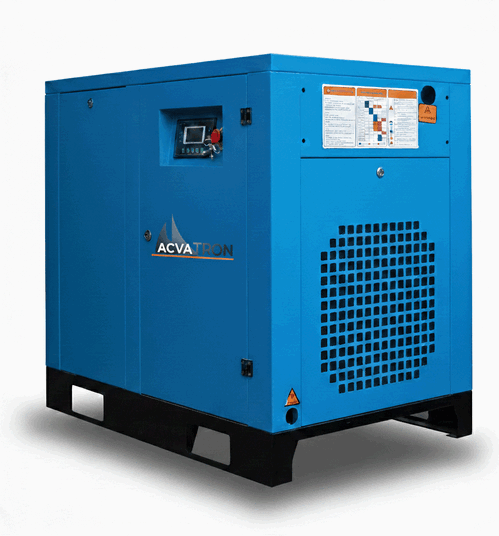
A screw compressor is the right choice for professional and industrial sandblasting work. Air is supplied continuously and without pulsations thanks to the rotation of a pair of screw rotors rather than the reciprocating motion of a piston.
Advantages:
- Continuous air supply without cooling breaks
- Stable pressure — higher surface treatment quality
- Less wear on parts, long service life
- More economical to maintain with large work volumes
Disadvantages:
- Higher purchase price
- Requires a three-phase 380 V network
When to choose screw: Production, ship repair, construction, large metal structures, pressure sandblasting machines. For industrial use — performance from 3,000 l/min (5 m³/min) and higher.
Электрический или дизельный компрессор?
Электрический — стандартный выбор для стационарной работы в мастерской, цеху, боксе. Дешевле в эксплуатации, выше КПД. Требует подключения к промышленной сети 380 В при мощности от 5–7 кВт.
Дизельный (мобильный) — незаменим при выездных работах: очистка фасадов зданий, обработка металлоконструкций на строительной площадке, судоремонт в порту. Не зависит от наличия электросети. Расходы на топливо выше, чем у электрического аналога.
Electric or Diesel Compressor?
Electric — the standard choice for stationary work in a workshop, shop, or box. Cheaper to operate, higher efficiency. Requires connection to an industrial 380 V network for power from 5–7 kW and above.
Diesel (mobile) — indispensable for field work: cleaning building facades, processing metal structures on construction sites, ship repair in ports. Does not depend on the availability of an electrical network. Fuel costs are higher than for an electric counterpart.
Is a Receiver Needed for a Sandblasting Machine?
A receiver (compressed air storage tank) is almost always needed, especially when working with a piston compressor. It performs two functions:
- Smooths pressure pulsations that occur in the piston cycle. This is critical for sandblasting quality — sudden pressure fluctuations ruin the result.
- Provides an air reserve during peak load — for example, when switching to a fresh nozzle.
For small tasks (4–5 mm nozzle), the built-in receiver of the machine itself is sufficient. For 6 mm nozzles and larger — a separate receiver of 100 liters or more connected to the compressor.
For large pressure systems, an external receiver of 500–900 liters paired with a screw compressor is the standard setup for industrial sites.
Dryer and Filters — Mandatory or Not?
Mandatory. Air coming out of the compressor contains moisture and oil vapors. In sandblasting, this creates problems:
- Moisture mixes with the abrasive → the abrasive clumps and clogs the nozzle and hoses.
- Oil contaminates the treated surface → paint or primer will not adhere.
- When air travels through cold zones, warm air (~60 °C at the outlet) causes moisture to condense directly in the pipe.
Minimum set: moisture separator + oil filter before the sandblasting machine. For professional tasks — a refrigerated dryer.
Compressor Selection Table by Task Type
| Task | Sandblaster Type | Nozzle | Compressor |
|---|---|---|---|
| Garage, hobby, small parts | Ejector | 4–5 mm | Piston, 500–700 l/min, 8 bar |
| Auto shop (body repair) | Ejector or pressure | 6–8 mm | Piston, 700–1,000 l/min, 8–10 bar |
| Small production | Pressure | 8–9.5 mm | Piston/screw, 2,000–4,000 l/min |
| Industrial metal structures | Pressure | 9.5–12.5 mm | Screw, from 5,000 l/min, 7–8 bar |
| Field work (no power) | Pressure | Any | Diesel mobile compressor |
Brief Selection Recommendations
- Determine the nozzle diameter of your sandblasting machine — this is the starting point for performance calculation.
- Choose a compressor with a 30–40% reserve over the machine’s rated consumption: the nozzle wears out and air consumption increases.
- For continuous operation, choose a screw compressor — a piston one requires periodic stops for cooling.
- Don’t chase high pressure — for most tasks, 6–8 bar is enough; air volume supply is more important.
- Include a dryer and filters in the kit — without them, the abrasive will clump and clog the equipment.
- A receiver is mandatory when working with a piston compressor — it stabilizes pressure and extends motor life.
We’ll Help You Select a Compressor for Your Sandblaster — in Chișinău and Across Moldova
The acvatron.md catalog offers piston and screw compressors for sandblasting work of any scale — from a small auto shop to industrial production. All models are in stock or available on order with fast delivery across Moldova.
Not sure which compressor is right for your task? Call our specialists or submit a request — we will select the optimal option for free, taking into account the type of machine, nozzle, and volume of work.
The article was prepared by Vitali Bolucevschi (acvatron.md). We share expertise in professional selection and maintenance of compressor equipment on the Moldovan market.
Осушитель и фильтры — обязательны или нет?
Обязательны. Воздух, который выходит из компрессора, содержит влагу и пары масла. При пескоструйной обработке это создаёт проблемы:
- Влага смешивается с абразивом → абразив слипается в комки, забивает сопло и шланги.
- Масло загрязняет обрабатываемую поверхность → краска или грунт не пристанут.
- При прохождении воздуховода через холодные зоны тёплый воздух (~60 °C на выходе) конденсирует влагу прямо в трубе.
Минимальный набор: влагоотделитель + масляный фильтр перед пескоструйным аппаратом. Для профессиональных задач — рефрижераторный осушитель.
Таблица подбора компрессора по типу задачи
| Задача | Тип пескоструя | Сопло | Компрессор |
|---|---|---|---|
| Гараж, хобби, мелкие детали | Эжекторный | 4–5 мм | Поршневой, 500–700 л/мин, 8 бар |
| Автосервис (кузовной ремонт) | Эжекторный или напорный | 6–8 мм | Поршневой, 700–1 000 л/мин, 8–10 бар |
| Небольшое производство | Напорный | 8–9,5 мм | Поршневой/винтовой, 2 000–4 000 л/мин |
| Промышленные металлоконструкции | Напорный | 9,5–12,5 мм | Винтовой, от 5 000 л/мин, 7–8 бар |
| Выездные работы (без сети) | Напорный | любой | Дизельный мобильный компрессор |
Краткие рекомендации по выбору
- Определите диаметр сопла вашего пескоструйного аппарата — это отправная точка для расчёта производительности.
- Возьмите компрессор с запасом 30–40% от паспортного потребления аппарата: сопло изнашивается, расход воздуха растёт.
- Для непрерывной работы выбирайте винтовой компрессор — поршневой требует периодических остановок на охлаждение.
- Не гонитесь за высоким давлением — для большинства задач 6–8 бар достаточно; важнее объём подачи воздуха.
- Включите в комплект осушитель и фильтры — без них абразив будет слипаться и засорять оборудование.
- Ресивер обязателен при работе с поршневым компрессором — он стабилизирует давление и продлевает жизнь мотору.
Подберём компрессор для вашего пескоструя — в Кишинёве и по всей Молдове
В каталоге acvatron.md представлены поршневые и винтовые компрессоры для пескоструйных работ любого масштаба — от небольшого автосервиса до промышленного производства. Все модели в наличии или под заказ с быстрой доставкой по Молдове.
Не уверены, какой компрессор подойдёт именно для вашей задачи? Позвоните нашим специалистам или оставьте заявку — подберём оптимальный вариант бесплатно, с учётом типа аппарата, сопла и объёма работ.
Статью подготовил Виталий Болучевский (acvatron.md). Мы делимся опытом профессионального подбора и обслуживания компрессорного оборудования на рынке Молдовы.