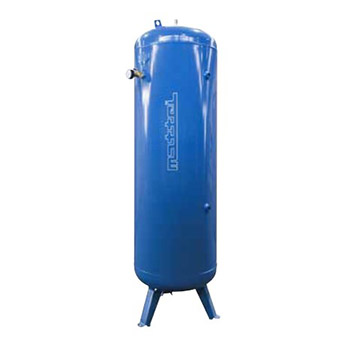








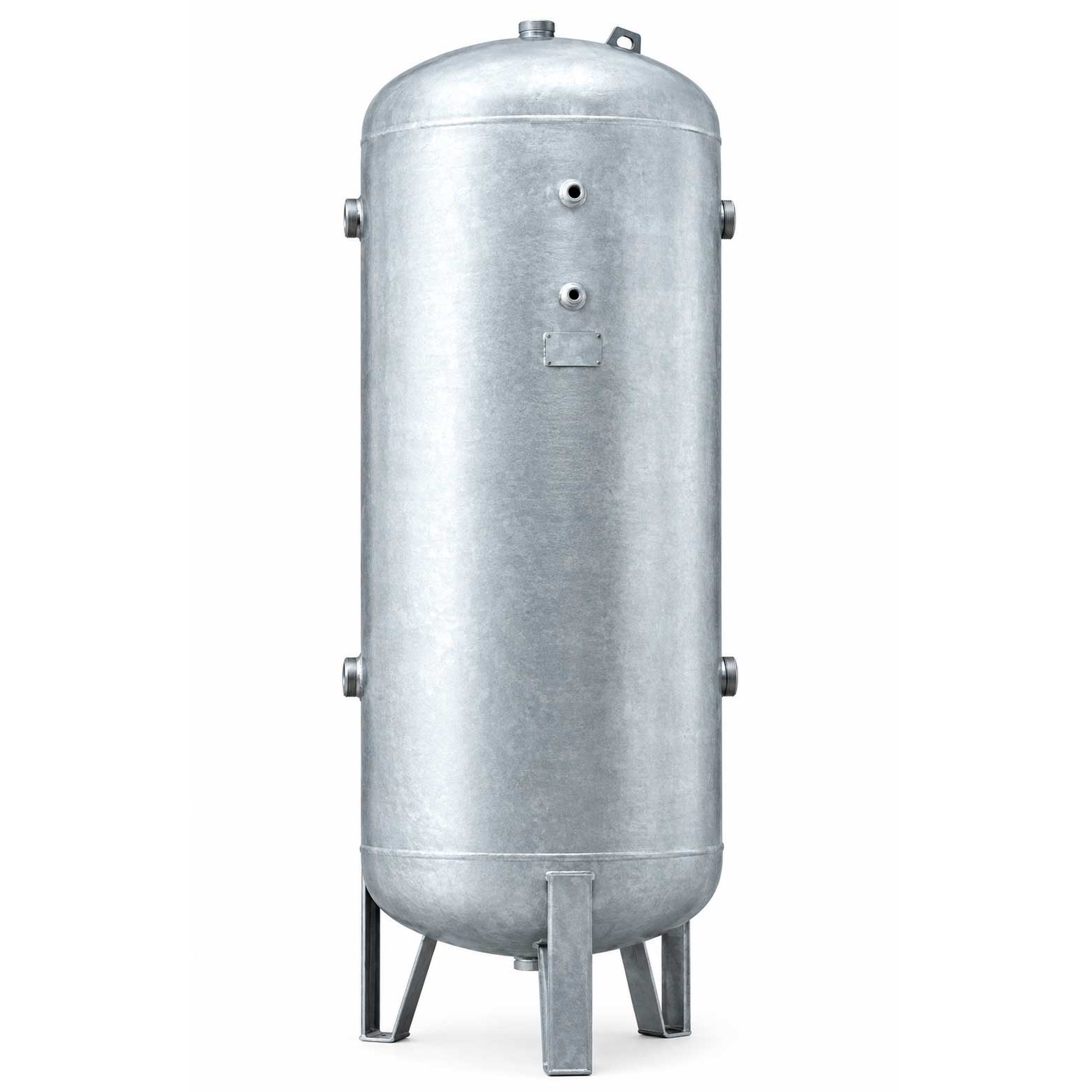

Galvanized Air Receiver REMEZA РВ 500 16.30 (500 L, 16 bar)
The РВ 500 16.30 air receiver is a vertical pressure vessel manufactured by the Belarusian plant Remeza. It stores compressed air supplied by the compressor and delivers it to downstream equipment. Its 500-litre capacity and maximum operating pressure of 16 bar (1.6 MPa) are intended for compressor stations that require elevated pressure.
1. Purpose and operating principle
The receiver performs four functions in the system:
- Air storage. The reserve in the tank covers short-term demand peaks, so the compressor does not have to respond to every downstream air demand.
- Pressure pulsation damping in the line downstream of a piston compressor.
- Primary condensate separation. Air cools inside the tank, moisture settles and collects at the bottom for draining.
- Energy savings. Fewer starts and stops allow the compressor to run more steadily. Motor starting current is significantly higher than rated current, so less frequent starts can reduce electricity consumption. The actual savings depend on the compressor control scheme.
The “galvanized” version has walls protected by hot-dip galvanizing. Condensate (a mixture of water and oil) is in constant contact with the tank’s inner surface, so internal protection helps reduce the risk of corrosion and rust entering the compressed-air network.
2. Technical specifications
| Parameter | Value |
|---|---|
| Model | РВ 500 16.30 |
| Manufacturer / brand | Remeza (Republic of Belarus) |
| Type | Vertical air receiver on support legs |
| Capacity | 500 L |
| Maximum operating pressure | 16 bar (1.6 MPa) |
| Corrosion protection | Hot-dip galvanizing |
| Purpose | Compressed-air storage, pulsation damping and condensate collection |
| Documentation | Pressure-vessel passport |
The specifications shown on the product page must be checked against the vessel passport. The page lists 11 bar pressure, dimensions of 600 × 2100 mm, Rp 1″ / Rp 1/2″ connections and a weight of 120 kg. These values match the РВ 500.11.00 version (11 bar, painted) and should not be treated as confirmed for a 16-bar vessel. Other 500-litre receivers rated at 16 bar are considerably heavier (for example, ABAC V500 16B ZINC at approximately 173 kg and Airpress 3650016GC at approximately 190 kg; their ports are G 2″). Verify and enter the following from the passport: pressure, diameter and height (the page lists 600 and 2100 mm), weight, connection sizes and types (inlet and outlet, pressure gauge, safety valve and condensate drain connections), wall thickness, design and test pressures, operating temperature range, service life and compliance with applicable technical regulations.
3. Design features
Model code breakdown:
| Code element | Meaning |
|---|---|
| РВ | Air receiver |
| 500 | Capacity in litres |
| 16 | Maximum pressure in bar |
| 30 | Galvanized version (according to the website classification, 00 means painted) — confirm |
Design details:
- Vertical design with support legs — takes up little floor space, and condensate collects at one point at the bottom.
- Hot-dip galvanizing — coating on the vessel’s inner and outer surfaces; coverage and coating thickness must be confirmed in the passport.
- Ports and connections for air inlet and outlet, pressure gauge, safety valve and condensate drain; quantity and sizes must be checked against the passport.
- Pressure-vessel passport supplied.
Standard equipment. Receivers of this type are commonly supplied with a pressure gauge, safety valve, condensate drain valve and outlet valve. Confirm which items are included with this specific model when ordering.
4. Installation recommendations
- Foundation. Install the receiver vertically on a level, rigid base, ensuring that the support legs are not tilted. Keep the pressure gauge, safety valve and drain accessible.
- Location. Choose a cool area away from heat sources: lower temperatures allow more condensate to separate inside the tank.
- Line arrangement. Install the receiver downstream of the compressor (and after the aftercooler, if fitted). Place the dryer and filters downstream of the receiver so they receive air from which some moisture has already been removed.
- Pressure. The compressor’s maximum pressure and the safety-valve setting must not exceed the receiver’s allowable pressure of 16 bar.
- Safety valve and pressure gauge. They must be suitable for the receiver’s operating pressure and kept in good working order. Do not install a shut-off valve between the compressor and the safety valve.
- Connection threads. The receiver connections are specified as female parallel Rp threads; confirm this in the passport. Under the relevant standard, an Rp thread mates with a male tapered R thread: use PTFE tape or sealant on the tapered fitting. If the fitting has a male parallel G thread, seal at the face with a washer or O-ring rather than with thread tape.
- Condensate drainage. Drain moisture through the condensate drain every day and at the end of each shift. Install an automatic condensate drain if necessary.
- Documentation and inspection. Registration and periodic inspection requirements for pressure vessels are governed by local legislation; confirm the applicable requirements before commissioning.
5. Alternatives and comparison
We do not have verified model numbers for direct equivalents, so the table below compares receivers listed on the website. The data are taken from model designations; weights and dimensions shown on their respective pages also need verification.
| Model | Capacity | Pressure | Finish |
|---|---|---|---|
| РВ 500 16.30 (this product) | 500 L | 16 bar | Hot-dip galvanized |
| РВ 500.11.00 (REMEZA) | 500 L | 11 bar | Painted |
| S 500 11Z (Mattei) | 500 L | 11 bar | Galvanized |
| S 500 11V (Mattei) | 500 L | 11 bar | Painted |
The key difference of the РВ 500 16.30 is the combination of a higher 16-bar pressure rating and galvanizing. If your system operates at up to 11 bar, the lighter 11-bar versions may be sufficient; an 11-bar receiver is not suitable for higher pressure. Choose the galvanized version where the receiver is regularly exposed to substantial amounts of condensate or where compressed-air cleanliness requirements are higher. A painted receiver remains a suitable option for standard applications.
6. Common mistakes
- Choosing by capacity alone. 500-litre receivers are available in 8, 11 and 16 bar ratings. Check both capacity and pressure; the receiver rating must be at least as high as the compressor’s maximum pressure.
- Forgetting to drain condensate. Galvanizing slows corrosion but does not eliminate the need for daily drainage. Accumulated water and oil can still damage fittings and the system.
- Welding or modifying the vessel. Welding brackets or ports and making other modifications to the body are prohibited: they can damage the zinc coating and compromise the strength of the pressure vessel.
- Incorrect safety-valve setting. An 11-bar valve on a 16-bar receiver will open too early, while a valve set to a higher pressure may fail to protect the vessel.
- A shut-off valve between the compressor and safety valve. If the valve is closed, the safety valve cannot protect the receiver against overpressure.
- Installation on an uneven base or near hot surfaces. The legs may be unevenly loaded, while overheating increases stress on the vessel and affects condensation in the line.
7. Applications
- Central compressor stations operating at pressures up to 16 bar (screw and piston compressors).
- Systems requiring stable pressure of 12–16 bar, such as laser-cutting lines.
- Production facilities with substantial condensate levels and higher compressed-air cleanliness requirements.
- Workshops and production areas where the receiver reduces compressor starts and stabilizes network pressure.
8. Expert opinion
“For a compressor station operating continuously, the galvanized РВ 500 16.30 is a sensible choice: it protects the inner walls against condensate and helps prevent rust from entering the air network. However, do not neglect the basics: drain condensate daily, keep the pressure gauge and safety valve in good working order, and never modify the vessel by welding. Always check the pressure rating when ordering: 500-litre receivers are available for different pressures, and the selected vessel must match your compressor’s requirements.”
Vitalii Boluchevski, Acvatron SRL — 18 years of experience
9. FAQ
1. What is the difference between a galvanized and a painted receiver?
A galvanized receiver has a zinc coating applied by hot-dip galvanizing, including on the inside, where it is constantly exposed to condensate. A painted receiver is coated with paint and is suitable for standard applications. Galvanized models are recommended for more demanding conditions, such as aggressive environments.
2. Does a galvanized receiver still need condensate drainage?
Yes. Drain moisture through the condensate drain daily and at the end of each shift. The zinc coating slows corrosion but does not remove condensate from the tank.
3. How can a receiver help save electricity?
The stored air reduces the number of compressor starts. With load/unload control, the motor may run unloaded for longer or stop completely. Starting current is higher than rated current, so fewer starts can reduce electricity consumption.
4. Is the РВ 500 16.30 suitable for an 8- or 11-bar compressor?
Technically, yes: the receiver is rated for 16 bar. The compressor’s maximum pressure and the safety-valve setting must not exceed the receiver’s allowable pressure. If your system operates at up to 11 bar, you may also consider receivers rated for 11 bar.
5. Can a bracket or additional port be welded onto the receiver?
No. Any modification to a pressure vessel, including welding, can damage the zinc coating and reduce its strength. Order additional connections from the manufacturer.