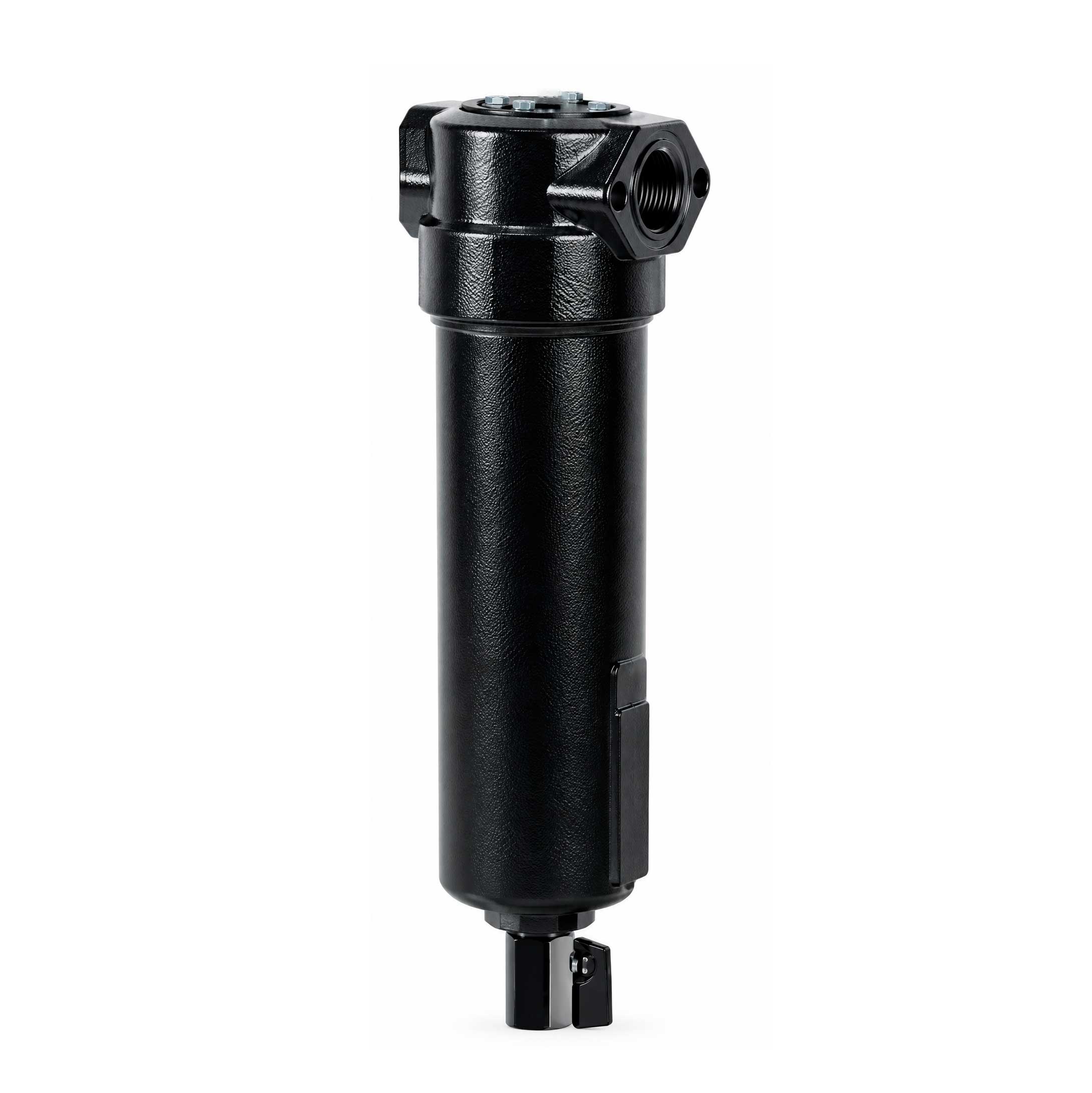











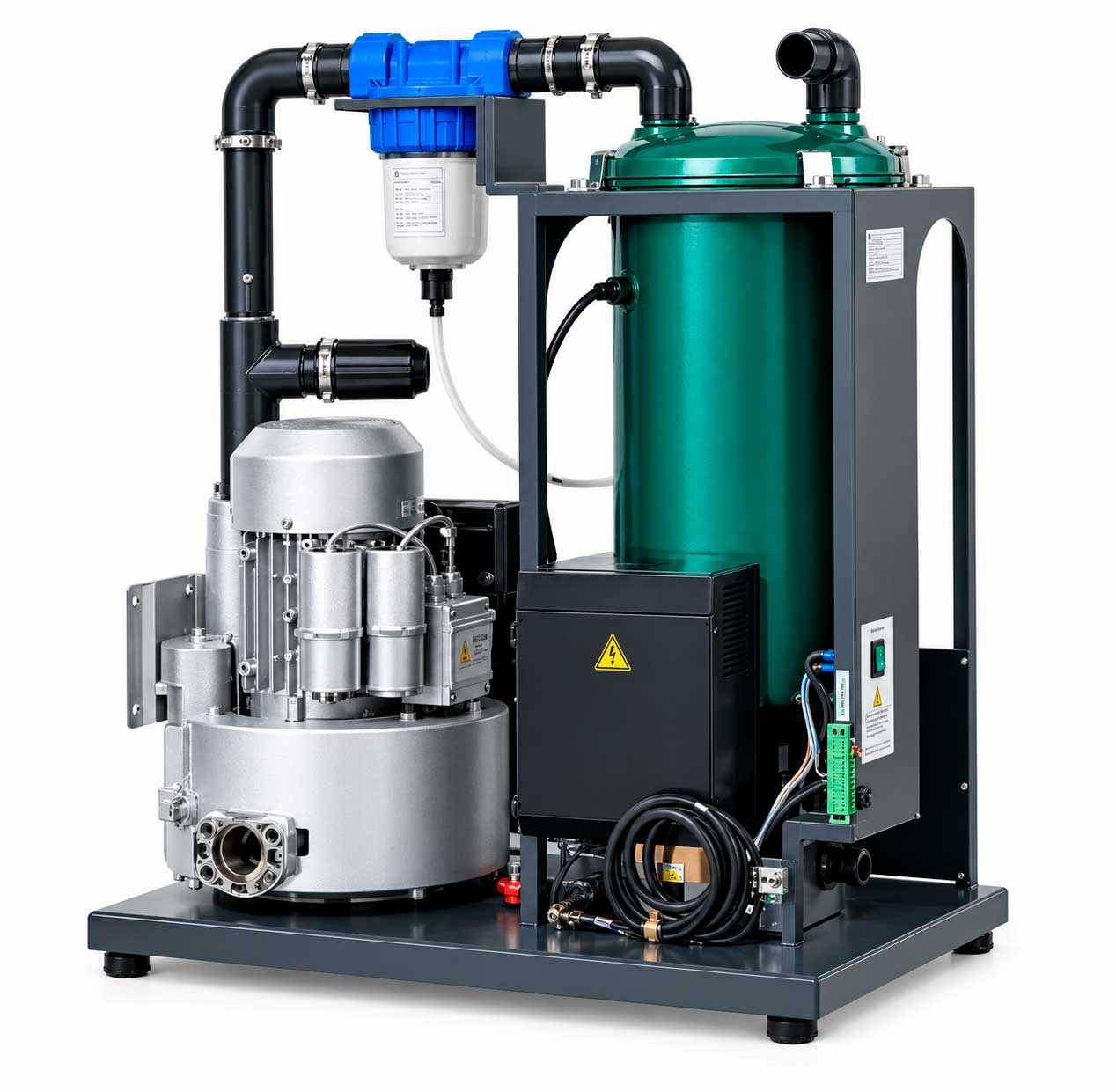
The system is built around a powerful vacuum motor (1.1 or 1.3 kW) and a fiber-molded separator tank that provides strong corrosion resistance under constant contact with the aspirated fluid. An automatic level-control and drain system with a dedicated drain pump removes the need for staff to manually monitor tank filling and emptying.
Technical specifications
| Parameter | Value |
|---|---|
| Model | DSU-003-3 (Maxi Open Version) |
| Manufacturer | Nardi Compressori Srl (Italy) |
| Recommended chair count | 3–4 |
| Vacuum motor power | 1.1 or 1.3 kW (depending on configuration) |
| Installation type | Open (cabinet-free), for backroom placement |
| Separator tank | Fiber-molded, high corrosion resistance |
| Drain system | Automatic, with level control and dedicated drain pump |
| Power supply | 110V or 230V, 50 or 60 Hz (confirm at order) |
| Certification | CE, ISO 9001:13485 |
| Warranty | 24 months (12 months on the vacuum motor) |
⚠️ The manufacturer does not publish a full plain-text table with vacuum level in mbar, exact weight, or precise dimensions — this data appears on the site in a separate technical block that isn’t machine-readable, or in a PDF catalog. Before ordering, we recommend requesting an up-to-date DSU-003-3 technical datasheet from an Acvatron manager.
Engineer’s tip: “The DSU-003-3 motor power is given as a range — 1.1 or 1.3 kW, depending on the build. When sizing it for a specific clinic, confirm the exact configuration and the actual air and fluid throughput with your supplier — that directly determines the load margin when all 3–4 chairs run at the same time,” notes Vitalie Boluchevschi, Chief Engineer at Acvatron SRL.
Design features
Model designation breakdown for DSU-003-3:
| Element | Meaning |
|---|---|
| DSU | Dental Suction Unit — Nardi’s dental aspiration system series |
| 003 | The “Maxi Open Version” line — stationary open-format units for higher throughput |
| -3 | Configuration for 3–4 chairs (1.1/1.3 kW motor) |
Related models for comparison:
- DSU-003-1 (“Midi Open Version”) — the same open construction, sized for 1–2 chairs.
- DSU-003-3 — the model at hand, for 3–4 chairs, with a 1.1 or 1.3 kW motor.
- DSU-003-5 (“Maxi Open Version”) — the top model in the line, for 5–6 chairs, with a 1.5 or 1.75 kW motor.
Key design choices:
- Open, cabinet-free format — the compact body can be placed in any technical room of the clinic (a backroom, a cabinet niche), rather than being kept in plain sight beside the chair like the mobile DSU-001 models.
- Fiber-molded separator tank — resists constant contact with the aggressive mix of saliva, blood and dental material residue, extending the tank’s service life compared to metal alternatives.
- Automatic level and drain control with a dedicated pump — fluid is pumped out as it accumulates without staff intervention, which matters under the continuous load of 3–4 chairs running at once.
- Compact footprint at high throughput — the open architecture allows several treatment rooms to be served at once without installing a separate aspirator per chair.
Installation and operation guidelines
- Plan the suction piping layout in advance, running from each chair to the DSU-003-3’s location in the backroom — unlike the mobile DSU-001 units, this system requires fixed pipework.
- Confirm line voltage at order time — the unit is available in 110V or 230V (50/60 Hz); Moldova’s standard supply is 230V/50Hz, so specify this explicitly when placing an order.
- Provide an organized fluid outlet for the automatic drain system’s pump — the discharge piping needs to be built into the room during renovation, not added afterward.
- Ensure adequate ventilation in the room housing the unit — the 1.1–1.3 kW vacuum motor generates heat and needs free airflow for cooling.
- Service the separator tank and filter elements on schedule per the manufacturer’s guidance — even with its corrosion-resistant fiber construction, the tank still needs periodic cleaning of solid residue.
- Size the unit to the chair count, not the other way around — when planning a 3–4 chair clinic, choose the DSU-003-3 specifically rather than an “oversized” DSU-003-1 or an “undersized” DSU-003-5: the manufacturer sizes motor power for a specific number of chairs running concurrently.
Compatibility and comparison
| Model | Format | Chair count | Motor power |
|---|---|---|---|
| DSU-002-1 | Compact, semi-wet separation | 1–2 | — |
| DSU-002-4 | Compact, semi-wet separation | 3–4 | 1.1–1.3 kW |
| DSU-002-2 | Midi compact, silenced | 8–10 | — |
| DSU-003-1 | Midi, open unit | 1–2 | — |
| DSU-003-3 | Maxi, open unit | 3–4 | 1.1 or 1.3 kW |
| DSU-003-5 | Maxi, open unit | 5–6 | 1.5 or 1.75 kW |
Choosing between the DSU-002-4 and the DSU-003-3 (both rated for 3–4 chairs): the DSU-002-4 belongs to the compact line with semi-wet separation and a silenced cabinet — a good fit when the unit must sit close to the working area in a tight space. The DSU-003-3 is an open, cabinet-free build meant for a separate technical room, where a compact footprint and tank corrosion resistance matter more than cabinet noise insulation. For an exact choice between the two, we recommend discussing your clinic’s actual floor plan with an Acvatron manager.
Common selection and operation mistakes
- Ordering without confirming line voltage — the 110V and 230V builds are not interchangeable; a default order can result in a mismatch with the local electrical supply.
- Confusing DSU-003-1, DSU-003-3, and DSU-003-5 — the models look alike (same line, open format) but are sized for different chair counts and motor power; ordering the wrong index leads either to insufficient throughput or unnecessary cost.
- Skipping piping design before installation — unlike the mobile DSU-001 units, the DSU-003-3 requires the room to be prepared with fixed pipework well in advance.
- Placing the unit in a room with no ventilation — reduces motor cooling efficiency and can shorten its service life.
- Ignoring scheduled maintenance of the separator tank — even a corrosion-resistant fiber tank still needs periodic clearing of solid residue.
Application examples
The DSU-003-3 is a strong fit for:
- Dental clinics with 3–4 treatment rooms that need a single centralized aspiration system instead of a separate mobile aspirator per chair.
- Clinics with a dedicated technical or back room, allowing an open-format unit to be installed without needing a decorative cabinet.
- Growing practices transitioning from single-chair mobile units (the DSU-001 line) to a centralized system as chair count increases.
- Sites where equipment corrosion resistance matters under long-term continuous operation.
Expert opinion
“Once a clinic grows to 3–4 chairs, it makes sense to move from mobile units to a central system like the DSU-003-3 — it reduces the burden on staff and simplifies maintenance: one separator tank and one drain system instead of several separate aspirators. The one thing I always flag for clients is that the DSU-003-3’s open format requires the piping layout to be planned in advance, along with a dedicated technical room — this needs to go into the clinic renovation plan at the earliest stage, not added afterward,” comments Vitalie Boluchevschi, Chief Engineer at Acvatron SRL.
FAQ
What’s the difference between the DSU-003-1, DSU-003-3, and DSU-003-5? All three are stationary open-format units from the Maxi/Midi Open Version series, but sized for different chair counts: the DSU-003-1 for 1–2, the DSU-003-3 for 3–4 (1.1/1.3 kW motor), and the DSU-003-5 for 5–6 (1.5/1.75 kW motor).
Does the DSU-003-3 fit Moldova’s standard electrical supply? The unit is available in a 230V, 50 Hz build, matching Moldova’s standard supply. Be sure to specify the required voltage and frequency when placing your order.
Does the DSU-003-3 need fixed pipework? Yes — unlike the mobile DSU-001 units, the DSU-003-3 is a stationary open system that requires suction piping planned in advance, running from each chair to its installation point in the backroom.