










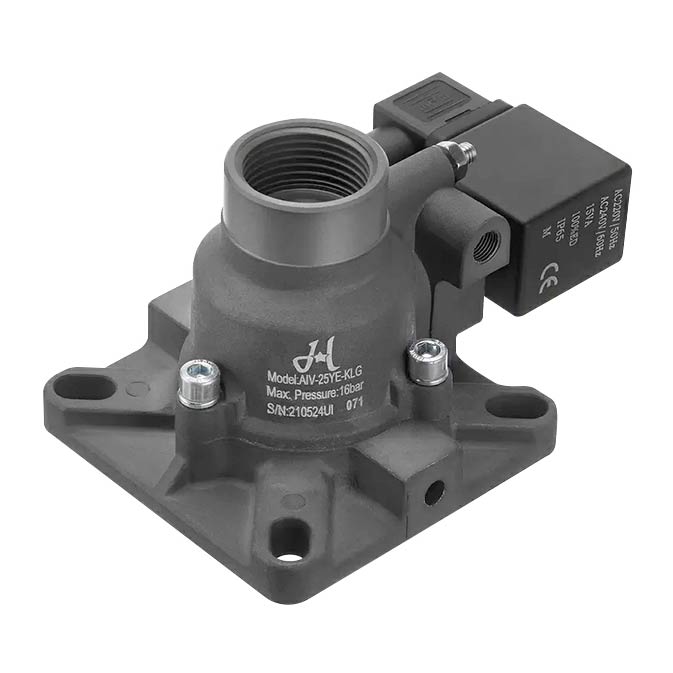
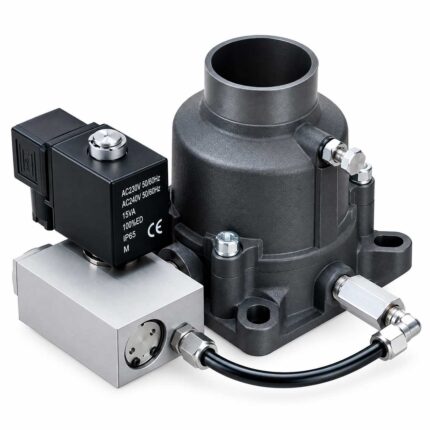
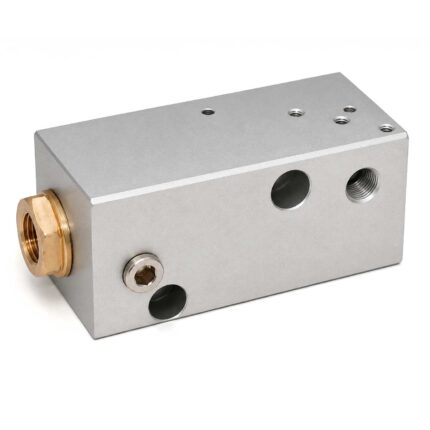
The valve is installed at the air inlet of the screw airend and performs three functions simultaneously:
- regulates air intake depending on the compressor’s operating mode (loaded/idle);
- ensures a smooth transition between modes without hydraulic shock or extra strain on the electric motor;
- acts as a check valve, preventing the ejection of oil-air mixture through the air filter when the compressor stops.
Technical Specifications
| No. | Parameter | Value |
|---|---|---|
| 1 | Device type | Suction valve (integrated) |
| 2 | Series | AIV (RedStar) |
| 3 | Nominal diameter (DN) | 25 mm |
| 4 | Application | Oil-flooded screw compressors, 11–15 kW |
| 5 | Maximum working pressure | 16 bar |
| 6 | Control system | Pneumatic / solenoid |
| 7 | Housing material | High-strength cast aluminum |
| 8 | Quality certification | ISO 9001 |
| 9 | Working medium | Compressed air with oil mist |
| 10 | Temperature range | −20 °C to +120 °C |
| 11 | Response time | < 0.4 sec |
| 12 | Service life | Over 1,500,000 cycles |
| 13 | Check valve | Built-in |
| 14 | Manufacturer | RedStar AirCompressor Parts |
| 15 | Country of origin | China (Nantong City, Jiangsu Province) |
| 16 | Connection type | Verify against the technical drawing for your specific airend — see FAQ section |
Design Features
- RedStar’s own engineering base. The model is developed by the manufacturer’s in-house R&D center, which holds a number of patents in compressor components — it is not a copy of Western designs but an independent development.
- Precision internal machining. Precision machining of the internal seating surfaces ensures a smooth transition to idle mode and reduces starting loads on the compressor’s electric motor.
- Built-in protection against oil blow-back. The check valve mechanism prevents oil-air mixture from entering the air filter in the event of a sudden pressure drop or emergency shutdown.
- Compact architecture. The optimized dimensions of the AIV-25 series allow installation in the limited space of the compressor airend without loss of flow capacity.
- Multi-stage quality control. Production undergoes strict quality control under the ISO 9001 quality management system.
Installation Recommendations
Since connection dimensions may vary between different compressor airends, always check the technical drawing or the markings on the removed valve before installation.
- Identify the thread type before installation. If the connection is tapered (BSPT), use PTFE tape or thread sealant. If the connection is cylindrical/metric, sealing is achieved with a rubber O-ring, and PTFE tape is not required and may cause improper seating.
- Observe flow direction and valve orientation. The check valve is built into the assembly and only functions correctly when installed with the correct orientation — check the arrow or marking on the housing.
- Do not exceed the torque specified by the compressor airend manufacturer — excessive force will deform the seating surface and the valve’s cast aluminum housing.
- Replace seals at every installation, even if the valve appears to be in good condition — this prevents micro air leaks during idle operation.
- Check the cleanliness of the air intake passage before installation — contamination accelerates wear on the control piston.
- Test the load/unload cycle for several cycles after installation before leaving the compressor unattended in automatic mode.
Analogues and Comparison
The AIV-25YE-K is functionally and dimensionally comparable to suction valves used on screw airends from other manufacturers — notably solutions from Kaeser, Atlas Copco, Ingersoll Rand, and a number of Chinese OEM airend manufacturers.
When selecting an equivalent, always verify:
- nominal diameter (DN) and connection type (threaded/flanged);
- maximum working pressure and control-type compatibility (pneumatic/solenoid);
- check valve compatibility in terms of direction and sealing;
- mounting dimensions for your specific screw airend — visually similar valves from different manufacturers are not always interchangeable without adaptation.
If you are replacing a valve from another brand with an AIV-25YE-K (or vice versa), we recommend sending us a photo of the removed part and its markings — we will help you find the exact equivalent or the original part.
Common Installation Mistakes
- Using PTFE tape on cylindrical/metric threads — instead of sealing, the tape prevents the O-ring from seating correctly and causes leaks.
- Installing the valve in reverse orientation — the check valve stops functioning correctly, resulting in oil mist ejection when the compressor stops.
- Ignoring the condition of the seals when reinstalling — leads to increased oil consumption and reduced performance.
- Selecting a valve based on appearance alone, without checking connection dimensions and working pressure — a frequent cause of returns.
- Over-tightening fasteners — deforms the housing and compromises the seal.
Practical Applications
Compact AIV-25 series suction valves are used in the following areas:
- Small production workshops — for reliable operation of pneumatic tools.
- Medical equipment — as part of specialized compressor stations.
- Dentistry — for a clean, stable compressed air supply.
- Food packaging — in automated bottling and packaging lines.
- Furniture manufacturing — powering pneumatic cylinders on assembly tables.
- Laboratory research — gas supply control systems.
Expert Opinion
Vitali Boluchevski, Lead Engineer at Acvatron SRL (18 years of experience):
“The AIV-25YE-K model is a workhorse for screw compressors up to 11–15 kW. The main advantage of RedStar products is that the manufacturer doesn’t just copy Western designs — they use their own patented solutions. In our market, where compressed air quality often leaves much to be desired, AIV series valves show excellent wear resistance. From practical experience: most issues with this component aren’t caused by defects, but by the wrong seal being fitted during installation — confirm the thread type in advance, and the valve will deliver its rated service life without problems. The key is to use original repair kits and not skip scheduled maintenance.”
Frequently Asked Questions
1. What does the “YE” index mean in the valve’s marking? Indices in the AIV series typically indicate specific modifications to the mounting seats or the design of the control piston. For an exact match, send us a photo and the markings of the removed valve — we’ll verify against the technical drawing.
2. Is the AIV-25YE-K compatible with European brand compressors? Yes, many compressor manufacturers use RedStar assemblies as OEM components. The valve is universal for most airends with a matching DN25 connection diameter, but confirm your airend’s thread type before purchasing.
3. How do I identify the thread type (tapered or cylindrical) on my compressor? Inspect the removed valve or the mounting seat: tapered (BSPT) thread narrows toward the end and is sealed with PTFE tape; cylindrical/metric thread has a constant diameter and is sealed with a rubber O-ring. If unsure, contact us — we’ll send identification instructions.
4. Are the valve’s seals compatible with oils from other manufacturers? The valve’s sealing materials are designed for standard mineral and synthetic compressor oils. When using non-standard lubricants, we recommend confirming compatibility before installation.
5. What is the maximum tightening torque for installation? Tightening torque depends on the thread type and the seating material of your specific screw airend — check your compressor manufacturer’s documentation to avoid damaging the valve’s cast housing.
6. How can I extend the service life of the suction valve? The main factor in durability is air cleanliness and timely oil changes. We recommend inspecting the valve every 2,000 operating hours and replacing the seals (repair kit) every 8,000 hours.
7. Is there a separate repair kit for the AIV-25YE-K? Check with our specialists for the current repair kit (seal set) part number for your specific airend — the kit contents may vary by modification.












Reviews
Clear filtersThere are no reviews yet.