











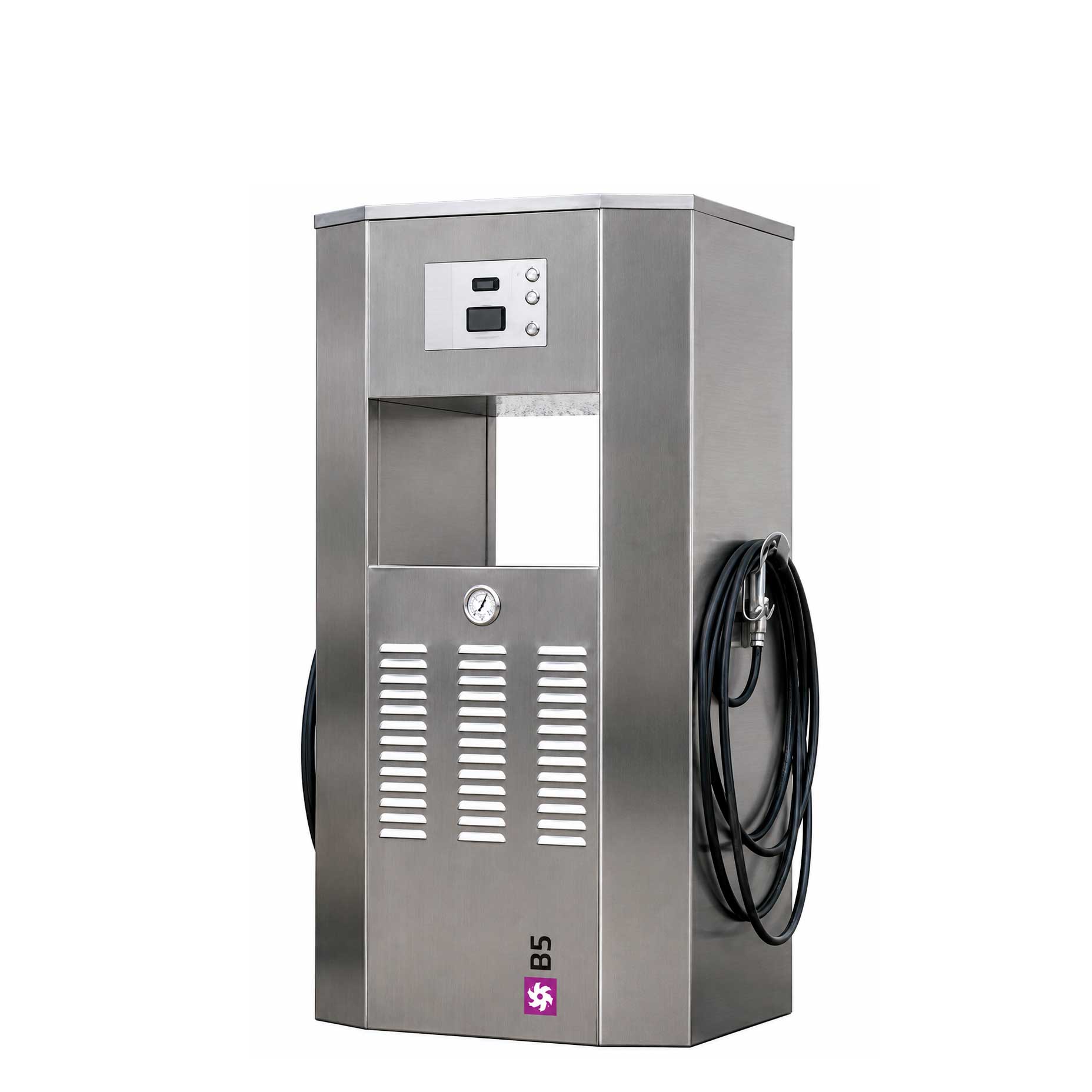

The built-in AWS-C controller provides precise and simple tyre pressure regulation — the petrol station operator or the customer sets the required value, and the electronics manage the process, cutting off air supply once the target pressure is reached. The model also handles water supply for customers, meaning a single station covers two common needs of a fuel station site.
Technical specifications
| Parameter | Value |
|---|---|
| Manufacturer | Omega Air (Slovenia) |
| Model | BS12-3,5 |
| Operating pressure | max. 12 bar (gauge) / max. 174 psi |
| Operating temperature range | −15 to +45 °C (5 to 113 °F)* |
| Flow rate (ISO 1217) | 350 Nl/min |
| Power supply | 230 V / 50 Hz |
| Motor power | 1.8 kW |
| Noise level (A), 1 m | 67 ± 2 dB |
| Electric heater power | on request |
| Hose length | 8 m |
| Weight | 136 kg |
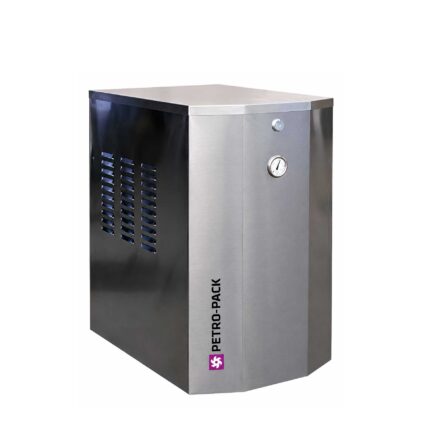
| Housing material | stainless steel (INOX) |
| Receiver material | carbon steel |
| Receiver volume | 25 L |
*If the ambient temperature at the installation site drops below 1.5 °C, the operating configuration (e.g., an electric heater option) must be agreed with the manufacturer or supplier.
Design features
- Stainless-steel (INOX) housing — resistant to corrosion, precipitation, and mechanical vandalism; the receiver itself is made of carbon steel, the standard material for pressure vessels, protected inside the housing.
- 25 L receiver — smooths peak loads when serving several customers at once, reducing how often the compressor cycles on.
- 1.8 kW piston compressor — delivers a flow rate of 350 Nl/min on a 230 V / 50 Hz single-phase supply.
- Moderate noise level of 67 ± 2 dB(A) at 1 m — comfortable for placement near a customer service area.
- 8 m hose — allows servicing wheels on both sides of the vehicle without repositioning the station.
- Optional electric heater (on request) — enables station operation below the standard temperature range, relevant for cold winters.
- Built-in AWS-C controller — precise, simple pressure adjustment without special operator skills.
Installation recommendations
- The station should be installed on a flat, prepared foundation with organised drainage, since it operates outdoors.
- Power supply is single-phase 230 V / 50 Hz; the line should be sized with a margin above the 1.8 kW motor power and fitted with protective grounding.
- Air and water are supplied through ground-level connections; lines should run through mechanically protected conduits.
- The station’s 136 kg weight should be accounted for when planning the site — the foundation must provide a stable base without settling.
- For regions with winter temperatures below 1.5 °C (relevant for Moldova), it is recommended to order the electric-heater version in advance and confirm the configuration with the supplier.
- Before commissioning, check the tightness of all air and water connections at the 12 bar working pressure.
Comparable solutions
Within the Omega Air petrol-station range, BS12-3,5 sits alongside other solutions from the same series — the AWS system and the BS TOWER station — which address similar air and water supply needs but differ in layout and flow rate. When choosing between models, it’s worth comparing receiver volume, compressor power, and mounting format (wall, ground, or tower).
| Criterion | What to check |
|---|---|
| Receiver volume | 25 L — a mid-range value for stations with moderate customer flow; higher-traffic sites may need larger-receiver versions (e.g., BS TOWER) |
| Flow rate | 350 Nl/min — twice that of base models (170 Nl/min), suited to busy petrol stations |
| Motor power | 1.8 kW — standard for single-phase connection, no three-phase line required |
| Temperature range | −15…+45 °C without heater — wider than some budget alternatives |
| Housing | stainless steel is preferable to painted steel for outdoor use in humid climates |
Expert comment: “BS12-3,5 is a classic dual-function petrol-station unit: air plus water in one compact housing. The key advantage is the 25-litre receiver, which smooths peak loads when several customers are served at once, while the stainless-steel (INOX) housing removes corrosion as a concern for the entire service life,” notes Vitali Boluchevski, lead engineer at Acvatron.
Common installation mistakes
- Installing the station without accounting for the site’s minimum temperature — the standard version is rated down to 1.5 °C without a heater; in colder zones this leads to winter failures.
- Connecting to a single-phase line without a power margin — the 1.8 kW compressor requires stable supply, especially during starting currents.
- Skipping foundation drainage — leads to water pooling around the housing and accelerated corrosion of fixing elements.
- Using a longer hose than specified (8 m) without consulting the manufacturer — can affect outlet pressure drop.
- Skipping a leak-tightness check of the air and water lines after installation — leads to pressure loss and extra power consumption.
Practical use cases
- Petrol stations and fuel complexes — the primary scenario: self-service tyre inflation and water for washer fluid/radiator top-up.
- Self-service car washes — an additional service offered to customers after washing.
- Tyre and auto service centres — used by staff for precise inflation during seasonal tyre changes, especially with the 25 L receiver serving several bays.
- Logistics and transport yards — servicing commercial vehicle fleets at site entry/exit points.
Expert opinion
“BS12-3,5 is a classic dual-function petrol-station unit: air plus water in one compact housing. The key advantage is the 25-litre receiver, which smooths peak loads when several customers are served at once, while the stainless-steel (INOX) housing removes corrosion as a concern for the entire service life. For Moldova, I’d specifically advise customers to check the electric-heater configuration — the standard range is rated down to around +1.5 °C, and winter temperatures in the region often go lower than that,” — Vitali Boluchevski, lead engineer at Acvatron SRL.
FAQ
What is the minimum temperature at which BS12-3,5 can be installed? The standard station is rated for a range of −15 to +45 °C. If the installation site temperature drops below 1.5 °C, the configuration (e.g., an electric heater) must be agreed with the manufacturer.
Can BS12-3,5 be used for air only, without water supply? Yes, the station supports both functions independently — the water line can be left unconnected if not needed on site.
What is the receiver made of, and why is the housing stainless steel? The receiver is made of carbon steel (the standard material for pressure vessels), while the outer housing is stainless steel (INOX), protecting the electronics and mechanics from corrosion and unauthorised access during outdoor installation at a petrol station.
What electrical power does the station require? The station runs on a single-phase 230 V / 50 Hz supply, with a motor power of 1.8 kW.
What is the station’s noise level? 67 ± 2 dB(A) at a distance of 1 metre — a moderate level that allows placement near the customer service area.









Reviews
Clear filtersThere are no reviews yet.