











Key Specifications
| Parameter | Value |
|---|---|
| Article code | 55905-4-M5 |
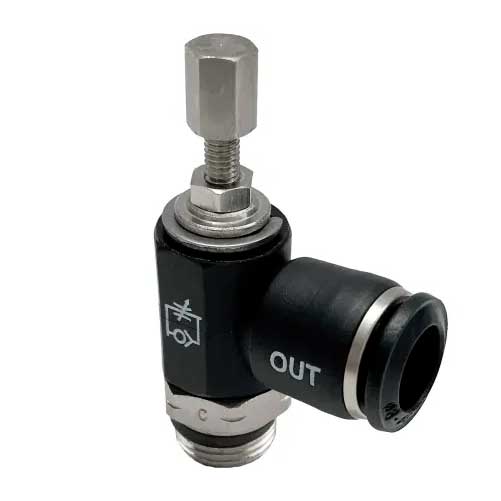
| Type | Angular swivel flow control valve with check valve, needle type |
| Valve function | Meter-out (mounted on actuator) |
| Port 1 | M5, male thread |
| Port 2 | Ø4 mm tube |
| Adjustment element | Protruding knurled screw (hand-adjustable, no tools) |
| Mounting type | External hex |
| Body | Technopolymer (plastic) |
| Working pressure | up to 10 bar |
| Working temperature | −20…+80 °C |
| Working medium | compressed air and neutral gases |
| Manufacturer | AIGNEP, Italy |
| Series | FUNCTION |
Design Features
The compact angular technopolymer body resists condensation and is lightweight, which matters when mounting on small actuators and grippers where port loading needs to stay minimal. The fine-pitch needle adjustment mechanism allows smooth, precise flow setting even at small M5-4 mm sizes, where adjustment sensitivity matters most. The swivel banjo simplifies orienting the valve in tight mounting spaces without rotating the entire body.
Application Recommendations
When installing on the M5 port, avoid excessive tightening torque — the plastic body and fine thread are sensitive to over-tightening, which can strip the thread. Before fine-tuning actuator speed, set the screw to mid-position and purge the line of debris. For stable cylinder motion under variable load, meter-out control (as implemented in this model) is preferable to meter-in. Note that the small 4 mm tube diameter limits maximum flow — high-speed actuators with a large working chamber volume may require a version with a larger tube diameter.
Analogues and Comparable Brands
Functionally comparable M5-4 mm angular flow control valves with check valve are made by SMC (AS-M5 series), Festo (GRLA-M5 series), Camozzi (PMCU 702-M5-4), EMC (ZSC04-M5), and Metal Work (Function series). When selecting a replacement, compare not only connection dimensions but also control direction (meter-in/meter-out), body material, and rated flow capacity (l/min) — compact M5 flow controls from different brands can vary notably in flow rate even at identical nominal sizes.
Common Installation Mistakes
- Using meter-in instead of meter-out control — causes unstable actuator speed under variable load.
- Excessive tightening torque when threading into the M5 port — risk of stripping the thread in the plastic body.
- Adjusting abruptly “from the stop” without gradually opening the screw — makes it harder to find a stable operating point.
- Using the valve on a line with insufficient flow capacity relative to actuator volume — pressure drop and slower cycle time.
Practical Use Cases
- Tuning the extension speed of a miniature pneumatic cylinder with a 20 mm stroke at 5 bar — fine adjustment via meter-out control gave a stable cycle without pressure fluctuation in the main line.
- Installation in a gripper module with limited mounting space — the angular swivel design allowed reorienting the valve without changing the tube routing.
- Replacing a screwdriver-adjustable flow control with a knurled-screw hand-adjustable model — reduced fine-tuning time during frequent changes of line operating modes.
Expert Opinion
★ “For miniature actuators and grippers, an M5-4 mm flow control valve is the standard choice wherever compactness and precise adjustment of small flows matter. The 55905-4-M5, with its hand-adjustable knurled screw, is convenient because the technician can tune speed right on the line without a screwdriver, while the check valve preserves free travel in the return direction.” — Vitali Boluchevski, Acvatron SRL.
Frequently Asked Questions
What’s the difference between meter-in and meter-out control? Meter-in restricts air supply into the actuator and is sensitive to supply pressure fluctuations; meter-out, as used in this model, restricts exhaust flow and provides more stable speed under variable load.
What’s the built-in check valve for? The check valve provides free flow in one direction and adjustable, restricted flow in the other, allowing independent speed control for the actuator’s forward and return strokes.
Can this valve be used with a large-volume actuator? The 4 mm tube diameter limits maximum flow; actuators with higher air consumption should use a version with 6–8 mm tubing and a matching thread.
How do I avoid stripping the M5 thread during installation? Thread the valve in by hand until it seats, then tighten with a wrench only a small additional angle — exceeding the torque limit on the fine M5 thread in a plastic body raises the risk of damage.








Reviews
Clear filtersThere are no reviews yet.