










A problem you have already faced
- No room for a standard cylinder — SDA body height is half that of ISO 15552: essential in tight assembly spaces.
- Small bore Ø20 — compactness requirements exceed those of Ø32 — Ø20 is used where 15–20 N force is sufficient and cylinder mass and footprint are critical.
- No position sensor — PLC cannot see rod end position — without suffix -B there is no piston magnet; reed or Hall sensor does not respond at any rod position.
- Replaced with AirTAC without letter B — sensor does not work — suffix B is mandatory; without it the piston is invisible to the sensor even when correctly mounted.
- FESTO ADVU-20-50 — 4–8 weeks on order and three times more expensive — XCPC SDA-20X50-S-B with the same ISO 21287 dimensions is available from Chisinau stock on the day of payment.
SDA-20X50-S-B is the optimum choice for small-format pneumatics: minimum bore in the SDA series for production tasks, plus position feedback via the built-in piston magnet.
What is the XCPC SDA-20X50-S-B and part number breakdown
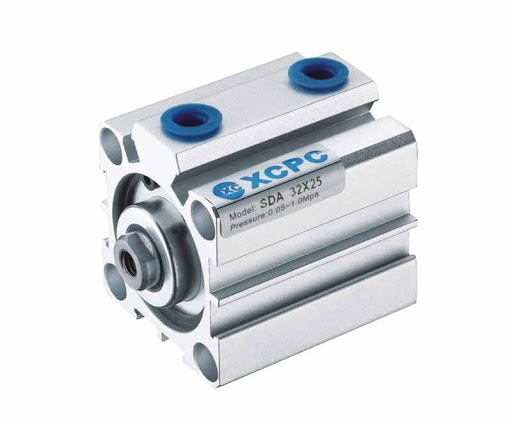
The XCPC SDA series comprises compact flat double-acting pneumatic cylinders per ISO 21287. Body height is half that of ISO 15552 cylinders, with full mounting-pattern compatibility.
SDA-20X50-S-B breakdown:
- SDA — Short stroke Double Acting: compact, double-acting. Equivalent to FESTO ADVU, SMC CQS.
- 20 — piston bore 20 mm. Piston area ≈ 3.14 cm². Force at 6 bar: push ~19 N, pull ~16 N. Used where loads up to 20 N are sufficient and cylinder size is critical.
- X50 — rod stroke 50 mm.
- S — external thread M6×1.0 on the rod end. Smaller than M10 of the Ø32 — verify when selecting a clevis or bracket.
- B — built-in piston magnet for position sensors (reed, Hall). Without B — no magnet, sensor will not work.
Difference from SDA-32X100-S-B: bore 20 mm vs 32 mm (force ~19 N vs ~48 N), stroke 50 mm vs 100 mm, rod thread M6×1.0 vs M10×1.25. ISO 21287 mounting patterns differ by bore — interchanging units requires reworking the mounting face.
XCPC SDA-20X50-S-B Technical Specifications
| Parameter | Value |
| Series / standard | SDA / ISO 21287 |
| Bore (piston diameter) | 20 mm |
| Stroke | 50 mm |
| Action type | Double Acting |
| Working pressure | 0.1–1.0 MPa (1–10 bar) |
| Test pressure | 1.5 MPa (15 bar) |
| Push force (6 bar) | ~19 N |
| Pull force (6 bar) | ~16 N |
| Rod speed | 50–500 mm/s |
| Rod thread | M6×1.0 (external, suffix S) |
| Air connection | G 1/8″ (BSP) |
| Piston magnet | Yes (suffix B) — for CS/RS/D-A93 sensors |
| Working medium | Filtered, non-lubricated compressed air |
| Temperature range | −20°C … +80°C |
| Body material | Aluminium alloy (anodised) |
| Seals | NBR |
| Lubrication | Not required (self-lubricating seals) |
| Certification | CE, RoHS |
💡 Expert tip: At Ø20 mm and 6 bar, output force is ~19 N. If load exceeds 15 N with end-of-stroke impact — fit flow control valves on both ports. Without speed control, at a 50 mm stroke the rod reaches 400–500 mm/s and generates shock loading that damages seals after >2,000 cycles. For precise positioning at short stroke — needle-type flow control (meter-out on exhaust port).
XCPC SDA-20X50-S-B alternatives by brand
| Brand | Alternative P/N | Series | Standard | Rod thread | Magnet | Note |
| XCPC (this unit) | SDA-20X50-S-B | SDA | ISO 21287 | M6×1.0 | Yes | Base part number |
| FESTO | ADVU-20-50-A-P-A | ADVU | ISO 21287 | M6×1.0 | Yes | Direct equivalent; 2–3× more expensive |
| SMC | CQSB20-50D | CQS | ISO 21287 | M6×1.0 | Yes | Japanese; on request |
| Parker | P1D-S020MS-0050 | P1D | ISO 21287 | M6×1.0 | Yes | European; long lead time |
| AirTAC | SDA20X50S | SDA | ISO 21287 | M6×1.0 | ⚠️ No B — no magnet | Verify magnet suffix |
| Pneumax | 1311.20.0050.S.M | Series 1311 | ISO 21287 | M6×1.0 | Yes | Italian manufacture |
⚠️ Important: AirTAC SDA20X50S without suffix B has no piston magnet — the position sensor will not work. When ordering any alternative, always verify the complete part number character by character, particularly the B suffix.
5 mandatory parameters for compatibility verification:
- Bore — 20 mm — ISO 21287 mounting pattern for Ø20 is not compatible with Ø25/Ø32: substitution requires new fixing holes.
- Stroke — 50 mm — physical travel distance; shorter stroke means load does not reach position; longer exceeds the envelope.
- Rod thread M6×1.0 (suffix S) — half the size of M10 on SDA-32: confirm that the load attachment is rated for M6.
- Piston magnet (suffix B) — mandatory for position sensors CS1, D-A93, RS; without B the sensor will not trigger.
- Air connection G 1/8″ — standard across the SDA series; adapters available for M5 or G 1/4″ if needed.
Why Acvatron SRL — 5 solid arguments
1. Engineering selection — correct part number first time
Before issuing an invoice the Acvatron engineer verifies bore, stroke, rod type, B suffix, air thread and mounting method. You receive exactly SDA-20X50-S-B, not a similar cylinder without magnet or with a different thread.
2. ISO 21287, CE — documentation included
Every XCPC cylinder is supplied with CE certificate and ISO 21287 declaration of conformity. Full package for QC, technical audit and regulated production. Issued on the day of dispatch.
3. Stock in Chisinau — no waiting for European suppliers
XCPC SDA cylinders are a standing stock item at Acvatron SRL. Replace FESTO ADVU-20-50 without 4–8 weeks of waiting. Dispatch on the day of payment.
4. Complete XCPC ecosystem
Acvatron supplies alongside the cylinder: position sensors CS1/D-A93, T-slot profiles, M6 clevises and brackets, G 1/8″ fittings, flow control valves. All in one order.
5. Technical support — sensor and flow control valve selection
The Acvatron engineer advises on sensor type (reed / Hall, NPN / PNP) for your PLC, and on flow control valve type and placement. Free of charge on the day of enquiry.
XCPC SDA-20X50-S-B — applications
Electronics and instrumentation
- SMD component pressing and holding during assembly — Ø20 mm integrates into dense assembly layouts
- Positioning of contact probes and test heads on test rigs
- Raising and lowering transport trays in automatic sorters
Medical and laboratory equipment
- Control of microvalves and dosing heads in analytical instruments
- Drive of sample feed carriages in laboratory automation
- Lid pressing in sealed test chambers
Food industry — small formats
- Control of separator flaps on packaging lines
- Feeding and picking of small individual items (sweets, capsules, ampoules)
- Film pressing during tray heat-sealing
Mechanical engineering and precision machining
- Clamping miniature parts in precision fixtures
- Control of stops and latches on conveyors handling small components
- Drive of small-format valves and gates
Expert opinion
Vitaliy Boluchevsky, Chief Engineer at Acvatron SRL, 15 years in the industry:
On 20 mm bore cylinders it is especially important not to mix up the rod thread: M6×1.0 on SDA-20 versus M10×1.25 on SDA-32. I have seen cases where a clevis from an old Ø32 cylinder was threaded onto the rod of a new Ø20 — the result was predictable. The second point: at Ø20 mm force is only ~19 N, and in automation there is often a temptation to skip the flow control valve. But small cylinders without end-of-stroke damping actually have high relative seal wear. A flow control valve on both ports is not a luxury — it is service life. Correctly set up, an SDA-20 with flow control will run 5–10 million cycles without seal replacement.
Standards and certificates: ISO 21287 (compact cylinders), CE, RoHS; sensors — IEC 60947-5-2
How to select a compact 20 mm bore cylinder correctly: 6-step algorithm
- Step 1 — Force: at Ø20 mm and 6 bar — ~19 N. If load is 20–40 N — use Ø25 mm. Above 40 N — Ø32.
- Step 2 — Stroke: 50 mm — compact stroke for precise positioning. If > 50 mm is required — SDA-20X75, SDA-20X100.
- Step 3 — Position sensor: if the PLC must confirm rod position — suffix -B plus sensor in T-slot. Without B the sensor cannot be fitted.
- Step 4 — Rod type: suffix S — M6×1.0 for direct load attachment. Confirm that the load fitting is rated for M6.
- Step 5 — Mounting: threaded holes on body per ISO 21287. For non-axial mounting — M6 threaded clevis or swivel bracket.
- Step 6 — Flow control valve: mandatory on both ports. For 50 mm stroke and load > 0.3 kg — meter-out control on the exhaust port.
Handling typical objections
“I’ll take FESTO ADVU-20-50 — a trusted brand”
FESTO ADVU-20-50-A-P-A and XCPC SDA-20X50-S-B are identical per ISO 21287: same mounting dimensions, same stroke, same M6×1.0 thread. The difference — FESTO is 4–8 weeks on order and 2–3 times more expensive. XCPC is from Chisinau stock on the day of payment, CE and ISO 21287 included.
“You don’t have the stroke / bore I need”
The XCPC SDA series for Ø20 mm is available in strokes of 10, 15, 20, 25, 30, 40, 50, 75 and 100 mm. Non-standard positions — on order within 5–10 working days. Check availability with the Acvatron manager.
“I’m not sure the XCPC sensor is compatible with my PLC”
Sensors for SDA: reed CS1-U (NO/NC, 5–240 V, 2-wire) and Hall D-A93 (NPN/PNP, 5–24 V). Compatible with Siemens, Omron, Schneider, Delta and Allen-Bradley. The Acvatron engineer clarifies the output type for your PLC model — free of charge.
Frequently asked questions
❓ What is the difference between SDA-20X50-S-B and SDA-32X100-S-B?
SDA-20X50: bore 20 mm, stroke 50 mm, rod thread M6×1.0, force at 6 bar ~19 N — for loads up to 20 N. SDA-32X100: bore 32 mm, stroke 100 mm, thread M10×1.25, force ~48 N. ISO 21287 mounting patterns differ by bore — interchanging requires reworking the mounting face.
❓ Which position sensor fits the SDA-20X50-S-B?
For SDA-20X50-S-B (suffix B = piston magnet), sensors for the SDA T-slot are compatible: reed CS1-U (2-wire, 5–240 V AC/DC), Hall D-A93 (3-wire NPN or PNP, 5–24 V DC). T-slot width for SDA-20 is identical to SDA-32 — sensors are interchangeable across the series. Specify PLC input type when ordering.
❓ Can SDA-20X50-S-B replace FESTO ADVU-20-50-A-P-A without reworking the mounting face?
Yes. Both conform to ISO 21287 for 20 mm bore: mounting holes, G 1/8″ port positions, rod diameter and thread M6×1.0 are identical. Direct swap, no machining required. FESTO SMEO and SMT-8M sensors may require verification of T-slot width compatibility.
❓ Is lubrication required during operation?
No. The cylinder has self-lubricating NBR seals. After lubricated air has been used it is not possible to revert to dry operation — seals adapt to oil and dry out quickly without it. Use dry filtered air to ISO 8573-1 class 3 or better.