










1. Purpose and Operating Principle
The compressor check valve is designed for installation in the pneumatic line of a piston compressor and prevents reverse flow of compressed air after the compressor stops.
The XBV-50 model is intended for use with compressor units of approximately 2.2–3 kW. The valve ensures one-way air movement: during compressor operation air flows toward the receiver, and after stoppage it must not return to the compressor head.
For the compressor owner a functional check valve is important for two reasons:
-
reduces the likelihood of reverse pressure on the compressor head;
-
ensures normal operation of the automatic start and unload system of the compressor.
The valve is especially relevant when repairing or restoring piston compressors when the original part is worn or has lost sealing integrity.
2. Technical Specifications
|
Parameter |
Value |
|---|---|
|
Type |
Compressor check valve |
|
Model / designation |
XBV-50 |
|
Primary application |
Piston air compressors |
|
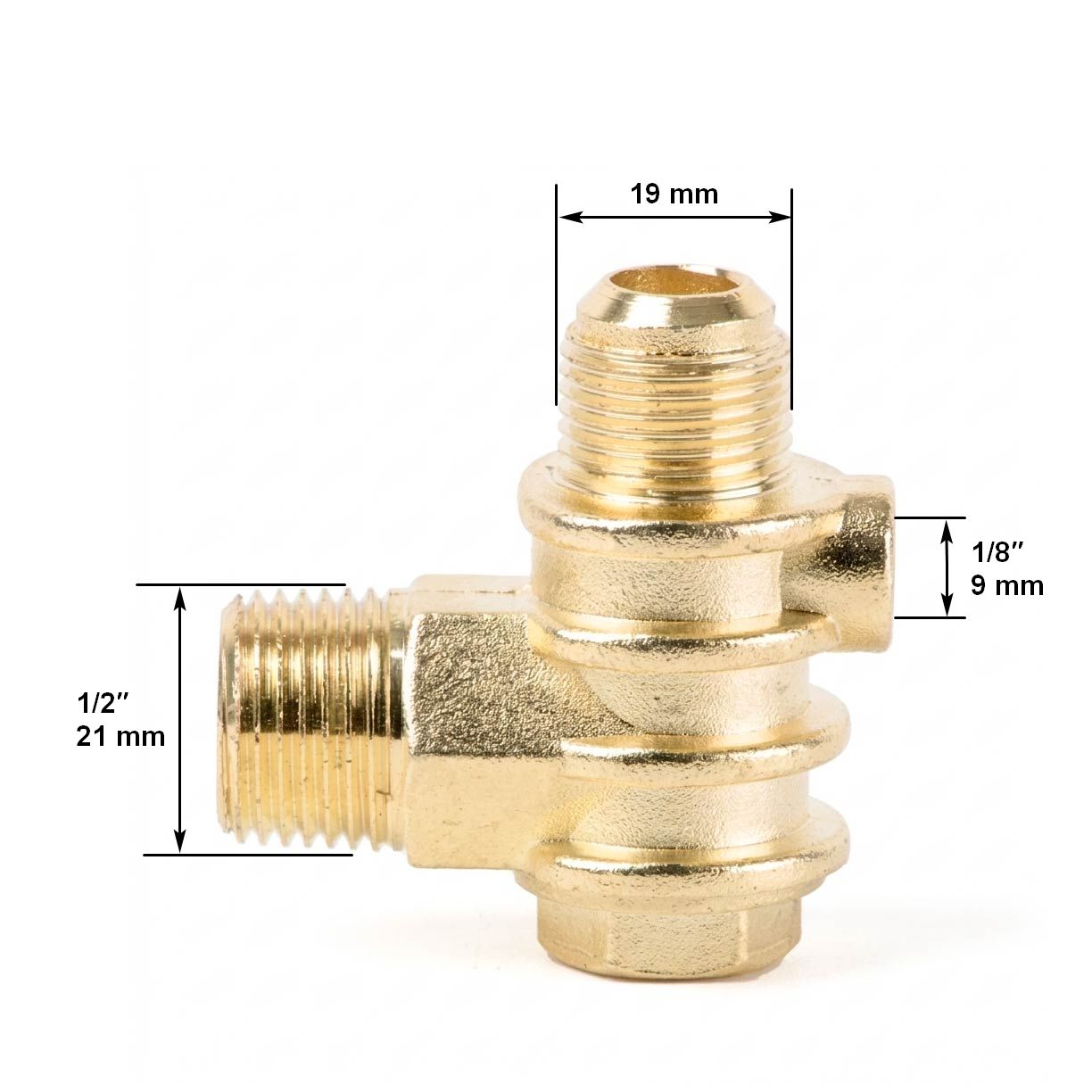
Connection diameter |
1/2″ |
|
Tube connection |
19 mm |
|
Additional thread |
1/8″ (female, internal) |
|
Maximum working pressure |
10 bar |
|
Body material |
Brass |
|
Recommended compressor power |
2.2–3 kW |
|
Compatible compressor versions |
LB30 / LB30A; V-0.25/8 |
⚠️ Not confirmed in available data: valve weight, exact opening pressure value, temperature range, flow capacity and type of internal seal. These parameters should not be stated as technical specifications without the manufacturer’s datasheet.
3. Design Features
Designation breakdown
|
Designation |
Meaning |
|---|---|
|
XBV-50 |
Check valve model designation |
| 1/2″ |
Threaded connection size |
|
19 mm |
Tube connection size |
|
1/8″ (female) |
Auxiliary threaded connection (internal) |
|
10 bar |
Maximum working pressure indicated for the product |
Main design features:
-
brass body;
-
compact design for compressor systems;
-
connection for 19 mm diameter tube;
-
1/2″ threaded connection;
-
additional 1/8″ thread (female, internal);
-
operation on the principle of one-way air passage.
4. Installation Recommendations
Before replacing the valve it is necessary to compare it with the original part:
-
main thread size;
-
diameter of the connected tube — 19 mm;
-
presence and size of the additional 1/8″ thread (female, internal);
-
air flow direction;
-
permissible working pressure.
On the body or next to the connection the flow direction must be determined. The check valve is installed so that air from the compressor head flows toward the receiver.
When dismantling the old valve the pressure in the receiver and the pneumatic system must be fully released.
Important note on thread
If a parallel BSPP/G thread is used, the thread itself is not self-sealing. Sealing must be performed with the sealing element provided by the design.
PTFE tape should not be automatically used on every threaded connection: first the actual thread type and sealing method of the specific joint must be determined.
After installation the connection must be checked for air leakage at working pressure.
5. Cross-References and Comparison
For a universal check valve it is not safe to assign an analogue by thread diameter alone. Before replacement the following minimum points must be compared:
-
main thread;
-
tube connection diameter;
-
additional thread;
-
working pressure;
-
flow direction;
-
sealing design;
-
actual overall dimensions.
When selecting a replacement, priority should be given to the geometry and parameters of the original valve, not only to the name “compressor check valve”. Specific catalogue numbers of analogues are intentionally not provided.
6. Common Mistakes
Incorrect installation direction
If the valve is installed against the flow direction, the compressor will not be able to supply air to the receiver normally.
Selection by 1/2″ size only
Identical thread does not guarantee compatibility. In this case the 19 mm tube connection and the additional 1/8″ thread (female, internal) must also be taken into account.
Use of a valve with insufficient working pressure
The valve must have a permissible working pressure not lower than the working pressure of the compressor system.
Attempting to eliminate leakage by excessive tightening
Strong tightening can damage the thread, body or sealing surface. First the cause of the leak must be determined.
Replacement without checking the cause of the fault
If after installing the new valve air continues to flow back, the pipeline, connections, unload circuit and the compressor head itself must also be checked.
7. Application Area
The XBV-50 check valve is used in the pneumatic systems of piston compressors and can be used when repairing compressor units of approximately 2.2–3 kW.
The Acvatron product card indicates compatibility with:
-
LB30;
-
LB30A;
-
Remeza / V-0.25/8 version.
The valve is suitable as a spare part for repair if the dimensions and connections of the existing assembly match the indicated parameters.
8. Expert Opinion
Vitali Boluchevski, Lead Engineer, Acvatron SRL, 18 years of experience
When selecting a check valve for a piston compressor I recommend not limiting yourself to checking the thread diameter. In practice it is precisely the mismatch of the tube connection, additional thread or flow direction that often becomes the cause of incorrect installation.
For the XBV-50 it is important to check several dimensions at once: 1/2″, 19 mm tube connection and the additional 1/8″ thread (female, internal). If the old valve has failed, before installing the new one it is also worth checking the condition of the tube and threaded connections — the new valve will not solve the problem if the leak is located elsewhere in the pneumatic system.
9. FAQ
Which compressor is the XBV-50 check valve suitable for?
The valve is intended for use in piston compressor units. The Acvatron product card indicates it for LB30/LB30A and V-0.25/8 versions, as well as for compressors of approximately 2.2–3 kW.
What is the size of the main connection?
The main connection is 1/2″. Additionally indicated are the 19 mm tube connection and the 1/8″ thread (female, internal).
What is the maximum pressure of the valve?
The indicated maximum working pressure is 10 bar.
What material is the body made of?
The body is made of brass.
Can this valve be installed on another compressor?
Yes, but only after checking the dimensions and operating parameters. Compatibility cannot be determined by motor power or 1/2″ thread alone.