







Air Compressor for Tire Shop and Auto Service: How to Choose and Get It Right

What a Compressor Does in an Auto Service and Why Everything Depends on It
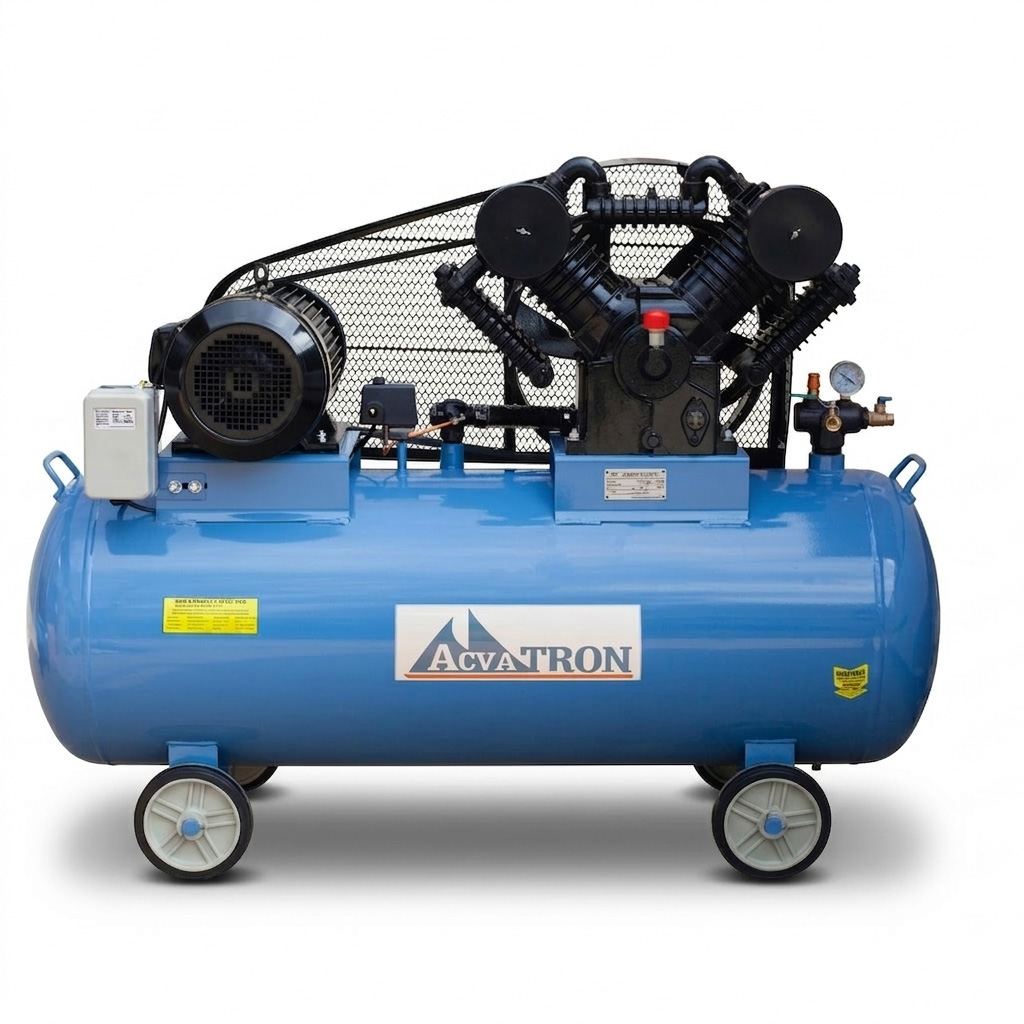
The compressor is the heart of any tire shop and auto service center. It supplies compressed air to every pneumatic tool in the workshop: impact wrenches, tire mounting machines, balancing adapters, spray guns, blow guns, and of course the tire inflator with pressure gauge. If the compressor can’t keep up — tools lose power, tires inflate slowly, and mechanics lose time.
Typical compressed air consumers in a tire shop and auto service:
- inflating passenger car and truck tires;
- pneumatic impact wrenches and screwdrivers;
- tire mounting machines (bead breaker drive);
- spray guns (HVLP, RP, LVLP);
- blowing off parts and radiators;
- pneumatic lifts and vehicle hoists;
- sandblasting cabinets for bodywork preparation.
A wrong compressor choice is expensive: either the equipment can’t handle the load and keeps stopping, or you overpay for power you don’t need. Let’s look at what to pay attention to.
Two Key Parameters: Flow Rate and Pressure
The most common mistake is choosing a compressor based on pressure alone, ignoring flow rate. These are different parameters, and both matter equally.
Flow rate (l/min or m³/min) — the volume of air the compressor delivers per minute. This parameter determines whether the compressor can “keep pace” with the tools without pressure drops.
Working pressure (bar) — the force at which air is delivered to the tool. For tire work and most pneumatic tools, 8–10 bar is sufficient. Pressure above 12–16 bar is only needed for specialized tasks — for example, mounting tires for trucks and agricultural machinery with large cross-sections.
Practical rule: to deliver 1 m³/min of flow rate, the compressor needs approximately 7 kW of motor power. A 5.5 kW compressor will realistically deliver around 600–700 l/min — keep this in mind when choosing.
How Much Air Each Tool Consumes
| Tool | Air consumption | Working pressure |
|---|---|---|
| Impact wrench (1/2″) | 150–250 l/min | 6–8 bar |
| Impact wrench (3/4″, trucks) | 350–500 l/min | 8–10 bar |
| HVLP spray gun | 200–400 l/min | 2–3 bar (at gun) |
| Blow gun | 50–150 l/min | 4–6 bar |
| Inflating a passenger tire | 80–150 l/min | up to 8 bar |
| Inflating a truck tire | 200–400 l/min | up to 12 bar |
| Tire mounting machine | 100–200 l/min | 8–10 bar |
| Pneumatic lift | 200–400 l/min | 8–10 bar |
Important: multiple tools work simultaneously — add up their consumption. For a tire shop with 2 bays and 3–4 tools running at the same time, you need a minimum of 600–900 l/min real flow rate.
Always choose a compressor with a 30–40% margin above the calculated consumption: tools wear out, consumption increases, and a compressor running at its limit fails twice as fast.
Piston or Screw — What to Choose for a Tire Shop and Auto Service?
Piston Compressor
Piston compressors are an affordable and proven option for small tire shops and garage-type auto services. They are suitable for shift work with breaks, when the load on the compressor is not continuous.
Advantages:
- Lower purchase price
- Simple maintenance — oil changes, rings, valve plates
- Models available for 220 V mains (REMEZA LB30/LB40, MZB direct drive)
- High pressure — up to 10–12.5 bar without additional equipment
Disadvantages:
- Cyclic operation: pressure build-up — cooling pause. Under continuous load, breaks are needed
- Noisier than a screw compressor — 80–90 dB during operation
- On a 220 V mains, real flow rate is limited to ~400–600 l/min
When to choose piston: tire shop with 1–2 bays, small garage service, seasonal work, limited budget. Optimal parameters — flow rate 500–900 l/min, pressure 8–10 bar, receiver from 100 l.
Models from Acvatron stock: REMEZA AirCast LB50, LB75 (belt drive, 8/10 bar), MZB (direct and belt drive, 50–270 l receiver).
Screw Compressor
A screw compressor is the right choice for a professional auto service with continuous load. Air is delivered continuously without pauses: the pair of helical rotors rotates constantly, unlike the reciprocating motion of a piston.
Advantages:
- Continuous air supply without cooling stops
- Stable pressure — the tool runs at full power all day long
- Noise level 60–72 dB — significantly quieter than piston
- Service life 40,000–80,000 motor hours versus 3,000–10,000 for piston
- More economical to maintain at high work volumes
Disadvantages:
- Higher purchase price
- Requires three-phase 380 V mains from 5.5 kW upwards
When to choose screw: auto service with 3 or more bays, continuous pneumatic tool operation, car body painting, truck tire mounting. For a full-scale auto service — flow rate from 800 l/min (1.3 m³/min) and above.
Models from Acvatron stock: MZB direct drive (from 7.5 kW), AIRPOL Poland (belt drive, with receiver and dryer).
220 V or 380 V Mains?
220 V — for small tire shops without a three-phase supply. Power is limited to ~2.2–3 kW, flow rate — up to 400–500 l/min. Sufficient for 1 passenger car tire bay and hand tools.
380 V — the standard for any professional service. Opens access to the full range of piston compressors and all screw compressors. At powers from 5.5 kW, flow rate reaches 600 l/min and above — meaning simultaneous operation of 2–3 tools without issues.
If your premises don’t yet have a three-phase supply — check with an electrician on the connection cost. As a rule, the price difference between 220/380 V compressors is recovered from operating savings in less than a year.
Is a Receiver and Dryer Necessary?
The receiver (air tank) is needed almost always. It serves two functions:
- Smooths out pressure pulsations — especially important when working with a spray gun: pressure fluctuations lead to an uneven paint coat.
- Creates an air reserve at peak load moments — for example, when an impact wrench and blow gun are running simultaneously.
For a tire shop with 1–2 bays, a 100–200 l receiver is sufficient. For a service with 3 or more bays — from 270–500 l.
The dryer for an auto service is not an option, it is a necessity. Moisture in compressed air:
- causes corrosion inside the pneumatic cylinders of lifts and tire mounting machines;
- ruins paintwork — water droplets in the air leave craters and bubbles in the paint and lacquer coat;
- escapes from the tire during temperature changes — tire pressure drops after inflation with moist air in cold weather.
Minimum set: moisture separator + oil filter before the distribution line. For the painting bay — a refrigeration dryer.
Compressor Selection Table by Service Type
| Service type | No. of bays | Compressor | Receiver | Dryer |
|---|---|---|---|---|
| Tire shop (220 V, 1 bay) | 1 | Piston MZB, direct drive, 220 V, 2.2 kW | 50–100 l | Moisture separator |
| Passenger tire shop, 1–2 bays | 1–2 | Piston REMEZA LB50 or MZB belt drive, 4 kW, 380 V | 100–200 l | Moisture separator |
| Truck tire mounting | 1–2 | Piston REMEZA LB75 or screw MZB 7.5 kW | 200–270 l | Refrigeration |
| Auto service, bodywork repair | 2–3 | Screw MZB or AIRPOL 7.5–11 kW | 270–500 l | Refrigeration |
| Professional service + paint shop | 4+ | Screw AIRPOL 15–22 kW | 500 l and above | Refrigeration + filters |
Quick Selection Tips
- Calculate the simultaneous consumption of all tools across bays — this is your starting point for choosing the flow rate.
- Choose a compressor with a 30–40% margin above the calculated consumption — tools wear out and consumption grows.
- For continuous operation choose a screw compressor — a piston compressor requires planned cooling stops every 30–40 minutes of load.
- Don’t chase high pressure — for most tire shop and auto service tools, 8–10 bar is enough; the volume of air delivered matters more.
- The receiver is mandatory with a piston compressor — it stabilizes pressure and reduces motor wear.
- Include the dryer and filters in the package from the start — especially if there is a painting bay.
We’ll Help You Choose the Right Compressor for Your Tire Shop or Auto Service — in Chisinau and Across Moldova
The acvatron.md catalog features piston and screw compressors for tire shops and auto services of any scale — from a small 220 V tire shop to a multi-bay service with a paint booth. All models are in stock in Chisinau or available to order with fast delivery across Moldova.
Not sure which compressor suits you? Call us or leave a request — we’ll select the optimal option free of charge, taking into account the number of bays, tool types, and three-phase mains availability.
Article prepared by Vitali Bolucevschi (acvatron.md). We share our experience in professional selection and maintenance of compressed air equipment on the Republic of Moldova market.