










SC 08-02
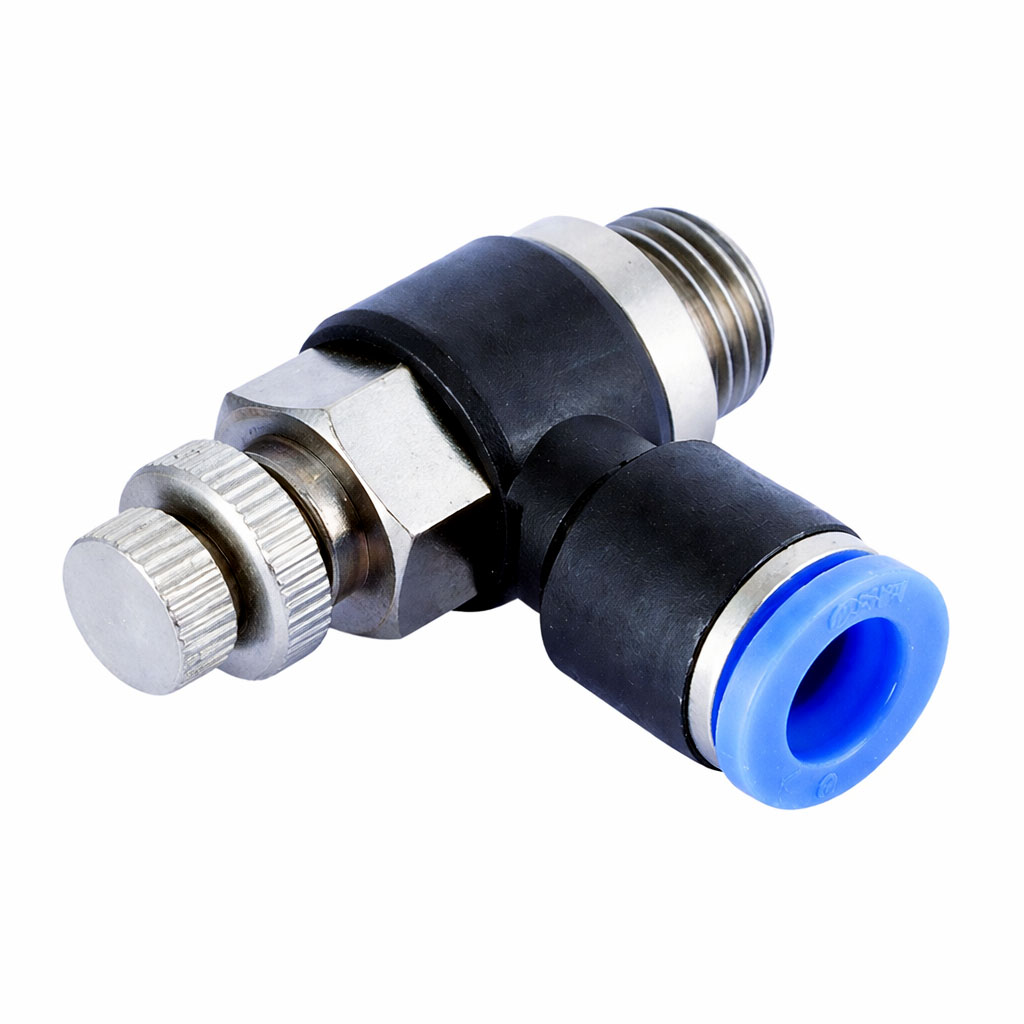
SHPI Pneumatic Flow Control Valve — 8 mm Tube, PT 1/4″ Thread, Meter-out / Meter-in Speed Controller
The SC 08-02 is an industrial pneumatic speed controller from the One-Touch series by SHPI (Taiwan) for precise control of pneumatic cylinder rod speed. Tube 8 mm, thread
PT 1/4″ (BSPT) — the most widely used industrial standard for medium and large pneumatic cylinders. Working pressure 0–150 PSI, vacuum support to -750 mmHg, 360° swivel body,
pre-applied PTFE thread sealant.
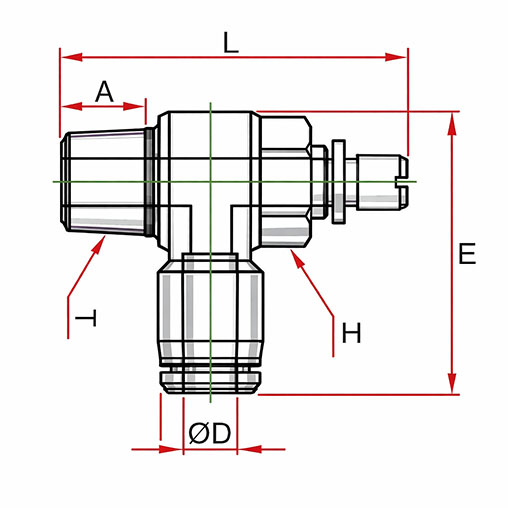
Technical Specifications — SC 08-02
| Tube OD (ØD) | 8 mm |
| Thread (T) | PT 1/4″ × P1.814 (BSPT tapered) |
| Working medium | Compressed air |
| Working pressure | 0–150 PSI (0–9.9 kgf/cm²) |
| Vacuum (negative pressure) | to −750 mmHg (−29.5 inHg) |
| Temperature range | 0°C – +60°C |
| Body material | Nickel-plated brass |
| Collet material | POM (polyoxymethylene) |
| Dimension E (mm) | 37.5 |
| Height L MAX (mm) | 48.5 |
| Dimension A (mm) | 11.4 |
| Wrench H Hex (mm) | 14 |
| Body rotation | 360° (Swivel) |
| Thread seal | Pre-applied PTFE coating |
Design Features of the SC 08-02
PT 1/4″ Thread with Pre-Applied PTFE Coating
BSPT tapered thread self-seals on tightening. SHPI additionally applies PTFE coating at the factory — eliminating the need for tape or liquid sealants. Leak-free connection immediately on installation.
One-Touch Collet for 8 mm Tube
The One-Touch mechanism fixes the 8 mm tube with a single push, no tools needed. Collet material — POM: wear-resistant plastic with precise dimensions ensuring reliable grip without deforming the tube.
360° Swivel Body
The elbow body rotates freely around the threaded section 360° — before and after tightening in the port. Allows tube routing in any direction even in tight installations.
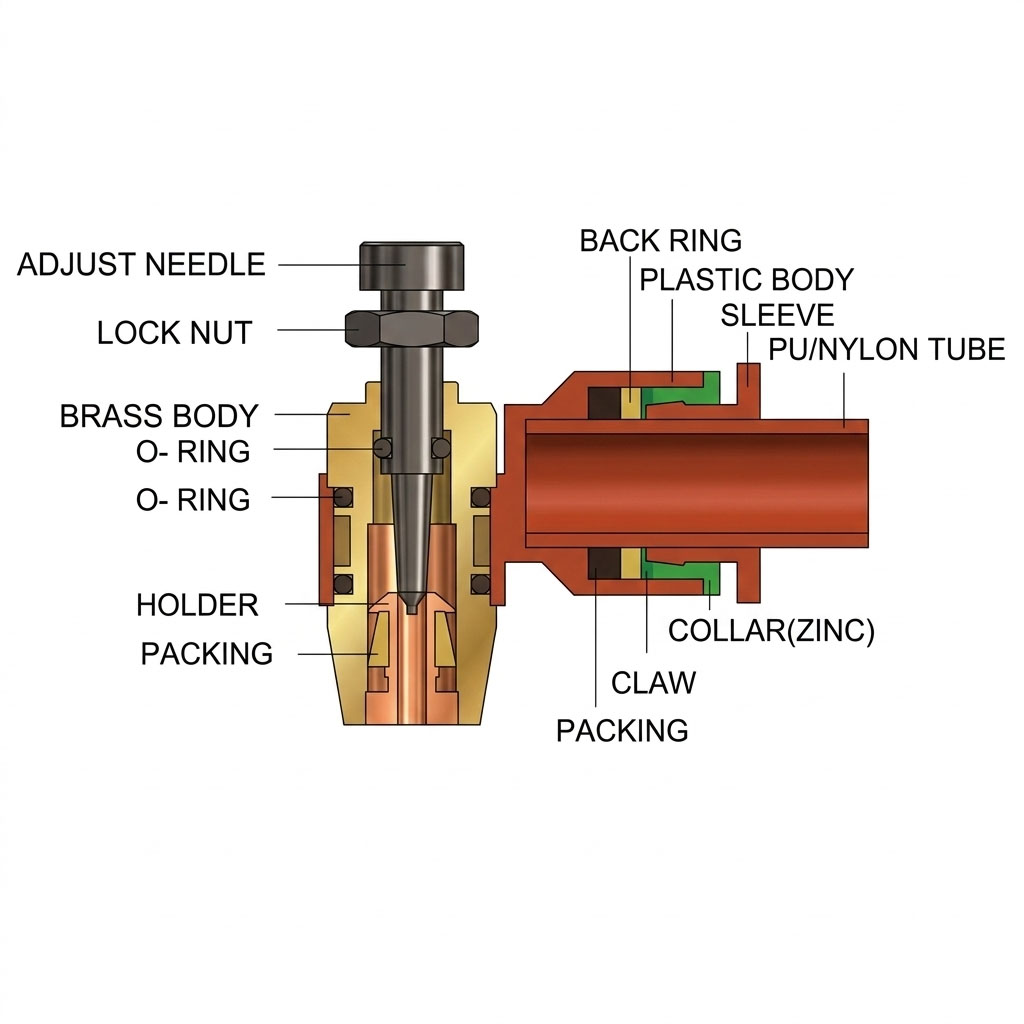
Precision Needle Valve
The needle valve provides linear and stable flow control. Settings do not drift due to vibration or pressure fluctuations — particularly important for high-speed production lines.
Vacuum Compatibility
SC 08-02 officially supports negative pressure to -750 mmHg — usable in vacuum lines for controlling the speed of vacuum creation/release in suction cups and positioning systems.
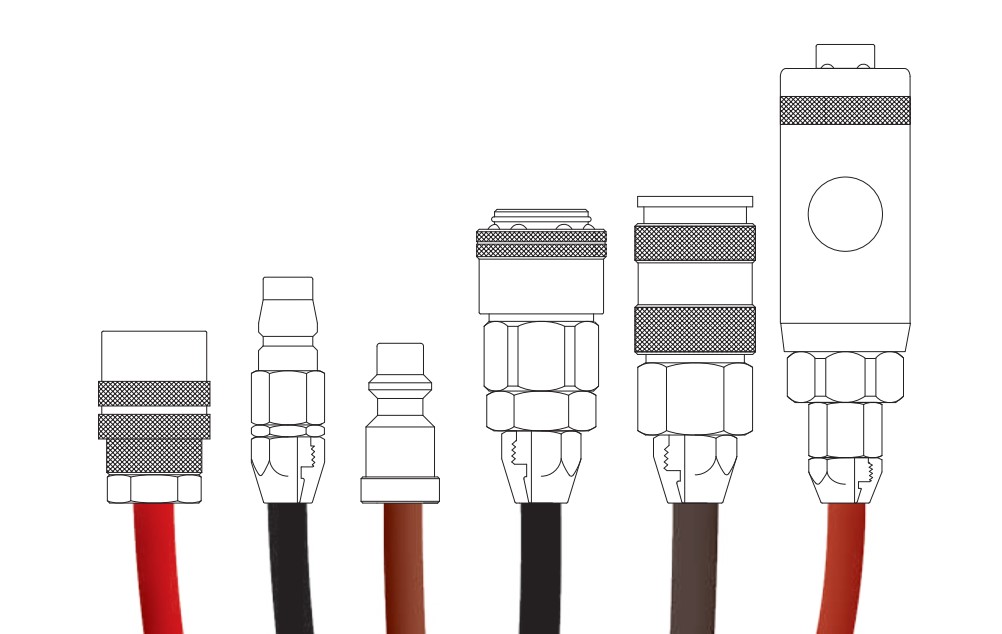
How to Install SC 08-02: Step-by-Step
Step 1. Choose the control type (Meter-out/Meter-in) and fit to the appropriate cylinder port.
Step 2. Thread the PT 1/4″ into the cylinder port with a 14 mm wrench. No PTFE tape needed.
Step 3. Rotate the body to the desired angle (360°).
Step 4. Push the 8 mm tube into the One-Touch collet until it clicks. Confirm with a gentle pull.
Step 5. Open the air supply and adjust the needle: clockwise = slower, anticlockwise = faster. Run a test cycle and fine-tune as needed.
Applications for the SC 08-02
Automated production lines — speed control of pusher, lifter and clamp cylinders. PT 1/4″ is the standard port thread for cylinders with bore diameters from 25 to 80 mm, the most common actuator size in mechanical engineering.
Packaging and filling machinery — synchronising actuator speed with conveyor timing. Stable needle ensures cycle repeatability at high operating frequencies.
Automotive manufacturing and body shops — pneumatic fixtures, presses, paint shop manipulators. 8 mm tube and PT 1/4″ deliver the air flow needed for cylinders generating 100–1000 N force.
Robotics and pick-and-place systems — for vacuum suction cup grippers, SC 08-02 can control both the pneumatic actuator and vacuum flow speed, thanks to -750 mmHg vacuum compatibility.
Pneumatic presses and stamping equipment — controlling punch descent and return speed. Meter-out (blue) on both cylinder ports is the gold standard for press equipment where position repeatability matters.
Compatible SHPI Tubes for SC 08-02
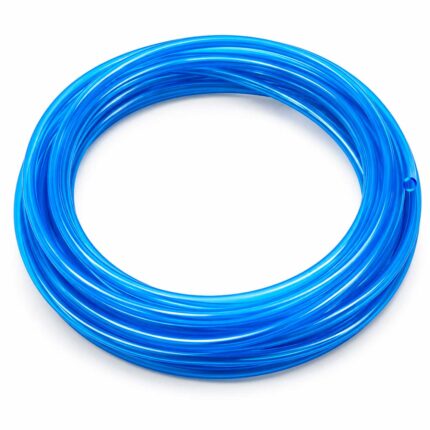
SC 08-02 requires tubes with an outer diameter of exactly 8 mm. Available from Acvatron:
- PU polyurethane tubes 8×5 mm (8*5 mm SHPI) — flexible, for moving mechanisms.
- Nylon PA tubes 8 mm — rigid, for fixed pneumatic lines with higher pressure and minimal losses.
Fitting Selection Guide for Pneumatic Cylinders
Selecting the right fitting for a pneumatic cylinder is a critical stage that determines not only the system’s airtightness but also the smoothness of stroke, operating speed, and equipment longevity. Based on SHPI technical catalogs, the selection algorithm includes the following steps:
1. Identify Cylinder Port Thread Type and Size
The first step is to determine the port size in the pneumatic cylinder end cap.
-
For small cylinders: Metric M5 threads are most common (e.g., PC 06-M5 or SC 04-M3 series).
-
For medium and large cylinders: Tapered PT (BSPT) or parallel G (BSPP) threads in sizes 1/8″, 1/4″, 3/8″, or 1/2″ are used.
-
Key Advantage: SHPI tapered threads come with pre-applied Teflon coating, eliminating the need for PTFE tape and ensuring instant sealing.
2. Choose Functionality: Standard Fitting or Speed Controller?
-
If speed adjustment is NOT required: Use standard One-Touch fittings. Straight (PC) models are ideal for open spaces, while elbow (PL) models allow for compact tube routing along the cylinder body.
-
If rod speed control is needed: You must install SC series speed controllers (flow controls). These allow for precision adjustment of the airflow rate.
3. Select Regulation Type (for SC series)
This is one of the most important technical aspects when working with cylinders:
-
Meter-out (Blue Collet): Regulates air as it exhausts from the cylinder. This is the recommended standard for most applications, as the resulting backpressure (“air cushion”) ensures stable and smooth rod movement.
-
Meter-in (Red Collet): Regulates the incoming flow. This is used less frequently, primarily for single-acting cylinders or specialized control circuits.
4. Match the Tubing Outer Diameter (O.D.)
The fitting must match the diameter of the pneumatic line. Common industrial standards are: 4, 6, 8, 10, and 12 mm.
-
The One-Touch collet mechanism allows for instant tube connection with a single push, providing a secure grip without damaging the tube surface.
5. Consider Operating Conditions and Tubing Material
-
Tubing Material: One-Touch fittings are perfectly compatible with Polyurethane (PU) for flexible connections or Nylon (PA6/PA12) for systems requiring higher pressure and rigidity.
-
Installation Space: If space is extremely limited, choose the Compact One-Touch series, which offers reduced dimensions with the same performance.
-
Rotation: SHPI elbow controllers and fittings feature a swivel design, allowing the tube outlet to be oriented 360° even after the threaded portion has been tightened into the cylinder port.
Quick Order Checklist:
-
Cylinder port size (e.g., 1/4″).
-
Is speed control required? (Yes: SC series; No: PC/PL series).
-
Tubing diameter (e.g., 8 mm).
-
Control type (for cylinders, Meter-out/Blue is almost always preferred).
Frequently Asked Questions about SC 08-02
What is the difference between SC 08-02 and SC 06-M5?
SC 06-M5 — 6 mm tube, M5 metric thread, small cylinders. SC 08-02 — 8 mm tube, PT 1/4″ BSPT tapered thread, industrial standard for medium and large cylinders.
What is PT 1/4 thread and is PTFE tape required?
PT 1/4″ is tapered BSPT, 1/4 inch nominal diameter — the most common standard in industrial pneumatics. SHPI applies pre-applied PTFE coating at the factory. No tape or sealant needed.
How do I install SC 08-02?
Thread PT 1/4″ with 14 mm wrench (no tape). Rotate body 360° to desired angle. Push 8 mm tube into One-Touch collet until click. Open air and adjust needle.
Can SC 08-02 be used in vacuum systems?
Yes. SC 08-02 supports negative pressure to -750 mmHg. Suitable for suction cup grippers, vacuum forming and other vacuum applications with 8 mm tube and PT 1/4″ port.
Which tubes are compatible?
Any tube with OD of exactly 8 mm: PU polyurethane (flexible), nylon PA6/PA12 (rigid), PTFE (chemically resistant). SHPI 8 mm tubes available at Acvatron.
|
Model (MODEL)
|
ØD (mm)
|
T (Thread)
|
E
|
L MAX
|
A
|
H (Hex)
|
|---|---|---|---|---|---|---|
|
SC 04-M3
|
4
|
M3xP0.5
|
24.5
|
38.5
|
3.5
|
8
|
|
SC 04-M5
|
4
|
M5xP0.8
|
24.5
|
37
|
3.5
|
8
|
|
SC 04-M6
|
4
|
M6xP1.0
|
24.5
|
39.8
|
4.8
|
8
|
|
SC 04-01
|
4
|
PT 1/8
|
29.5
|
41
|
7.5
|
12
|
|
SC 04-02
|
4
|
PT 1/4
|
33
|
48.5
|
11.4
|
14
|
|
SC 06-M5
|
6
|
M5xP0.8
|
26.5
|
38.5
|
3.5
|
8
|
|
SC 06-M6
|
6
|
M6xP1.0
|
26.5
|
39.8
|
4.8
|
8
|
|
SC 06-01
|
6
|
PT 1/8
|
30
|
41
|
7.5
|
12
|
|
SC 06-02
|
6
|
PT 1/4
|
34
|
48.5
|
11.4
|
14
|
|
SC 06-03
|
6
|
PT 3/8
|
37.5
|
54
|
12.8
|
19
|
|
SC 06-04
|
6
|
PT 1/2
|
45.5
|
60
|
15.5
|
24
|
|
SC 08-01
|
8
|
PT 1/8
|
31.5
|
41
|
7.5
|
12
|
|
SC 08-02
|
8
|
PT 1/4
|
37.5
|
48.5
|
11.4
|
14
|
|
SC 08-03
|
8
|
PT 3/8
|
40
|
54
|
12.8
|
19
|
|
SC 08-04
|
8
|
PT 1/2
|
46
|
60.5
|
15.5
|
24
|
|
SC 10-01
|
10
|
PT 1/8
|
37
|
41
|
7.5
|
12
|
|
SC 10-02
|
10
|
PT 1/4
|
41
|
48.5
|
11.4
|
14
|
|
SC 10-03
|
10
|
PT 3/8
|
44
|
54
|
12.8
|
19
|
|
SC 10-04
|
10
|
PT 1/2
|
49.5
|
61.5
|
15.5
|
24
|
|
SC 12-02
|
12
|
PT 1/4
|
42.5
|
48.5
|
11.4
|
14
|
|
SC 12-03
|
12
|
PT 3/8
|
46
|
54
|
12.8
|
19
|
|
SC 12-04
|
12
|
PT 1/2
|
50
|
60
|
15.5
|
24
|
MD2032, Молдова, Кишинев, ул. Сармизегетуса 12, офис 129









Reviews
Clear filtersThere are no reviews yet.