









Purpose and Applications
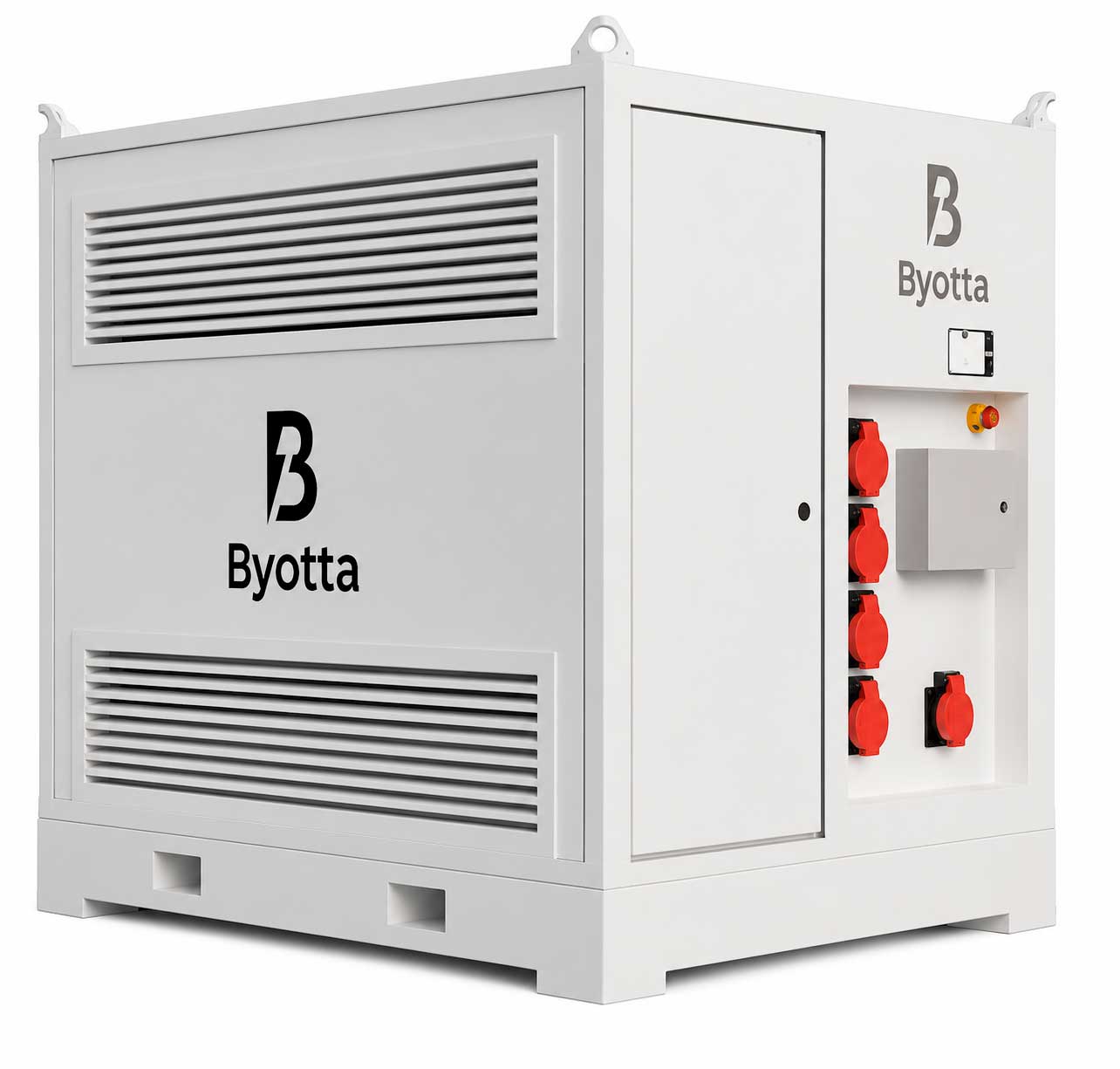
The Byotta Boost 500/500 addresses a common challenge on industrial and construction sites: delivering stable three-phase power where grid capacity is limited or unavailable altogether. The system is used as:
- an alternative or hybrid complement to a diesel generator — reducing fuel consumption and generator run-hours;
- a peak-power source for sites with limited grid connection capacity (load peak shaving);
- a backup power source for construction cranes, temporary electrical installations, and production lines;
- a storage unit for reactive power compensation and voltage stabilization in conjunction with an EMS.
Equipment Configuration
| No. | Equipment |
|---|---|
| 1 | IP54 container with thermal insulation and anti-corrosion coating |
| 2 | LiFePO4 (LFP) battery modules, total capacity 560 kWh (500 kWh usable) |
| 3 | Bidirectional power inverter, 500 kW / 500 kVA |
| 4 | Battery Management System (BMS) |
| 5 | Heating and cooling system (HVAC) |
| 6 | Automatic fire suppression system (aerosol, module-level) |
| 7 | Powerlock power connectors, 400 A, 1 row |
| 8 | Remote service access and monitoring module |
The key design feature is its modular architecture: battery packs, BMS, and power electronics are all integrated into a single container, simplifying transport, on-site installation, and subsequent servicing.
Technical Specifications
General Parameters
| Parameter | Value |
|---|---|
| Rated power* | 500 kVA / 500 kW |
| Rated storage capacity | 560 kWh |
| Usable storage capacity | 500 kWh |
| Rated output voltage | 400 V AC |
| Charging time at rated power, 10–100%, no calibration | approx. 1 h |
| Depth of discharge (DoD%) | 90% |
| Total energy throughput, up to | 2030 MWh |
| Rated cycle life (@DoD, 80% capacity, 25 °C) | ≥4000 cycles |
| Ingress protection | IP 54 |
| Operating temperature | −20…50 °C |
| Dimensions (L × W × H) | 3030 × 2438 × 2896 mm |
| Weight | <10,000 kg |
| Noise level (LwA / LpA at 7 m) | <60 dB(A) |
Battery
| Parameter | Value |
|---|---|
| Battery type | LiFePO4 / LFP |
| Rated / operating voltage | 460 / 441–508 V DC |
| Rated capacity (at rated conditions) | 1216 Ah |
| Cell discharge rate (C-rate) | 2C |
| End of life (EoL%) | 70% |
| Battery weight | 110 kg |
Inverter
| Parameter | Value |
|---|---|
| Rated inverter power | 500/500 kVA/kW |
| Peak efficiency | >97% |
| Integrated transformer | No |
| Bidirectional | Yes |
| Power factor | −0.8… +0.8 |
Operating Parameters
| Parameter | Value |
|---|---|
| Maximum peak power | 550 kW |
| Continuous-mode power | 300 kW |
| Recommended generator power | 200–1000 kVA |
| Battery calibration | Every 3 months |
| Heating and cooling system | HVAC (standard) |
Features and Options
| Feature | Configuration |
|---|---|
| Remote service access | Standard — Yes |
| Isolated charging input | Optional — up to 80 kW |
| Power connectors (Powerlock) | Standard — 400 A, 1 row |
| Fire suppression system | Standard — aerosol (module-level) |
Why LiFePO4 Chemistry Matters
The choice of LiFePO4 battery chemistry (as opposed to NMC) for systems in this class comes down to several practical reasons:
- Thermal stability. LiFePO4 cells are far less prone to thermal runaway, which is critical for a containerized installation with limited ventilation.
- Cycle life. The stated ≥4000 cycles at 80% residual capacity support 10+ years of service under a daily charge-discharge cycle.
- Compatibility with module-level fire suppression — aerosol suppression contains an incident within a specific battery pack without affecting the whole system.
The Inverter: Why Bidirectionality Matters
The bidirectional 500 kW/500 kVA inverter allows the system not only to discharge stored energy to the load, but also to charge from the grid or a generator, and to participate in reactive power compensation (power factor −0.8…+0.8). This makes the Byotta Boost 500/500 more than just a “battery UPS” — it’s a functional building block of a hybrid power system, capable of smoothing load peaks and taking pressure off the generator during periods of minimal consumption.
The absence of an integrated transformer reduces the container’s weight and footprint, but it does mean that voltage matching with the site’s existing grid needs to be accounted for at the connection design stage.
Choosing a Companion Generator
The manufacturer specifies a recommended power range for the paired generator — 200–1000 kVA. An undersized generator won’t deliver the stated charging time (around 1 hour at rated power), while an oversized one will run underloaded, at reduced efficiency. When sizing the “generator + Byotta Boost 500/500” hybrid pair, it’s best to base the choice on the site’s actual daily load profile rather than just its peak value.
Maintenance
Routine battery calibration is performed every 3 months — this operation synchronizes the BMS readings with the actual state of the cells and prevents drift in the estimated residual capacity. The built-in remote service access module allows part of the diagnostics and monitoring to be carried out without an engineer visiting the site, which is especially useful for remote construction locations.
Comparable Products from Other Manufacturers
There are few direct equivalents on the market with an identical “500 kW / 500 kWh” configuration — most containerized BESS units are designed either for longer discharge duration (2–4 hours, i.e., capacity 2–4 times higher than power) or for utility scale (MWh). Below are comparable-class solutions from well-known manufacturers.
| Manufacturer / Model | Country | Power / Capacity | Cooling Type | Difference from Byotta Boost 500/500 |
|---|---|---|---|---|
| Motoma BESS-500kW/1045kWh | China | 500 kW / 1045 kWh | Forced air | Double the capacity at the same power — built for longer discharge (~2 h) rather than peak power |
| Sungrow PowerStack 200CS/255CS | China | 200–257 kWh per block, scalable up to 5 MWh | Liquid | Modular C&I platform, scaled by connecting blocks in parallel, rather than a single fixed-power container |
| Huawei LUNA2000-2.0MWH | China | 1016–2064 kW / 2032–2064 kWh | Liquid | Built for utility scale — power and capacity several times higher than the Byotta Boost 500/500 |
| Bonnen Battery (industrial line) | China | From 100 kW/215 kWh up to several-MWh containers | Air/liquid | Wide range of sizes, but no off-the-shelf 1C configuration (power = capacity) in a compact container |
| Vektor Energy | Russia | Custom calculation | Project-based | Custom integration per project, not a series product with fixed technical specifications |
The Byotta Boost 500/500’s key distinction is its power-to-capacity ratio close to 1C (500 kW at a usable capacity of 500 kWh), which makes the system more “power-oriented” than “energy-oriented”: it’s better suited to covering peak loads and running alongside a generator than to multi-hour standalone operation. For sites that need extended autonomy (4+ hours), the kWh-to-kW ratio — not power alone — is what should be compared across alternatives.
Specifications for competing products are based on manufacturers’ publicly available sources and may vary by version and delivery region — check the current datasheets before comparing.
Summary
The Byotta Boost 500/500 is a complete industrial solution for energy storage and management: an IP54 container rated for −20…+50 °C operation, a LiFePO4 battery with 500 kWh of usable capacity, and a bidirectional 500 kW/500 kVA inverter with peak efficiency above 97%. Rated for 4000+ cycles and compatible with generators from 200 to 1000 kVA, it’s suitable both as a full diesel-generator replacement on sites with limited grid capacity and for hybrid operation alongside one.
To size the right configuration for a specific site — load profile, available grid power, and required autonomy time — it’s recommended to request individual sizing support from Byotta specialists.








Reviews
Clear filtersThere are no reviews yet.