












Technical Specifications
| Parameter | Value |
| Power (kW) | 11 kW |
| Air pressure (bar) | 8 / 10 |
| Output flow rate (l/min) | 1700 / 1370 |
| Power supply V/Hz | 400 / 50 |
| Drive type | Direct drive via flexible coupling |
| Length (mm) | 1490 |
| Width (mm) | 790 |
| Height (mm) | 1610 |
| Receiver volume (l) | 270 |
| Weight (kg) | 428 |
| Noise level (dB) | 65 ±2 |
| Outlet connection (inches) | 1 |
| Compressed air dryer | +3°C pressure dew point |
The Role of the Oil System
During compression, synthetic oil is injected into the chamber, performing three critical functions:
- Sealing: The oil film on the stator walls and vane edges provides a perfect seal, eliminating air leakage.
- Lubrication: The oil lubricates all moving parts, minimising friction and wear.
- Cooling: The oil absorbs the heat generated during air compression, maintaining a stable operating temperature.
Multi-Stage Separation
After the compression cycle, the air-oil mixture enters the separation system, which typically consists of several stages:
- Mechanical separation: Inside the oil receiver, the flow slows down and changes direction, causing the bulk of the oil (up to 99.9%) to separate from the air.
- Filtration: Remaining oil vapour is captured by the coalescing separator filter. This results in clean air at the outlet with a residual oil content of no more than 1–3 mg/m³.
Operating Principle of Mattei Rotary Vane Compressors
Main Components and Compression Mechanism
The main elements of the compressor block are the stator (cylindrical housing) and the rotor, mounted eccentrically inside the stator (offset from the centre). Vanes (blades) move freely within the longitudinal slots of the rotor.
The compression process works as follows:
- Intake: As the rotor turns, centrifugal force presses the vanes against the inner walls of the stator, creating sealed working chambers (cavities).
- Compression: Due to the eccentric rotor position, the volume of these chambers decreases gradually in the direction of rotation. Air trapped between the vanes undergoes continuous, smooth compression as it travels from the low-pressure zone to the high-pressure zone.
- Discharge: Compressed air is expelled through the outlet ports into the system.
The Bearingless Block (RSU — Rotor Stator Unit)
The “bearingless block” (RSU — Rotor Stator Unit) is a patented design of the Mattei rotary vane compressor in which rolling-element bearings are completely absent. Unlike screw compressors, which require 6 to 9 ball or roller bearings to manage axial and thrust forces, the Mattei block uses a simpler and more durable design.
Key features of this technology:
- Slide bearings instead of rolling bearings: The rotor is supported by virtually wear-free bushings. This significantly reduces maintenance costs and increases the reliability of the unit.
- No axial or thrust loads: No axial load is generated in the Mattei vane compressor, so thrust bearings are not required in the design. The rotor moves freely in the axial direction and is centred relative to the end covers by means of a pressurised oil film.
- Extraordinary service life: The block is designed to operate for over 100,000 hours without the need to replace vanes or other metal components. Because the bushings and bearings do not wear, factory clearances remain constant throughout the service life, eliminating any decline in performance over time.
- Energy efficiency: The complete absence of roller or thrust bearings, combined with a low rotational speed (only 1,500 rpm), provides energy savings of more than 15% compared with other types of rotary compressors.
- Minimal maintenance: Block maintenance is limited to oil and filter changes at specified intervals. The absence of rolling-element bearings eliminates the risk of sudden bearing failure and the need for costly head overhauls.
Thanks to the high reliability of the bearingless unit, the manufacturer provides an extended warranty of up to 6 years with no restriction on the number of operating hours.
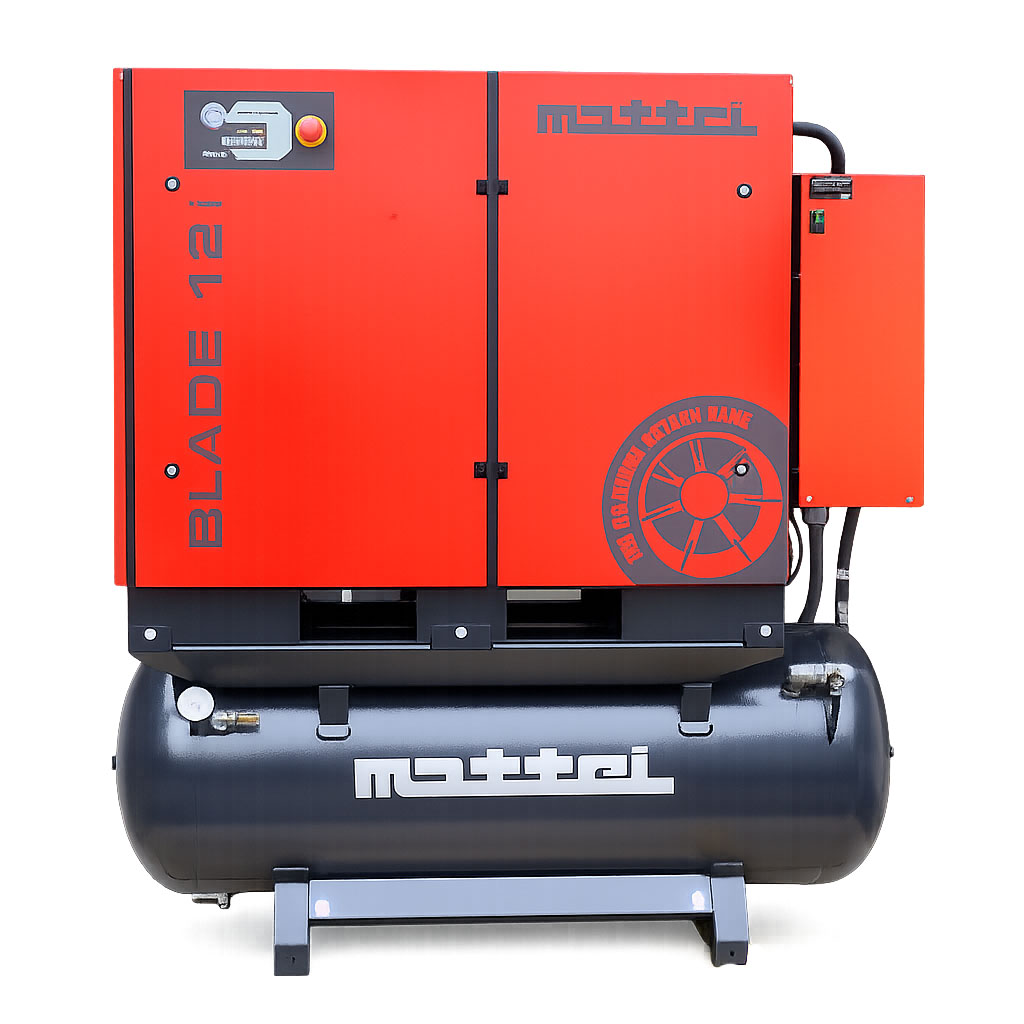
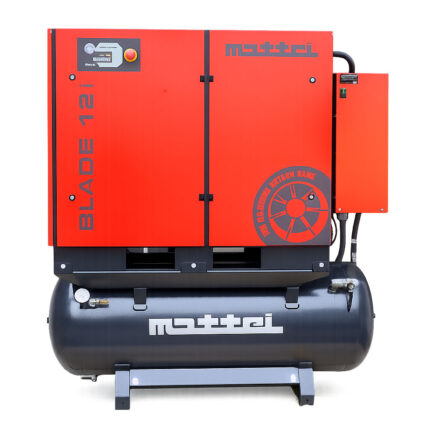
Rotary Vane Compressors BLADE SE 12 — 11.0 kW, 8/10 bar
Mattei rotary vane compressor technology delivers high compression efficiency, outstanding reliability, and low operating costs.
Efficiency and Volumetric Flow Coefficient
The rotor is fitted with slots in which the vanes can move freely. Centrifugal force continuously presses them against the stator walls, ensuring a perfect seal through an uninterrupted oil film. This constant contact eliminates leakage and delivers a high volumetric flow coefficient.
Furthermore, no axial loads arise in this type of compressor, so the lateral surfaces of the rotor are not subject to wear — eliminating the need for axial or radial bearings. The vanes, manufactured using a proprietary process, have a practically unlimited service life.
Reliability and Durability
The simple design and the absence of components subject to significant wear make these compressors exceptionally reliable. The lack of axial loads and continuous lubrication ensure stable operation over extended periods without complex maintenance. Vanes have a practically unlimited service life, reducing operating expenditure.
Quiet Operation and Simple Maintenance
The rotary design and the natural balance of the mechanism provide low vibration and noise levels during operation. The small number of wear parts and the simplicity of the design make servicing straightforward and cost-effective.
Compact and Attractive Design
Thanks to their small footprint and efficient internal layout, vane compressors fit easily into confined spaces. Compactness is combined with a modern appearance, making them suitable for a wide range of industrial environments.
Wide Application Range
High operational stability, energy efficiency, and reliability allow Mattei vane compressors to be used across the most diverse industrial sectors:
- Agriculture
- Food and beverage industry
- Automotive industry
- Chemical industry
- Medical industry
- Pharmaceutical industry
- Manufacture of polymer products
- Furniture production
- General / industrial use
Technical Data — BLADE Series i Compressors (400 V / 50 Hz)
| Model | Power (kW) | Flow rate (m³/min) | Pressure (bar) | Noise (dB(A)) | Dim. L×W×H (mm) | Weight (kg) |
| BLADE 8 i | 7.5 | 0.76 – 1.20 | 7 ÷ 10 | 66 | 1180 × 760 × 990 | 273 |
| BLADE 12 i | 11 | 1.06 – 1.68 | 7 ÷ 10 | 66 | 1180 × 760 × 990 | 311 |
| BLADE 15 i | 15 | 1.68 – 2.65 | 7 ÷ 10 | 66 | 1440 × 770 × 1330 | 575 |
| BLADE 18 i | 18.5 | 2.01 – 3.18 | 7 ÷ 10 | 66 | 1440 × 770 × 1330 | 590 |
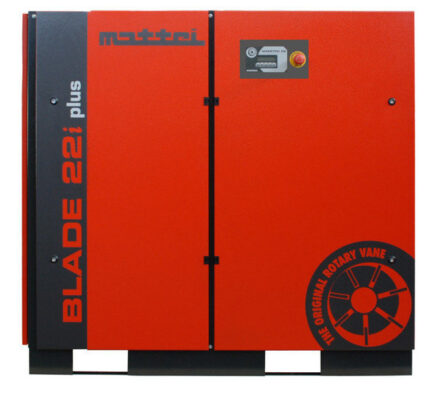
| BLADE 22 i | 22 | 2.27 – 3.59 | 7 ÷ 10 | 66 | 1440 × 770 × 1330 | 600 |
Key Series Features
- Drive type: Direct connection via flexible coupling (1:1), eliminating energy losses typical of belt or gear transmissions.
- Control system: Maestro XB microprocessor controller, which monitors operating parameters in real time and manages the inverter.
- Operating mode: The inverter system is most efficient when air consumption is between 40% and 100% of rated capacity.
- Additional versions: BLADE 8 i and BLADE 12 i are available in versions S (on 270 l receiver), E (with dryer) and SE (on receiver with dryer). Heat recovery (R) and water cooling (W) options are also available.
Inverter Control System in BLADE i Models
The control system in BLADE i inverter models is based on a variable frequency drive (inverter), which adjusts the motor speed to match the volume of compressed air produced to the actual demand of the pneumatic system. The equipment operates within a preset range of minimum and maximum pressure.
The regulation process includes the following stages:
- Capacity adaptation: When air flow in the network changes, the system smoothly adjusts motor speed to maintain stable pressure.
- Transition to unloaded mode: When pressure reaches the maximum set point (Pmax) at minimum speed, the inlet valve closes and the compressor switches to idle (off-load) mode.
- Internal pressure blowdown: In idle mode, the internal pressure within the unit is reduced to 1.5 bar, further lowering electricity consumption.
- Resumption of delivery: As soon as line pressure drops to the minimum set point (Pmin), the compressor returns to loaded mode and immediately begins air delivery, adjusting speed to current demand.
Key advantages of this control system:
- Energy savings: The Mattei inverter system reduces annual operating costs by up to 35%.
- High efficiency: Maximum efficiency is achieved when compressed air demand is between 40% and 100% of rated capacity.
- Intelligent control: The entire process is managed by the Maestro XB microprocessor controller, which analyses operating parameters and drives the inverter in real time.
Reduced stress on components: The inverter provides soft motor starting, minimising inrush currents and mechanical stress on system components.








Reviews
Clear filtersThere are no reviews yet.